
Many people assume that Japanese houses must be tiny simply because Japan is a small country with around 125 million inhabitants. The media keeps showing a handful of Tokyo apartments that look absurdly small, and on average, Japanese homes are smaller than the typical detached house in the United States or Australia. But anyone who has looked at the Japanese housing market as a whole knows that equating "Japanese" with "small" is a clumsy simplification.
This article looks at how big Japanese houses really are, why they are often built more compactly than in Western countries, what housing types exist, and which cultural reasons sit behind the preference for space-efficient living. If you are planning to live in Japan or you are simply curious about Japanese culture and daily life, this overview goes well beyond the viral YouTube clips.
Contents 18
Size and Standards: How big are Japanese houses, really?
Tokyo belongs to the largest metropolitan regions in the world. The Greater Tokyo area alone holds roughly 37 million people, and a large share of Japan's population is concentrated in a handful of urban centers: Tokyo, Osaka, Nagoya, and Yokohama. It stands to reason that a region this densely populated produces a lot of compact housing.
Still, the official statistics tell a more nuanced story. Japan has about 53 million households. The average floor area per household sits at roughly 94 m² spread across about four rooms. That figure covers both houses and apartments, and on paper it looks surprisingly generous, comparable to many mid-sized European countries.
The context matters, though. In countries such as the United States, Brazil, or Australia, single-family homes on generous lots of 300 m² or more are common. In Japan, especially in the cities, lots are small. A typical urban plot offers space for a narrow garage, a small front garden, and a two-storey house. The 94 m² of living space is then distributed across two floors and used efficiently through compact layouts.
More than 40 percent of Japanese houses are built from wood, a traditional material that still dominates, especially in rural areas. Roughly half of Japanese households live outside the major metropolitan regions, where plots are more generous and single-family Kodate (一戸建て) are more common. Most residential buildings have two storeys, which helps compensate for the small footprint of the lot.
For singles, young professionals, and many foreigners, owning a home remains a distant dream. That is why one- or two-room apartments are so common in the cities. Even families sometimes opt for more compact housing to save rent or live closer to work. The high cost of living in metropolitan areas shapes the picture, not Japanese building culture as a whole.
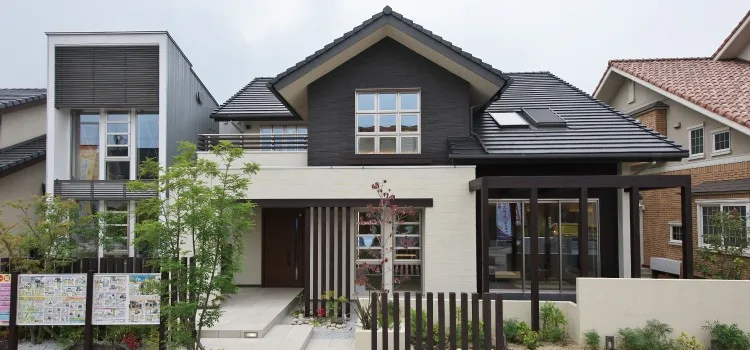
Why are Japanese houses so compact?
The smaller per-capita living space in Japanese cities has several overlapping causes.
High land prices in metropolitan areas
The single biggest factor is the extreme cost of land in Tokyo, Osaka, and the other big cities. Anyone building in a central location pays many times more per square meter of land than is typical in European or American cities. The logical result is to build upwards and keep the land footprint small, rather than spreading out into a single-storey house on a large lot.
The tradition of multi-generational households
Historically, several generations of one family lived under the same roof in Japan. The traditional ie system, the household as a unit, assumed that parents, children, and grandparents shared a home. Individual rooms could be smaller without anyone feeling cramped. Even today, many older Japanese live with their adult children, while younger generations move into their own apartments.
Earthquake-resistant wood construction
Japan sits in a tectonically active region. Earthquakes are a regular fact of life, and the building codes are accordingly strict. Wood has proved its worth as a material: it flexes under shaking, and in a severe tremor it tends to fail less catastrophically than concrete. It is also faster and cheaper to work with, which explains the preference for two-storey wooden houses in suburban and rural areas.
Cultural preference for clear, ordered space
On top of that, there is a cultural preference. Many Japanese value clean, well-ordered living space in which every object has a fixed place. A small, tidy apartment often feels more desirable than a large, cluttered one. This aesthetic ideal is closely linked to the concept of Ma (間), the deliberate use of empty space and pause as an aesthetic element rather than wasted area.
Housing types in Japan: Mansion, Apāto, Kodate, and Danchi
Anyone trying to navigate the Japanese housing market quickly runs into four terms that come up constantly: Mansion (マンション), Apāto (アパート), Kodate (一戸建て), and Danchi (団地). They describe very different kinds of homes.
Mansion (マンション)
The Japanese Mansion has little to do with the European building type of the same name. It refers to a multi-storey reinforced-concrete apartment block with units for sale, often with an elevator, an auto-locking entrance, and reasonably good sound insulation. In Tokyo or Osaka, a 2- or 3-bedroom Mansion in a central location easily runs into the high hundreds of thousands of US dollars. The word sounds luxurious, but in practice it simply means "concrete condo tower."
Apāto (アパート)
An Apāto is the simpler version: a two- or three-storey block built from wood or light-gauge steel, usually without an elevator, with thinner walls and lower rents. These buildings target singles, students, and first-job young professionals. Sound insulation is often poor, but rents stay affordable even in central locations. The line between Mansion and Apāto is fuzzy, because many newer buildings do not fit neatly into either category.
Kodate (一戸建て)
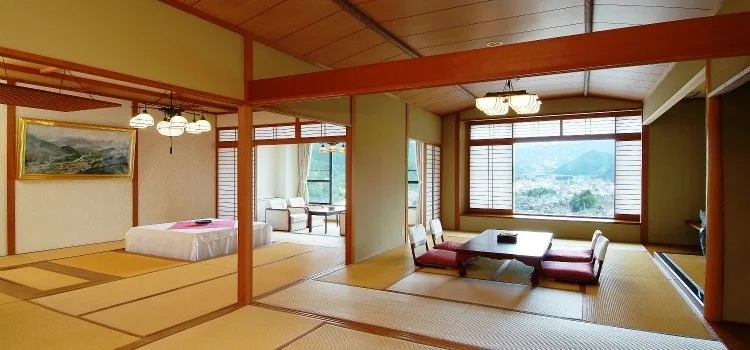
Kodate means a detached single-family house. In the suburbs and the countryside, this is by far the most common form. A Kodate usually has a small garden, a Genkan (玄関, the covered entryway where you swap street shoes for house slippers), and sometimes an Engawa (縁側, a covered veranda running along the edge of the house). Many Kodate also include a Washitsu (和室), a traditional Japanese room with Tatami flooring (畳), Shoji sliding doors (障子) made of paper, and a low table at floor level.
Danchi (団地)
Danchi are large housing complexes built mainly in the 1960s and 1970s on the outskirts of big cities, to ease the post-war housing shortage. They consist of mid- and high-rise concrete blocks with relatively spacious floor plans. Many Danchi are now considered dated and are being gradually demolished or renovated, but they remain an important and affordable housing option.
Regional differences: Tokyo and the countryside
Anyone quoting the 94 m² average should add that the figure swings sharply between central Tokyo, other big cities, and the countryside.
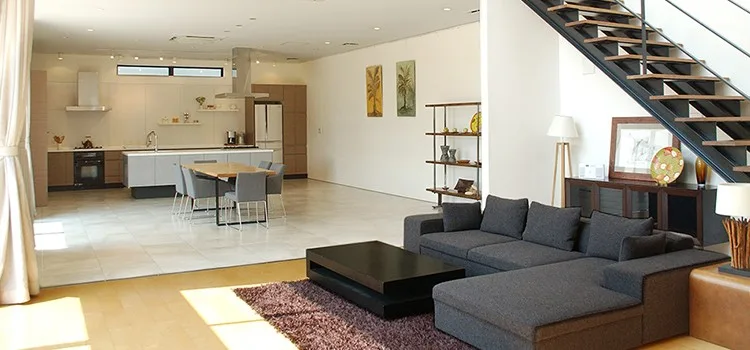
In Tokyo itself, the average apartment is about 65 to 70 m², and in central wards such as Shibuya or Minato the number is often lower. A single-person apartment in the city center at 18 to 25 m² is perfectly normal, and a typical 1LDK for a couple comes in at 35 to 50 m². In the outer wards and in Tokyo's commuter belt, available space rises quickly, because more Kodate and newer Mansion complexes are built there.
In Osaka, Kyoto, Kobe, and the rest of the Kansai region, floor plans tend to be a little more generous than in the capital. Many Osaka residents value larger homes and use their houses more actively for entertaining and gathering with friends than is common in Tokyo.
Far more space is available in rural prefectures such as Hokkaido, Tohoku, or parts of Kyushu. In villages and small towns, Kodate on larger plots with 120 to 200 m² of living space are not unusual. The catch is that many of these houses stand empty, because younger generations have moved to the cities and the population is shrinking. The Japanese government has run programs for years to make relocation to the countryside more attractive, from cheap renovation of old Kodate to financial incentives for families. You can read more about that effort in our piece on the Akiya Bank and Japan's empty houses.
Trends and social implications: small living as a statement
In recent years, the trends around housing in Japan have shifted noticeably. A few stand out.
Compact design and multi-functional furniture
Japanese interior designers and furniture makers are internationally recognized for their space-saving solutions. Walls fold down into beds, tables retract into the ceiling, and storage hides inside stair treads. These are not stopgaps; they are the visible expression of a design philosophy that combines efficiency with aesthetics. Once you have seen a well-designed Japanese 1-room apartment, you understand how much quality of life can fit into 25 m².
Smart storage and the genkan
The Japanese principle of keeping as few objects in plain sight as possible shows up in clever storage solutions. The Genkan separates outside and inside, with shoes taken off and house slippers put on at the entry. Many apartments add built-in closets in hallways, under stairs, and inside walls, absorbing clutter without compressing the living space.
Futon instead of a fixed bed
In many homes, especially Kodate and Mansion units, residents use a Futon (布団) instead of a Western bed, folding it up in the morning and sliding it into a closet. That saves space and lets the same room function as a living room by day and a bedroom at night, a principle that echoes the flexible use of a traditional Washitsu.
Social pressure and the status of a home of one's own
Having a place of your own is still an important status marker in Japan, the visible sign of a transition into adult life. At the same time, the housing market puts real pressure on young people, especially in Tokyo. Many workers in their thirties still live in tiny apartments and save for the down payment on a Kodate outside the city center. The link between floor area, career, and family planning is more tightly woven in Japan than in many Western countries.
So, are Japanese houses really small?
The honest answer is: it depends. In the big cities, especially Tokyo, apartments are on average smaller than in the United States or Northern Europe. In the countryside, in the suburbs, and in your own Kodate, you can live with about as much space as you would in a mid-sized European country. The "typical Japanese home" the media shows is usually an extreme example from central Tokyo, not the national average.
To understand Japan, it helps to look less at the raw square meter count and more at how the available space is used. The concept of Ma, the layered storage design, the Futon principle, and the flexible use of a Tatami room all show that Japanese housing is measured less by area than by function, aesthetics, and livability. A small, well-planned apartment can offer more quality of life than a large, underused house. The reverse is also true: Japan has plenty of empty Kodate standing in the countryside that no one wants to live in.
Next time you see a video of a 9 m² micro-apartment in Tokyo, remember that it is an extreme, not the rule. Japan has many housing forms, sharp regional differences, and a long tradition of making the most of limited space. If you want to go deeper on the everyday side of Japanese life, take a look at our guide to apartments in Japan and our overview of cultural differences you will run into in Japan.




Community
Comments
0 comments
There are no published comments in this language yet.
Send comment