
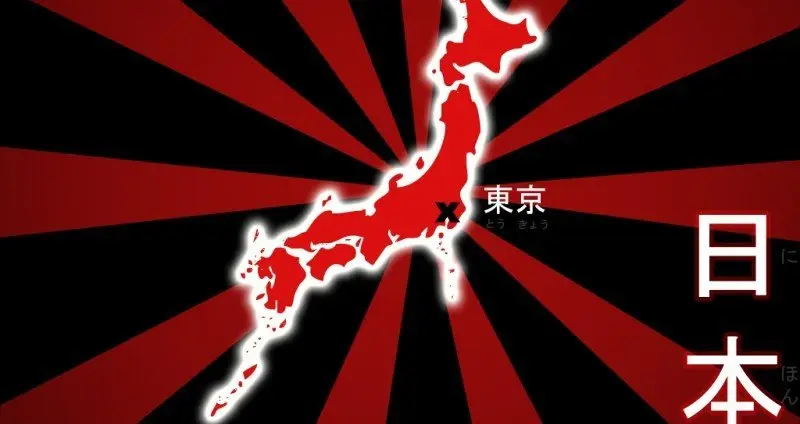
Some do not know, but Japan is an archipelago, in other words, a country surrounded by islands, moreover, it is washed by oceans.
The main islands of this archipelago are; Honshu [本州]], Hokkaido [北海道], Shikoku [四国], Kyushu [九州], Okinawa [沖縄島] we have an article telling more about these and the 6,852 islands of Japan.
In this article, we will delve into the timeline and discover curiosities about the history of these 5 main islands, describing historical events, economic influence, international relations, and other factors that led Japan to become what it is today.
Table of Contents
The history of Honshu
It can be said that the Island of Honshu is the foundation of Japan’s history as a whole, it is the largest island and has the largest number of people and is also where the capital of the country is located.
Around 300 BC, most Japanese were engaged in activities such as hunting, fishing, and gathering, but things began to change when rice cultivation became part of Japanese production.
This led to growth and evolution in the social structure, consequently, the rich and landowners began to gain power.

Buddhism had been part of the culture for a long time, along with the original Japanese religion which is Shintoism, already in 593, the Buddhist prince Shotaku gained much power and in 752 the Great Buddha in Nara would be completed.
During much of Japan’s history, various struggles for political power occurred between clans.
In 645, the Fujiwara Clan overcame the Soga Clan of Prince Shotaku, Fujiwara nationalized all lands and created tax systems, followed by many struggles and wars, and the second half of the 8th century witnessed countless natural disasters, famines, and epidemics.
Much happened after this time, the emergence of the Edo period, the transfer of the capital from Kyoto now being Tokyo, this in Honshu, Japan participating in the world war, and in 1923 there was the great earthquake in Kanto that destroyed much of Tokyo and Yokohama.

After the end of World War II, Japan was heavily influenced by the USA, with the country promising and helping in the reconstruction of the nation and applying similar economic systems in the country.
With today Honshu housing a large part of the economic concentration of the nation, where today are located Kyoto, Tokyo, Ikeda, Kobe, and other landmarks when talking about the Japanese economy and population.
Read also:
The history of Hokkaido
Hokkaido, in translation, would be something like “Northern Sea Circuit”, is the second island within the famous Japanese archipelago, geographically it is separated from Japan by the Tsugaru Strait, a channel between the Sea of Japan and the Pacific Ocean.
Hokkaido, like Honshu, was separated by periods, we had between 710 and 1185 the Nara and Heian periods, the people of this period depended on hunting, fishing, and rice, and iron was obtained through trade with other parts of Japan.
From 1336 to 1868, there were the Muromachi and Edo periods, the Muromachi period was marked by many wars between clans and even with the Japanese against the Ainu who lived on the southern coast of Hokkaido, later leading to trade with these Ainu.

Throughout history, there were several revolts by the Ainu against the feudal dominance that ruled Hokkaido. In 1669 to 1672, there was the largest of the revolts, titled the Shakushin revolt.
From 1799 to 1858, the Edo Shogunate took interim control of Hokkaido in response to invasion threats coming from the Russian government.
Throughout Hokkaido’s history, much occurred to prevent the Russian government from taking control of the area. But Hokkaido would only become similar to the other prefectures in 1947, when the Local Autonomy Law was actually implemented.
In 1949, the Japanese government established the Hokkaido Development Agency, serving as an agency for the office of the Prime Minister of Japan to maintain its executive power over Hokkaido.
Read also:

The history of Shikoku
Starting from the beginning of the medieval era to the modern period, four principalities emerged, Awa, Sanuki, Iyo, and Tosa.
Due to this fact, the island became known as Shikoku 四国, where 四 (Shi) means four and 国 (Ku) means country, and these domains were dominated and governed by local clans that developed the habits and cultures of the region according to the geographical characteristics of the area they were in.
Serving as a base, for example, the Kono clan from Iyo were originally pirates who charged tolls over the inland sea.
They also served as guides for ships in the region, in other words, they were Japan’s navy.
In the Tosa region, being an area with poor agricultural base, the Chosakabe led warriors who sought agricultural lands at the expense of neighboring territories. During the Muromachi period, the Hosokawa clan governed over Sanuki, Awa, and Tosa, while the Kono clan governed Iyo.
In Aki, Kochi, the commercial activities of Iwasaki Yataro led to the formation of a trading and technology company, the famous Mitsubishi, in 1873.

During the Russo-Japanese War, the Akiyama brothers from Matsuyama successfully commanded the cavalry and navy of Japan, Matsuyama housed a prisoner of war camp that received international praise for its balanced treatment of prisoners of war.
During the Russo-Japanese War, the Akiyama brothers from Matsuyama successfully led the Japanese cavalry and navy, respectively.
Matsuyama housed a prisoner of war camp that received international acclaim for its enlightened treatment of prisoners.
From the Showa period until now, preceding World War II, the Mitsukue coast in Ehime had been used for training crews of the small submarines that were used in the attack on Pearl Harbor.
During the war, there was also a grim prisoner of war camp in Zentsuji.
In the last months of World War II, Tokushima, Takamatsu, and Matsuyama were heavily bombed, destroying much of their buildings.
After the war, the industries that developed during previous periods expanded.
There was also copper mining in Besshi Dozan and smelting in Naoshima, which were important industries, but when they declined, the facilities were repurposed for tourism.
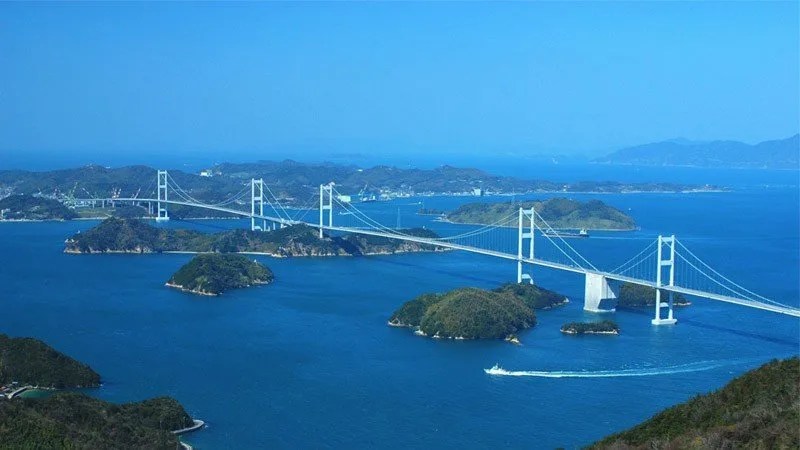
In 1985, the Great Naruto Bridge was completed, connecting Shikoku to Honshu by road for the first time in history.
This was followed by the Great Seto Bridge system in 1988, and the Nishiseto Expressway, also known as Shimanami Kaido, in 1999.
In fact, the blue LED light was invented by Nakamura Shuji in the early 90s in a small company in Tokushima, enabling today’s low-power LED displays.
Read also:
- Discover the island of Shikoku – Kochi, Ehime, Tokushima, and Kagawa
- How to overcome the fear of earthquakes in Japan?
The history of Kyushu
Kyushu literally means “9 provinces”, its name refers to the nine ancient provinces Kuni, into which the island was divided. The mountainous island is composed of a series of volcanic chains and contains the largest active volcano in the world, Mount Aso.
The island is known for its subtropical vegetation and heavy rainfall. In the region, the main crops are rice, tea, tobacco, sweet potatoes, soybeans, fruits, and wheat.
Kyushu also has coal, zinc, and copper mines and a very strong concentration of industry in the north in Kitakyushu, Fukuoka, and Omuta, which are the main industrial centers.
Historically, Kyushu’s proximity to China and South Korea made it a gateway for their cultural, artistic, and even religious influences and, later, for contact with the West.

The founder of the Yamato Kingdom and the first emperor of Japan, Emperor Jimmu, originally settled in southeastern Kyushu before moving to Nara on the island of Honshu.
In 1274 and 1281, attempts at Mongol invasions of Kyushu were repelled by typhoons, known as kamikaze, which destroyed the Mongol fleet.
In 1549, Saint Francis Xavier introduced Christianity to Japan through Kyushu. Nagasaki, the main port of Kyushu, was the first Japanese port to receive Western trade. Nagasaki was the site of the second atomic bomb explosion, which effectively ended World War II on August 9, 1945.
The first recorded contact with the West in Japan also occurred near Kyushu in 1543, when three Portuguese merchants traveling on a Chinese junk were blown off course and landed on Tanega-shima (Tanega Island), an island near the tip of Kagoshima.

Saint Francis Xavier came to Japan through Kyushu in 1549 and began to spread Catholicism throughout the region. By 1637, the Tokugawa shogunate, considering Christianity a direct threat to its sovereignty, killed 40,000 Catholics in a battle in Shimabara, a peninsula east of Nagasaki.
Japanese Christianity then went underground until the reopening of Japan in the mid-1800s.
The governance of Kyushu by Saigo Takamori (1827 – 1877), born into a samurai family in Kagoshima, was crucial in bringing about the Meiji Restoration in 1868. Later, he rebelled against the new order and led the unsuccessful Satsuma Rebellion in 1877.
Togo Heihachiro (1848 – 1934), also born in Kagoshima, was an admiral of the Imperial Japanese Fleet that annihilated the Imperial Russian Baltic Fleet in the Russo-Japanese War of 1905.
Read also:
The history of Okinawa
Throughout its history, Okinawa was once an independent country governed by the Ryukyu Kingdom, which managed to establish itself through its trade with China and some other neighboring countries.
However, after the Satsuma invasion in 1609, Ryukyu became part of Japan’s shogunate system. In other words, it became a prefecture of Japan due to the Abolition of the Han System and Establishment of the Prefectural System, which occurred in 1879.
During the Pacific War, Okinawa was the site of the only ground battle in Japan that even involved civilians.
Okinawa was also a fierce battleground in the final stages of World War II, and many lives were lost during the Battle of Okinawa (1945). The prefecture suffered severe damage, measured both culturally and in casualties.

When the war ended in 1945, Okinawa was placed under US control, and thus remained until it was returned to Japan on May 5, 1972.
For nearly 30 years, the islands were heavily influenced by American culture.
Today, Okinawa is best known as Japan’s paradise island and is a reference for travel to Japan, both in the country and abroad.
While travelers migrate to Okinawa to enjoy its beaches, laid-back culture, and luxury resorts, its historical sites and ecological importance continue to attract attention on the global stage.
In 2000, UNESCO registered the Gusuku Sites and Related Properties of the Ryukyu Kingdom as a World Cultural Heritage.

In 2021, the biodiversity of the northern part of Okinawa Island and Iriomote Island, along with Amami-Oshima Island and Tokunoshima Island, were recognized as Natural World Heritage.
If you enjoyed reading the history of each of these islands of Japan, we invite you to like and share the article so that more people can learn about the unique history of Japan’s foundation through its islands and provinces.
Leave a Reply