
Are there indigenous people in Japan? Yes — and a surprising number of visitors only hear the name Ainu late, often when the anime Golden Kamuy pulls attention north. Suddenly words like kamuy, kotan, and Ainu Mosir appear — and with them a history that the old cliché of a “single Japanese people” long kept off stage.
The Ainu are not a footnote in a tourist brochure. They are an indigenous people with their own language, a world of kamuy, and a landscape that historically reached from Hokkaido to Sakhalin and the Kuril Islands. Look closer and you see how trade, conflict, and assimilation reshaped that culture — and why recognition still feels late, and still matters.
Contents 8
History of the Ainu people
For Ainu communities, the natural environment was tightly bound to the kamuy: divine beings present in animals, places, and forces of nature. Rituals that guided coexistence with that environment helped keep ecological balance and honor obligations to the kamuy.
Today many people first encounter Ainu culture on the island of Hokkaido. While Japan’s majority history is often told through Yayoi settlement and later Yamato state-building with continental influences, the north developed its own cultural layers — long outside the postcard image of “classical” Japan around the old capitals.
Ainu means “human” in the Ainu language, in contrast to the kamuy. Historically, Ainu communities lived in Hokkaido, Sakhalin (now part of Russia), and parts of the Kurils. With the Meiji era from 1868 and the organized colonization of Ezo/Hokkaido, pressure on land, language, and livelihood intensified.
Much early history remains uncertain. What is clear is that Ainu and related northern cultures belong among the early inhabitants of this region. Scholars often connect their roots to Jomon-period layers and to Okhotsk and Satsumon cultural influences — a mixed northern story, not a single simple origin myth.
Origin of the Ainu
Older theories spoke loosely of “Mongolian” migrations. Contemporary research stresses archaeological and genetic complexity rather than one migration cartoon. People already lived in Hokkaido long before Meiji colonization; Japanese presence in the north grew from early contact and trade, then tightened into state control during and after the fifteenth century and especially in the Meiji period (1868–1912).
Another line of hypotheses looks north toward Eurasia, the Russian Far East, and Arctic contacts. None of that turns the Ainu into a tourist costume. It underlines how the northern archipelago was always more diverse than schoolbook Japan sometimes admits.
Conflicts with Japanese settlers
From the fifteenth century, Japanese (often called Wajin by the Ainu) sought trade and land access in Ainu territories. Contact was not peaceful for long. Ainu communities faced marginalization, unequal trade, and armed clashes — including major confrontations in 1457 and, later, the 1789 Kunashiri–Menashi uprising.
In 1789, fighting on Kunashir and nearby areas left more than seventy Japanese and dozens of Ainu dead. Motives are still debated; research points to poisoned sake offered during a loyalty ceremony and abusive behavior by traders, among other grievances.
Ainu people referred to the Japanese as Wajin or Shamo — terms that carried the weight of colonizer and untrustworthy outsider, not neutral neighbors. As Japanese power expanded, Ainu land use was squeezed, and communities were increasingly concentrated in Hokkaido under Meiji policies of assimilation.
Religious traditions of the Ainu
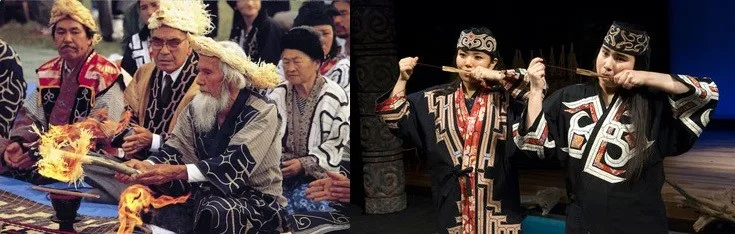
Ainu religiosity centers on kamuy linked to nature: wolves, bears, water, fire, wind. Three deities often stand out in explanations of daily life: the bear and mountain god Kim-un Kamuy; the hearth goddess Kamuy Fuchi; and the sea and fishing god Repun Kamuy.
Humans are not cast as a dominant species above everything else. What is taken from nature is received with thanks. The hearth fire was treated as a doorway toward the spirit world; Kamuy Fuchi protected the home and was said to place souls in newborn children. If you already read about religion in Japan through Shinto and Buddhism, Ainu practice is a different grammar of the sacred — still rooted in place, still alive in memory and revival.
Cultural aspects of Ainu life
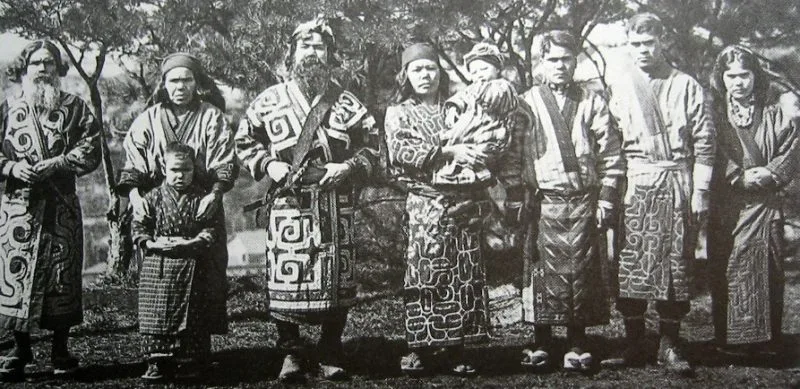
Traditional livelihoods mixed fishing, hunting, and gathering. To hunt, communities developed poisons for spear and arrow tips, including surku from aconite plants after careful preparation. Food preservation relied heavily on smoking and drying — salmon above all.
Ainu men often kept facial hair as they aged. Ainu women once practiced permanent tattoos around the mouth, hands, and forearms. That living custom has largely stopped under legal and social pressure, though temporary ink sometimes appears in cultural presentations. Japan’s wider debate over tattoos and stigma is a different story; Ainu mouth tattoos carried community meaning, not fashion branding.
Villages (kotan) held small houses called cise — roughly a few meters across, with one or two rooms — and each community had leadership roles. Children’s names started provisional; a lasting name came around age three, chosen to fit personality and, in tradition, to deflect harmful spirits. Temporary names could sound deliberately rough: ayay (a baby’s cry), poyshi (small excrement), shion (old excrement).
One of the most discussed ceremonies is iomante (also written iyomante): a sending ritual in which a raised brown bear cub is ceremonially returned to the world of the gods. The animal is not framed as a casual “sacrifice for show,” but as a kamuy whose soul goes home carrying offerings and human respect — a practice that outsiders have long misunderstood.
The Ainu people today
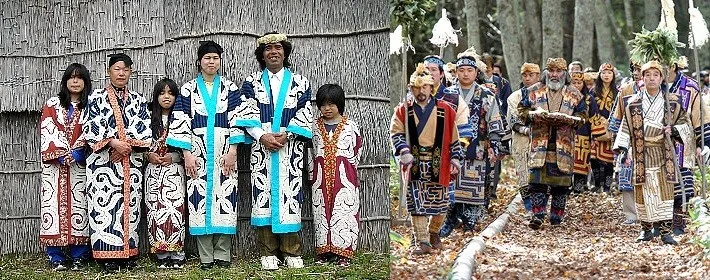
Assimilation policies and discrimination pushed many families to hide Ainu identity. The Ainu language is classified by UNESCO as critically endangered, with very few fluent first-language speakers remaining — even while Ainu place names still cover much of Hokkaido’s map.
Legal recognition moved slowly. Cultural promotion laws in the late 1990s opened limited space; activist Shigeru Kayano, elected to the Diet in 1994 as the first Ainu member of Japan’s parliament, became one of the clearest public voices for language and rights. In 2019, Japan’s Diet passed the Ainu Policy Promotion Act, which recognizes the Ainu as an indigenous people of Japan and funds culture and community measures — progress that activists still debate as incomplete on land and self-determination.
Population numbers are soft. Hokkaido surveys often count roughly twenty to twenty-five thousand people who identify as Ainu, while some estimates of wider ancestry run far higher because of undercounting and mixed families. Saying the people are simply “going extinct” flattens a harder truth: language and some practices are under severe pressure, while identity, craft, music, and political voice continue.
In July 2020, Upopoy (National Ainu Museum and Park) opened in Shiraoi, Hokkaido, as a national center for Ainu history and culture — a “symbolic space for ethnic harmony,” not a living village of forced residents. Replica cise and museum rooms exist so visitors can learn; real Ainu communities live across Hokkaido and elsewhere in Japan. Tourism can help fund culture, but it can also freeze people into costume if curiosity stops at the gift shop.
Golden Kamuy and Ainu visibility
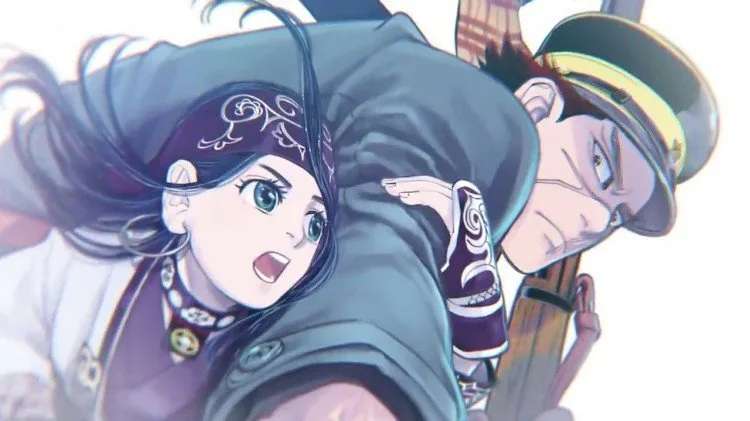
Golden Kamuy is a popular manga and anime that sends viewers into early twentieth-century Hokkaido with Ainu language, food, hunting knowledge, and belief woven into the plot. Former soldier Sugimoto hunts a tattooed treasure map with Ashiripa, an Ainu girl whose skill and worldview drive much of the journey after the Russo-Japanese War.
The series is entertainment, not a textbook — yet for many readers outside Japan it was the first serious window onto Ainu life beyond a one-line “indigenous tribe” label. If you want more on the story itself, there is also coverage of Golden Kamuy’s later seasons on the site.
Prejudice, language, and what still needs work
Discrimination did not vanish with a law. Criteria that once sorted “Ainu” from “Japanese” left social scars; casual comments that treat Ainu people as not truly Japanese still appear. Daily life for many Ainu families is ordinary Japanese urban life plus, for some, cultural practice, activism, or tourism work — not a museum diorama.
The Ainu serve and honor kamuy: nature gods of fire, water, wind, and thunder; animal kamuy such as bears, foxes, owls, and orcas; plant, object, and protective spirits. The word ainu names the human side of that relationship. Reviving language classes, craft, dance, and political claims is part of the same story as museums and anime fame.
Japan is not a single face. Learning Ainu history is not about ranking cultures; it is about refusing the lazy idea that everyone on the archipelago always lived the same way. The more precise the curiosity — language, land, law, ceremony — the less room there is for the old insult that treats difference as a costume or a flaw.

Community
Comments
0 comments
There are no published comments in this language yet.
Send comment