
When living in Japan comes up, someone usually mentions earthquakes and tsunamis before anything else. I hear it whenever I say I want to live there. How do you overcome the fear of earthquakes? I am writing this because I got tired of answering with a feeling. The records are more useful, and so is a short list of things worth doing before the next alarm.
I used to say, from here in Brazil, that an earthquake was more likely to kill us at home, because houses here are rarely built for this kind of shaking. I had the buildings in mind and the odds wrong. The deaths I can actually point to here are homicides and traffic.
Contents 5
Is it necessary to be afraid of earthquakes in Japan?
Worrying about safety is ordinary. Plenty of people fear flying, which is still the safest way to travel, or fear crime in a city they have never walked through. Earthquakes bother the conversation more than either of those once Japan is the subject. People say they would never have the courage to live there, as if the ground shook every week and killed people by the million.
Japan has 14,125 islands in the 2023 recount by the Geospatial Information Authority, which counted natural land with a coastline of at least 100 meters and left artificial islands out. The figure people grew up with, 6,852, came from a 1987 Coast Guard count. The country also has 111 active volcanoes. That geology is why the shaking is part of ordinary life, and why Japan's volcanoes belong in the same conversation. It is also why the history includes earthquakes that killed a great many people. The building rules, the alarm on your phone and the school drills exist because those deaths happened. A newer building still leaves you exposed if the shelf over the bed is loose, and a drill does not move you off a beach.
In Japanese the word is jishin (地震). A jishin can crack plaster and knock over a shelf and still kill almost no one. The same word covers mornings when a city burns or a coast goes under water. Living away from the sea lowers the chance that a tsunami reaches your door. The shaking is still there, and so is fire. Collapse, water and flames have each been the main cause in a different disaster.
What the numbers say about the fear
When someone questions my desire to live in Japan, I still answer with Brazil. I just stopped using the earthquake line. In 2024 the country recorded 42,590 homicides, the lowest rate in the Atlas of Violence series that Ipea and the Brazilian Forum on Public Safety have published since 2014. The same study says deaths of undetermined cause are hiding further killings, so 42,590 is the counted floor. One year of those recorded homicides is already higher than the confirmed dead and missing from Japan's 2011 disaster. That is the scale I mean. It leaves every Japanese earthquake as large as its own record.
Four disasters carry most of this fear. The times below are Japan time.
| Disaster | When | What did most of the killing | Toll used here |
|---|---|---|---|
| Great Kanto earthquake | 1 September 1923, magnitude 7.9 | The fires that followed | About 105,000 dead and missing |
| Great Hanshin-Awaji earthquake | 17 January 1995, 5:46 a.m., JMA magnitude 7.3 | Houses and furniture falling on people | 5,483 direct deaths in Hyogo, plus 919 related deaths |
| Great East Japan Earthquake | 11 March 2011, magnitude 9.0 | The tsunami | 15,901 dead and 2,519 missing as of 1 March 2026 |
| Noto Peninsula earthquake | 1 January 2024, magnitude 7.6 | Collapse and fire, then the long evacuation | 228 direct deaths, and 758 in all by 17 September 2026 |
Kobe is the answer to anyone who says the shaking itself is harmless. Hyogo Prefecture's review, released on 22 December 2005, counted 6,402 deaths inside the prefecture: 5,483 direct and 919 related. Of the direct deaths, suffocation and crushing accounted for 3,979 people, 72.57 percent. Burns accounted for 403. The quake hit at 5:46 in the morning, and many of those people were still in older wooden houses. The 6.9 that sometimes appears in foreign catalogs is the moment magnitude. The JMA magnitude was 7.3, and in Japan the day was 17 January.
11 March 2011 is a different disaster. The National Police Agency's count, as reported on 9 March 2026 for the situation on 1 March, was 15,901 deaths in 12 prefectures and 2,519 people still missing. Drowning in the tsunami accounts for the great majority of the immediate deaths. People who died later, from injury, cold, disrupted care and the strain of evacuation, are counted apart. The Reconstruction Agency's release of 1 March 2024 put those related deaths at 3,802, across Tokyo and nine prefectures, as of 31 December 2023. In Fukushima, the 2,343 related deaths in that count already outnumbered the prefecture's direct deaths, largely because of the long evacuation after the nuclear accident. The 2011 disaster therefore has a direct toll and a related toll, and they answer different questions.
The 1 September 1923 Kanto earthquake still matters if Tokyo is where you would live. About 105,000 people were killed or left missing, and about nine in ten of those deaths were in the fires that started while lunch was on the stove.
Noto is why I retired the line that 2011 was the only large death toll in recent memory. On 1 January 2024 a magnitude 7.6 earthquake struck the Noto Peninsula in Ishikawa. The direct toll has stayed at 228. On 17 September 2026 NHK reported that three more deaths in Ishikawa had been recognized as disaster-related, bringing related deaths to 530 and the combined toll to 758 in Ishikawa, Niigata and Toyama. The shaking killed people on the day. The months of evacuation kept adding names.
Large earthquakes have kept arriving without becoming another 2011. On 8 August 2024 a magnitude 7.1 quake under the Hyuganada Sea reached intensity 6 Lower in Nichinan and injured 16 people, in the Fire and Disaster Management Agency figures cited by the Japan Meteorological Agency. On 20 April 2026 a magnitude 7.7 quake off Sanriku, at a depth of 19 km, brought tsunami warnings to the Pacific coast of Hokkaido and Tohoku. A wave of about 80 centimeters was measured at Kuji Port in Iwate, and the warnings were cleared the same night. On 25 June 2026 a magnitude 7.2 quake off Iwate reached intensity 6 Upper in Hashikami, Aomori. The Meteorological Agency said that one had not produced a tsunami. People were hurt in Aomori and Iwate. None of those three days belongs in the table above. They are closer to the life the fear is actually about: an alarm, a hard minute, and the question of whether you already knew what to do.
How to overcome the fear of earthquakes?
It is easy to line these figures up for someone who has never felt a long shake. It is a different conversation with a person who has already been through one and still startles when a truck passes. I have not lived through a Japanese earthquake, so I am not going to pretend that a page can finish that kind of fear. What I can say, from having argued with myself about the move, is that the fear gets more usable when it is tied to one action.
Name it, then check the sentence doing the damage. "I will die the next time the phone alarm goes off" is a different claim from "a magnitude 7 earthquake can hurt people, and on a coast it can become a tsunami." The records support the second claim. The first one is what makes the whole country feel impossible.
The part I trust is the practical one. Learn the alert sound before you need it. Walk, in daylight, to the evacuation site your city lists for your block. Keep the hallway clear. If the apartment is near the sea, know the high ground you would actually climb. Practice getting under a sturdy table with the people you live with. That is smaller than "conquer your fear," and it is the task that changes the next minute of shaking.
I do not want this to turn into a tour of ways to die. If you are planning a move or a long stay, the useful part of the fear is that it makes you check the gas valve, the bookcase and the way uphill. A fear that only replays the worst footage you have seen does not do that job.
How to prepare for an earthquake in Japan?
These are the steps I would want finished before I unpacked. They follow the advice Japanese fire and disaster offices keep repeating: protect your head, stay under something sturdy, and do not run outside while the floor is still moving.
- Fix water heaters and tall furniture to the wall. In Kobe, falling furniture and collapsing houses did most of the killing, so treat a full bookcase as something that will come down.
- Keep televisions and other heavy things off high shelves, and keep the way to the door clear so a fallen shelf does not trap you in the room.
- When the shaking starts, get under a sturdy table and hold the legs. If there is no table, cover your head. Stay clear of glass. Wait until the shaking stops before you head outside.
- If a flame is within reach and you can turn it off in a second, do that. If the fire is already past you, move away from it instead of crossing the room.
- Keep a small emergency bag and a first-aid kit where you can still reach them if the entrance is blocked. A portable radio with working batteries matters when the phone network clogs.
- Show everyone in the house how to shut off electricity, gas and water. Agree on a meeting place outside the building, in case you cannot go back in.
- Read the city's hazard map for your neighborhood, or ask at the city office. On the coast, that map matters more than the furniture.
- Run the table drill once, including at the hour you are usually home. The drill gives your hands a job so the first ten seconds are not spent deciding.
On the coast, the tsunami changes the plan
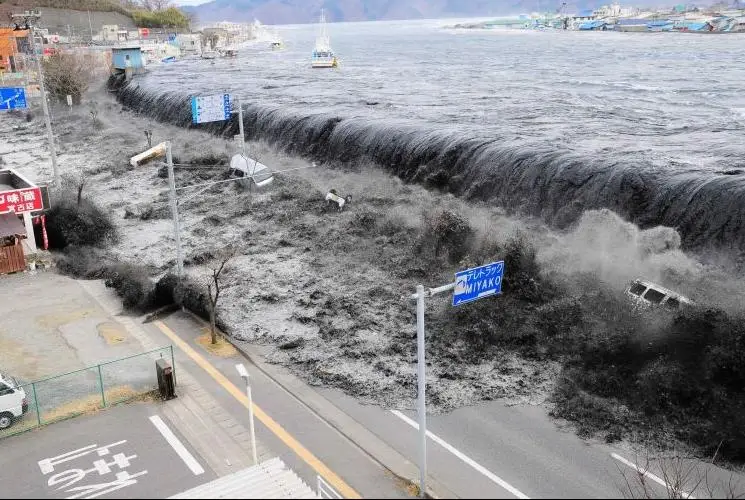
If you look only at 2011, the tsunami is the part that killed. The police toll above is mostly drowning. The photograph from Miyako is what those minutes looked like: dark water already over the road, a car in the wash, boats still out in the bay. Inland, Kobe and the fires of 1923 are a different death. Tsunamis in Japan are rarer than the shaking, and they depend on where you are standing.
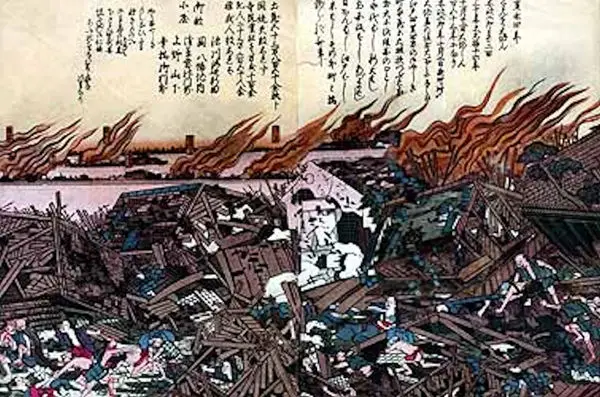
The woodblock below is from the Ansei earthquake. The houses are already down, and the fire is moving across what is left. The fear often arrives as footage from 2011. This print is older, and the people in it are caught in fire and collapse. Water, fire and a falling house ask for three different exits.
We put a seat belt on because cars crash, and then we still drive. I want to go to Japan, and earthquakes are the objection I keep hearing. The big disasters are in the table. The shaking I am more likely to meet is the kind that asks whether the shelf was fixed and whether I knew the way uphill. From here, the risk I already live with is homicide and traffic. On a Japanese coast the extra question is the tsunami map, and inland it is the bookcase and the table. I would rather settle both before I book the flight than meet them for the first time when the alarm sounds.


Community
Comments
0 comments
There are no published comments in this language yet.
Send comment