
Are you traveling to Japan and have no idea which Japanese medicine to take for a headache, a cold, a sour stomach, a hangover, or the mosquito that found you first? The drugstore will have a wall of boxes, and most of them look equally confident.
Many Japanese medicines come in packs of small pills, and the insert often asks for two or three at a time. That is not a hint to “double it like at home.” Read the label. The kanji on the box already tells you how careful the staff expects you to be.
Contents 10
Kusuri and Yakkyoku — pharmacy in Japan
Kusuri [薬] is the word you want: medicine, drugstore products, the thing you came in to find. Point at the symptom, say kusuri, and you are already halfway there.
A dispensing pharmacy is a yakkyoku [薬局], often next to a clinic, and that is where prescriptions get filled. The place tourists actually wander into is usually a drugstore [ドラッグストア] — Matsumoto Kiyoshi, Welcia, Tsuruha, Sundrug — a bright shop that sells shampoo, snacks, contact-lens solution, and a whole aisle of OTC boxes. Both can help. They are not the same counter.
If you are really unwell, skip the aisle and look for a hospital in Japan. The boxes below are for the ordinary trip problems, not for guessing at something serious.
Classification of medicines in Japan
On the box you will see 第○類医薬品, with 1, 2, or 3 in place of the circle. That number is the OTC risk class:
Class 1 [第1類医薬品]: a pharmacist has to hand it over and can ask what you need it for. These are the stronger OTC products.
Class 2 [第2類医薬品]: sold by a pharmacist or a registered seller. Most cold and pain boxes live here. Side effects are still worth reading.
Class 3 [第3類医薬品]: lower-risk products you can usually pick up yourself — vitamins, many skin items, everyday support.
Some boxes say 指定第2類医薬品, with the 2 in a circle or a square. That is a designated Class 2 product: extra caution, often shelved close to the information counter so staff can answer questions. It is not a stamp that automatically means “never mix” or “never for children.” Read the insert for that specific product.
Japanese medicines for headaches and other pain
Weather swings and long train days are enough to start a headache. Bufferin [バファリン] is the aspirin-family name you will see first, often around 1,000 yen depending on the pack.
The same brand splits into different jobs:
- Bufferin A — everyday pain;
- Bufferin Premium — a stronger combination for tougher pain;
- Bufferin Luna — cramps and menstrual pain;
- Bufferin Kaze EX — cold-related aches.
Tylenol [タイレノール] is acetaminophen (paracetamol). People reach for it for fever, toothache, headache, menstrual cramps, and back pain, and it is usually gentler on the stomach than the NSAIDs.
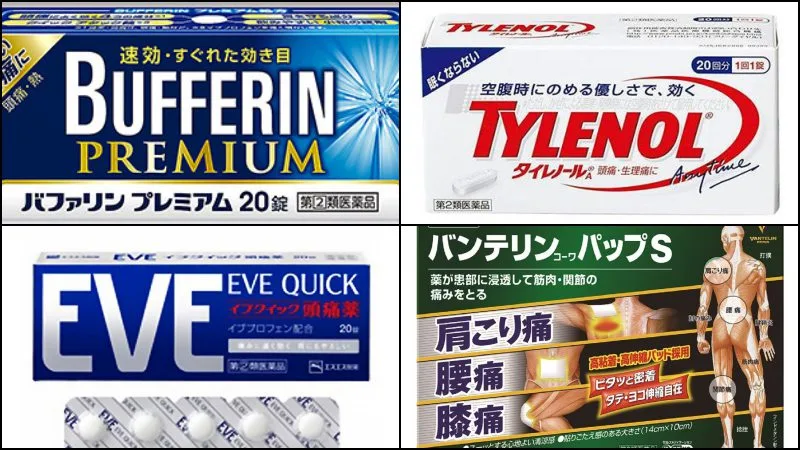
Another very common headache box is Eve Quick [イブクイック], built around ibuprofen. Tylenol, Eve, and the other headache packs often sit in the same price band, around 1,000 yen.
For sore muscles after a day of walking, look for Vantelin [バンテリン] gels and patches. They are easy to find and they are for the body, not a substitute for a headache tablet.
Japanese medicines for flu and colds
Bufferin and Tylenol can take the edge off a fever or an ache, but a Japanese cold is usually treated with a combination pack. Those formulas often include an antihistamine, so drowsiness is part of the deal. More on getting through a cold or flu in Japan is in its own guide.
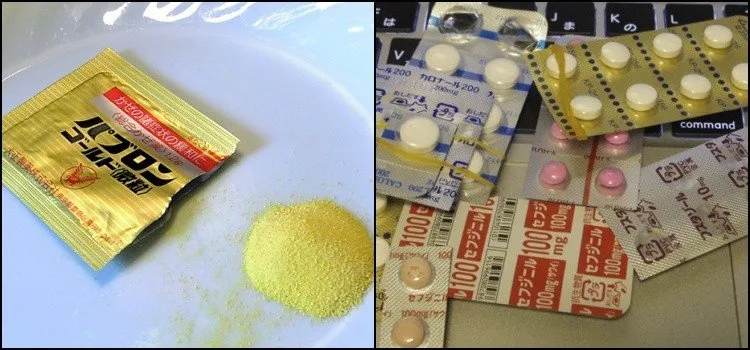
Pabron [パブロン] is the name many people grab first. It is meant for cough, throat irritation, and a runny nose, in tablets or powder, often around 1,300 yen.
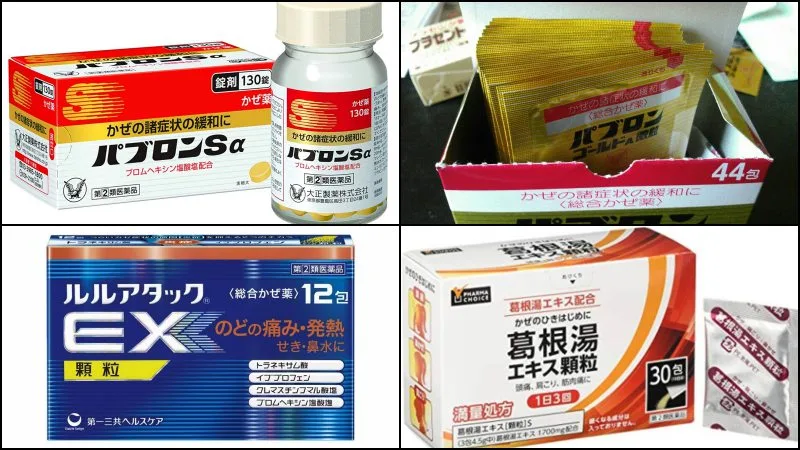
Lulu Attack EX [ルルアタックEX] is another multi-symptom pack for chills, congestion, phlegm, fever, and sneezing. Kakkonto [葛根湯] is the kampo option people take at the very start of a cold, not as a copy of Lulu with a different label.
If you want to hunt by symptom instead of brand, look for these words on the box:
- 風邪 (kaze) — common cold;
- 喉 (nodo) — throat;
- 咳 (seki) — cough;
- 咳き込む (sekikomu) — a cough that will not quit;
- 痰 (tan) — phlegm;
- 鼻づまり (hanazumari) — stuffy nose;
- くしゃみ (kushami) — sneezing;
- さむけ (samuke) — chills;
- 発熱 (netsu) — fever;
- アレルギー (arerugī) — allergy.
Japanese medicines for sore throat
For a raw or swollen throat, some people reach straight for Loxonin S [ロキソニンS]. It is a strong NSAID (loxoprofen) that also covers joint pain, sprains, headaches, bruises, shoulder pain, muscle pain, and cramps.
If your stomach is already unhappy, skip it. Loxonin S is harder on the stomach and usually costs more than a simple pain reliever. Start with lozenges or a throat spray unless you actually need that kind of anti-inflammatory.
Ask for nodo [のど/喉]. Throat lozenges turn up in pharmacies, supermarkets, and convenience stores. You will also see powders meant to sit on the tongue without water — useful when you do not want another tablet.
Japanese medicines for motion sickness, nausea, and indigestion
Travelmin [トラベルミン] is Japan’s familiar motion-sickness brand: dizziness, nausea, and the headache that comes with a winding bus or a long ferry. Take it for the ride, not for diarrhea. Travelmin Junior [トラベルミンジュニア] is the children’s version, generally from age 5; still check the box.
For loose stools, food that did not agree with you, or that sudden travel stomach, the household name is Seirogan [正露丸]. It is a wood-creosote digestive pill for diarrhea and related gut trouble. It does not do the same job as Travelmin.
Seirogan has a strong smell and a taste that not everyone can stand. If the first pill already feels like punishment, ask the staff for another diarrhea option instead of forcing the rest of the pack.
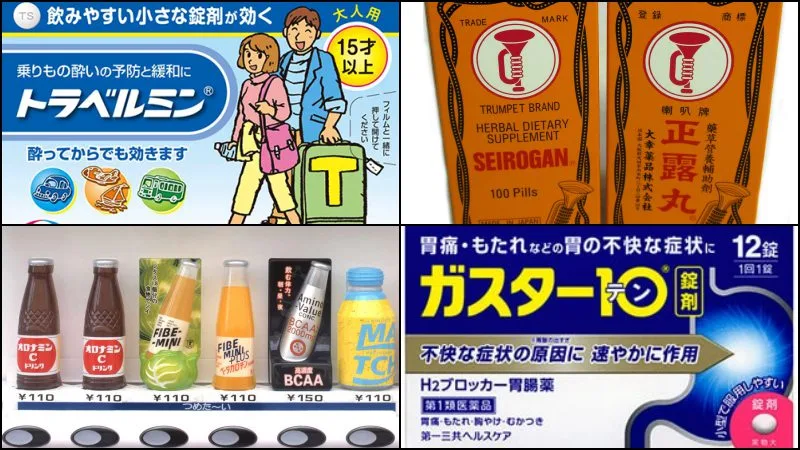
Fibe Mini is a drink people buy when constipation hits after a few days of travel food. It is a fiber drink, not a prescription laxative drama — useful in a pinch if your gut simply stopped.
Gaster 10 [ガスター10] is for heartburn and too much stomach acid (famotidine). It is a Class 1 OTC product, so a pharmacist has to hand it over. Tablets, powder, and liquid versions exist; it is not a diarrhea pill and it is not a motion-sickness pill.
Japanese medicines for insect bites
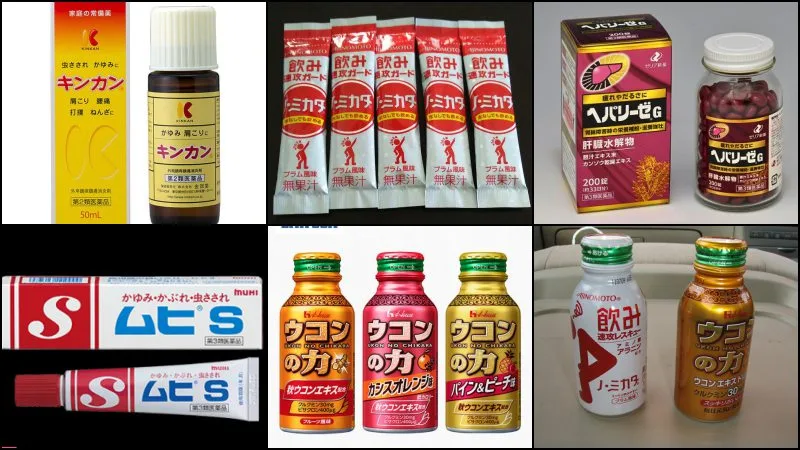
Kinkan [キンカン] is the old liquid people dab on mosquito bites. The same bottle is also used on tired hips, shoulders, sprains, and bruises. It goes on the skin, not in the mouth.
Next to it you will find Muhi [ムヒ], in tubes and roll-ons. Muhi is the itch brand: insect bites, heat rash, dermatitis, eczema, hives. Pick the strength on the box rather than grabbing the first pink tube.
For what to spray before the bite, there are repellents and other creams in the guide to insects in Japan.
Japanese medicines for hangovers
Hepalyse [ヘパリーゼ] is the little bottle you see after a night at an izakaya. It is a liver-extract drink people buy to feel less wrecked the next morning — popular, convenient, not a miracle.
No-Mikata [ノ・ミカタ] is a granule you can take before, during, or after drinking. Ukon no Chikara [ウコンの力] is the turmeric drink in the same convenience-store fridge. None of these replace water or sleep, but they are what the shelf is for.
Look for futsukayoi [二日酔い] if you want another option. Many of these drinks sit in convenience stores, not only in the pharmacy.
Skin, vitamins, and women’s drugstore staples
Ninocure [ニノキュア] is a urea cream for those rough red bumps on the upper arms and legs (keratosis pilaris), plus dry, itchy, irritated skin. It is a skin product, not a “women-only” medicine, even though it often lives near that aisle.
Chocola BB [チョコラBB] is a vitamin B2 series. The tablets are sold for rough skin, acne, and canker sores from the inside — not as a hormone treatment.
Bōkoren [ボーコレン] is a kampo tablet (goshinsan) people buy for the burning, residual, too-often feeling of a urinary tract irritation. It can ease those symptoms; it does not replace a doctor if the fever or pain is climbing.
Meditreat [メディトリート] is a common OTC option for vaginal yeast infection [kanjida chitsuen / カンジダ膣炎]. Cream, spray, or insertable tablet. Many people use it for symptom relief while they decide whether they still need to see a doctor.
Vocabulary to find your medicine in Japan
This list is what you show the pharmacist when the brand names above do not match what hurts. Point at the English, say the romaji, or just show the Japanese column. A longer clinic-side list lives in the Japanese medical vocabulary guide.
| English | Japanese | Romaji |
| common cold | かぜ/風邪 | kaze |
| acne | ニキビ | nikibi |
| pressure point adhesive | つぼ用シール | tsuboyō shīru |
| allergy | アレルギー | arerugī |
| antihistamine | 抗ヒスタミン剤 | kōhisutaminzai |
| burning, stinging | ヒリヒリ | hiri-hiri |
| Job's tears extract | はとむぎエキス | hatomugi ekisu |
| asthma | ぜんそく/喘息 | zensoku |
| heartburn, sour stomach | 胸やけ/胸焼け | munayake, muneyake |
| turmeric | ウコン | ukon |
| nutritional drink (energy/vitamins) | 栄養ドリンク | eiyō dorinku |
| bump, pimple | おでき | odeki |
| callus, corn | たこ | tako |
| face | かお | kao |
| carnitine | カルニチン | karunichin |
| poultice | パップ剤 | pappuzai |
| phlegm | たん/痰 | tan |
| scar | 傷あと | kizuato |
| scar, mark | あと | ato |
| itchy eyes | 目のかゆみ | me no kayumi |
| cholesterol | コレステロール | koresuterōru |
| collagen | コラーゲン | korāgen |
| eye drops | 目薬 | megusuri |
| overeating | 食べ過ぎ/食べすぎ/たべすぎ | tabesugi |
| itching | かゆみ | kayumi |
| tablet | 錠剤 | jōzai |
| compress | シップ剤 | shippuzai |
| frostbite | しもやけ/霜焼け | shimoyake |
| excessive consumption | 飲み過ぎ/飲みすぎ/のみすぎ | nomisugi |
| elbow | ひじ | hiji |
| cream | クリーム | kurīmu |
| calcium | カルシウム | karushiumu |
| capsule | カプセル | kapuseru |
| diaper | おむつ | omutsu |
| blue light damage | ブルーライトダメージ | burū raito damēji |
| skin peeling due to dryness | 皮むけ | kawamuke |
| discoloration | シミ | shimi |
| diarrhea | 下痢/げり | geri |
| diet | ダイエット | daietto |
| stomach ache, discomfort | 胃の不快感 | i no fukaikan |
| stomach ache, nausea | むかつき | mukatsuki |
| eczema | しっしん | shisshin |
| bruise | 打ち身 | uchimi |
| packaged | パック | pakku |
| mouthwash | うがい薬 | ugai-gusuri |
| rash | かぶれ | kabure |
| skin rash, acne | 吹き出物 | fukidemono |
| heat rash | あせも | asemo |
| burn, scald | やけど | yakedo |
| sneezing | くしゃみ | kushami |
| steroids | ステロイド | suteroido |
| stomach | おなか | onaka |
| heavy stomach, problematic digestion | 胃もたれ | imotare |
| eye fatigue | 目の疲れ | me no tsukare |
| fever | 発熱/熱 | netsu |
| wound | きず | kizu |
| crack | あかぎれ | akagire |
| tape | テープ剤 | tēpuzai |
| throat | のど/喉 | nodo |
| creamy gel | クリーミィーゲル | kurīmī geru |
| gel | ゼリー | zerī |
| royal jelly | ローヤルゼリー | rōyaru zerī |
| plaster | プラスター剤 | purasutāzai |
| ginkgo | イチョウ | ichō |
| granule | スティック顆粒 | sutikku karyū |
| hydrogen | 水素 | suiso |
| chapped skin, cracks | ひび | hibi |
| sore, eroded skin | ただれ | tadare |
| soy isoflavone | 大豆イソフラボン | daizui isofurabon |
| knee | ひざ | hiza |
| scratching due to dry skin | かきむしる | kakimushiro |
| languor | だるさ | darusa |
| lecithin | レシチン | reshichin |
| contact lenses | コンタクトレンズ/コンタクト/レンズ | kontakuto renzu, kontakuto, renzu |
| calorie limit | カロリミット | karorimitto |
| lotion | ローション | rōshon |
| lutein | ルテイン | rutein |
| powdered medicine | 粉薬 | konagusuri |
| corn on the foot | うおの目/魚の目 | uo no me |
| mineral | ミネラル | mineraru |
| multi-mineral | マルチミネラル | maruchi mineraru |
| multivitamin | マルチビタミン | maruchi bitamin |
| stuffy nose | 鼻づまり/鼻詰まり | hanazumari |
| nausea | 吐き気/はきけ | hakike |
| nausea, gagging | こみ上げる | komiageru |
| dry eyes | ドライアイ | dorai ai |
| dry eyes | 目の渇き/目のかわき | me no kawaki |
| stiff shoulders | 肩こり | katakori |
| dry skin | かさつく | kasatsuku |
| dry and flaky skin | 粉ふき | kofuki |
| rough and cracked skin | 荒れ肌 | arehada |
| hangnail | さかむけ | sakamuke |
| insect bite | 虫刺され/虫さされ | mushi-sasare |
| pigmentation | 黒ずんだ | kurozunda |
| placenta | プラセンタ | purasenta |
| athlete's foot | 水虫 | mizumushi |
| sunburn, tanning | ひやけ/日焼け | hiyake |
| chitosan | キトサン | kitosan |
| hangover | 二日酔い | futsukayoi |
| neck stiffness | 寝違え | nechigae |
| freckles | そばかす | sobakasu |
| feeling nauseous, queasy | むかむか | mukamuka |
| feeling bloated, gassy | おなかのハリ、おなかのガスだまり | onaka no hari, onaka no gasu-damari |
| feeling dry, rough | ガサガサ | gasa-gasa |
| drowsiness | 眠気 | nemuke |
| spray | スプレー | supurē |
| supplement | サプリメント | sapurimento |
| cough | せき/咳 | seki |
| violent cough | 咳きこむ/咳き込む | sekikomu |
| shivering | さむけ | samuke |
| moisture | うるおい | uruoi |
| redness | 赤み | akami |
| wart | いぼ | ibo |
| blurred vision | 目のかすみ | me no kasumi |
| Vitamin | ビタミン | bitamin |
| zinc | 亜鉛 | a’en |
| hyaluronic acid | ヒアルロン酸 | hiaruronsan |




Community
Comments
0 comments
There are no published comments in this language yet.
Send comment