
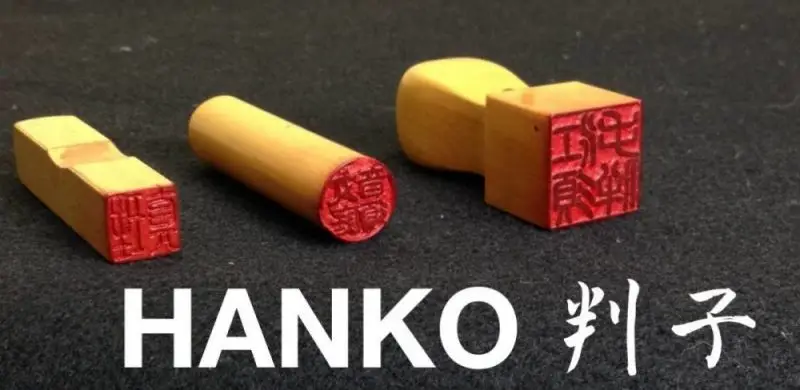
Inkan [印鑑] or Hanko [判子] are stamps (or seals) used by the Japanese, which hold the same value as signatures. In this article, we will see some curiosities about these signature seals and Japanese stamps.
The Inkan or Hanko are used in situations such as requesting documents at the city hall, opening a bank account, correspondence, among others. Both large corporations and ordinary people and families can own an Inkan.
Just as Brazilians need to register their signatures at notary offices to authenticate them, Inkan must be registered and certified by the government at the city hall before being used as a signature.
We recommend reading:
- List of Japanese Last Names 200+ Origin and Meanings
- Junko Furuta – All About the Worst Death in History
- Love in Japanese + 50 ways to say I love you
Table of Contents
What does Inkan and Hanko mean?
The Inkan [印鑑] is a personal signature in the form of a stamp. This signature also receives a document called “inkan shomeisho” [印鑑証明書], a card that proves that such a stamp or seal is your signature.
These stamps are usually made of stone or wood in a cylindrical shape, containing on their upper base the oriental characters, which can be either kanji or drawings (usually used in arts), and are typically used with red ink.
Some signature stamps can be made from elephant tusks, marble, and bamboo, with some costing up to millions of yen. Hanko are considered the cheaper versions, usually made of plastic.
Hanko – Cheap Seal
While Inkan means stamp or seal, there is also Hanko [判子] which means seal. The difference between Inkan and Hanko is that Hanko tends to be simpler, some are even made of rubber to be placed on a pen.
Besides that, they tend to be cheaper, and can be found with a ready-made name, even in 100 円 (Hyakuen) stores. People use it to sign smaller contracts and accept deliveries. It can be categorized as a “mitome-in”.
Both can refer to the same thing, but most of the time hanko is not used so officially. I believe the difference is the same as between seal and stamp, although seal in Brazil means something different. Stamp shops are called hankoya.
Other Names for the Japanese Seal
In addition to the names inkan and hanko, there are other terms used to refer to Japanese name stamps and seals. Here are some of those names and their meanings:
- insho [印章] – Legal Name;
- shirushi [印] – Means mark; emblem; symbol;
- han [判] – Means seal; stamp; signature;
- shirushiban [印鑑] – stamp; seal;
As mentioned in the list above, there is a legally correct form, used in public offices. It receives such a legal name because it is passed through shuniku [朱肉] to be stamped as if it were a seal on paper or document.
Other names on the list are just abbreviations and ideograms that have a certain meaning, which may be rarely used in specific situations.
Sutanpu – Stamp Impressions
Although it has no relation to the article, we can mention the word sutanpu [スタンプ] used to refer to the stamps found at train stations. Those beautiful ones we also find at tourist spots that serve as a record of visit.
When you go to Japan, carry a blank notebook to stamp all the places you visited. If you want to know more about these stamps.
Also read: Sutanpu – Tourist and Train Station Stamps in Japan

Origin of Inkan and Hanko
The Inkan originated 5,000 years ago in the region of Mesopotamia, with engravings carved on the side. Thus, the material was rolled over the surface of clay to obtain the designs of the stamp.
Only the wise of the time possessed the inkan, which was hung around the neck with a cord, carried as a necessary accessory for daily life. Each one had an inkan with peculiar engravings, made with valuable stones.
Subsequently, the inkan spread to the world. To the east, through China, it reached Japan. To the west, it crossed Greece, Egypt, Rome, and reached Europe, where the custom of using the inkan did not persist throughout history. Unfortunately, this custom did not reach Brazil.
In ancient Japan, the inkan was used only by the emperor and his most trusted agents, as a way to certify official documents with the symbol of the emperor’s authority.
From the Heian and Kamakura Eras, the inkan became common among the population, and in the Meiji Era, due to legislation, the inkan became an object of common use that needed to be registered by the city hall of each city (inkan shoumeisho) [印鑑証明書].

Types of Inkan and Hanko
The Inkan and hanko are usually separated according to their use. See the functions of these stamps below:
Mitome-in [認印] – which is used for daily tasks at home and in the office, such as signing for package deliveries, letters, and documents. A Hanko can be used. (We will talk about this soon…)
Ginko-in [銀行印] – This seal is used to open a bank account. To withdraw large amounts of money or close your account. You can use other types of inkan to open your bank account, but many people tend to separate the inkan for security reasons.
Jitsuin [実印] – The stamp that is registered at the City Hall. This is the most important stamp as it is used in all transactions that require official documents, such as buying and selling real estate, buying and selling vehicles, contracts, among others.

Questions about Inkan and Hanko
Below we will answer some questions about these Japanese signature stamps:
Does someone living in Japan need an Inkan/Hanko?
An Inkan is not necessary for survival. It is possible to do many things, even open bank accounts in some places without a seal. If someone asks you for the seal, and you don’t have it, just say so, and they usually allow a simple signature.
If you live in Japan, it doesn’t hurt to have a Seal. It will save you time and avoid problems.
What if someone steals my inkan and uses it?
I really wouldn’t worry about that at all, because if a document is important enough to need the seal, they will ask for identification, address, etc. Not to mention that Japan is a super safe country.
The Inkan and Hanko are a big part of Japanese culture and have probably been a custom for hundreds, if not thousands of years. If you are in Japan, do as the Japanese do, and get your Inkan or the cheaper Hanko.
What is Shuniku and Nurishuniku?
Shuniku [朱肉] is thick red ink used for signature seals, but it can also refer to ink pads. Shuniku is a mixture of refined castor oil, pine resin, white wax, washi (Japanese paper), and other materials that create the red color.
The shuniku pads used to stamp the seals were originally black and came from China, but over time the red color became the standard. The red color is used because it is considered auspicious, similar to the torii gates of temples.
Also read: Meaning of Torii – 5 Major Gates of Japan
Nurishuniku is a premium version of the ink and pad, usually comes in a circular case and has a more pasty consistency, made from non-toxic natural materials. It has a more intense and elegant shine and color, and does not fade over time.
Despite being much more visible, its disadvantage is that it takes longer to dry. Generally, the stamp pads can come inside a case used to store the inkan or can also be an external pad.

How to make your Inkan?
First, you must find a place that works with Inkan. Choose the material such as wood, marble, ivory, iron, and many others. And select the size of your Inkan, below we have a list of common sizes:
| Jitsu-in | Female: 13.5 millimeters or 15 mm Male: 16.5 millimeters or 18 millimeters |
| Ginko-in | Female: 12 mm or 13.5 millimeters Male: 13.5 millimeters or 15 millimeters |
| Mitome-in | 10.5 millimeters normal 12.0 millimeters Special |
Decide what you want on the inkan
You can have up to 6 characters on your inkan. You can put your first name, last name, family name, or organization name. You can choose to use kanji, katakana, and hiragana. In some places, it is even possible to customize.
Who can register?
Anyone over 15 years old who is a resident of the city where the city hall is located. However, you can only register one seal.

What do you need to register the seal?
1. Personal identification, such as a Foreign Resident Registration Card or driver’s license.
2. Inkan – the personal seal.
3. An application form – inkan-Touroku-shinseisho 印鑑登録申請書 – available at the local ward office or a city office, or for download on the city hall’s website.
4. The registration is free, but the authenticity certificate for the seal (印鑑登録証明書 inkan toroku Shomei-sho) costs 300 yen. This authenticity certificate is required for any significant commercial transaction, such as buying a car or purchasing real estate.
Did you like the article? Leave your comment, share, and like our page on Facebook and social networks.
Leave a Reply