

Have you ever walked into a Japanese shop and wondered why the greeting sounds so nasal and stretched — almost as if it were spoken through the nose? That is what people mean by Hanagoe: a voice that belongs to everyday life in konbini, supermarkets, and many stores, and that often surprises visitors the first time they hear it.
It is not a nervous tic, and it is not a cold. Many staff members lean into a brighter, more nasal way of speaking so they can stay audible and friendly for hours. What sits behind 鼻声, and why does “Irasshaimase” sometimes collapse into a single syllable with a long rising tone?
Contents 4
What does Hanagoe mean?
Hanagoe [鼻声], also read as bisei, simply means a nasal voice — in daily speech as well as in dialects that lean into nasality. In a shop, people usually point to the exaggerated, high, “through the nose” style used when greeting and serving customers.
Related, but not the same: bion [鼻音] is more of a phonetics term for nasal sounds (that “n”-like resonance). Hanagoe is the audible voice quality; in retail it is often stylized until the original word is hard to catch.
That is what many guests hear: instead of a clear “Irasshaimase” (いらっしゃいませ, “Welcome”), you get a short nasal syllable with a long rising trail — friendly, loud, and sometimes almost robotic.

Why do shop staff speak through the nose?
In konbini and supermarkets, fixed phrases repeat all shift long: welcome, “can I help you,” register lines, thank-yous. Pushing every one of those deep from the belly, loud and low, wears the throat out fast — especially when the store is packed.
So some employees are coached or encouraged to use Hanagoe: nasal resonance spares the vocal folds, carries in the store’s acoustics, and still feels “lively” and present. First impressions matter; the first word is often where the voice is most obvious.
If you try to shout over a crowd for hours, your throat feels it. Humming or speaking more through the nose are common ways to sound louder and more approachable without losing your voice as quickly — I personally do not know this technique, but in Japanese retail it is everywhere.
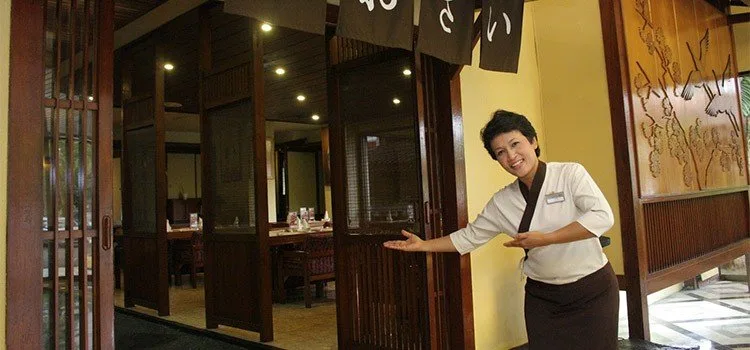
How is that sound produced?
The method is often described like this: keep the mouth and throat a bit closed, ease off pressure from the belly, and let the voice sit slightly forward into the nose — that is how the familiar tone appears. The catch is that it should not turn into a cold, purely mechanical voice. Many people still aim for a tone that stays friendly and “nice” even with training.
On top of that come classic service habits: keep the throat hydrated, use a local accent, smile, lean on keigo and polite formulas, and shift intonation with the situation. Hanagoe is less of a gimmick and more of a tool in the customer-service kit — next to the loud, stylized Irasshai / Irasshaimase guests hear when they walk in, and among other Japanese greetings.
What should you know as a guest?
You usually do not need to answer “Irasshaimase.” A short nod, a smile, or simply continuing on is normal; the phrase is for the store, not a two-way chat. What sounds odd to you is often energy-saving and standard training for the staff.
Not every shop sounds the same: a quiet boutique may keep the voice softer; a busy konbini may sound brighter and shorter. Some staff speak clearly, others heavily stylized — that says less about friendliness and more about load, volume, and house rules.
If you are learning Japanese, it helps to separate the “clean” pronunciation of いらっしゃいませ from the store version. You do not need the nasal short form for study; you do need it to understand everyday culture: Hanagoe is why the welcome in a shop so often sounds like the nose, not like a textbook.
Have you already heard this voice in a store — and did it amuse you or leave you confused?







Community
Comments
0 comments
There are no published comments in this language yet.
Send comment