
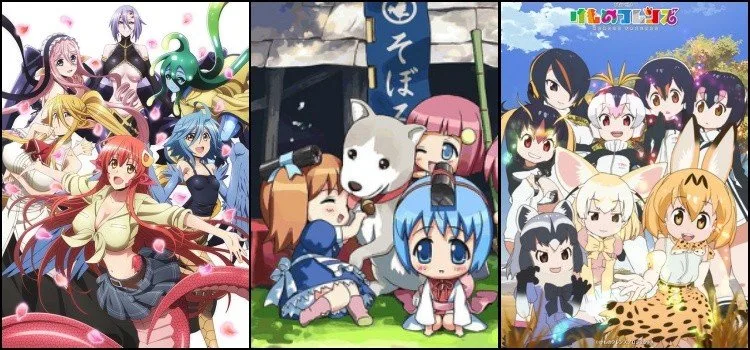
Moe culture in Japan is widespread, appearing in anime, games, advertising and even study aids. For readers who have not come across the word before, moe (萌え) usually describes a female character who is cute, innocent and endearing. Once that formula took hold, artists began applying it to almost everything.
Monster Musume (2012): Okayado's manga, which became an anime in 2015, gives mythological creatures the moe treatment. The lamia Miia, the harpy Papi and the centaur Centorea are among the monster girls who end up living with Kimihito Kurusu, a student caught in an interspecies exchange program. The title is usually translated as Everyday Life with Monster Girls.
T-REX na Kanojo (2014): The manga by Sanzo, translated as My Girlfriend Is a T-Rex, follows Yuuma Asahikawa as he starts over and ends up dating Churio, a Tyrannosaurus rex in girl form.
The Female Fridge No. 1 (2000): Tori Miki's one-shot, also known as Reizou(ko) Ningen Dai Ichigou, begins with a woman waking up transformed into a refrigerator inside a stranger's apartment.
Gokicha!! (2011): Rui Tamachi's four-panel manga follows Gokicha, a cockroach who moves to Hokkaido to escape her species' reputation and keeps trying to make human friends. The character later got a short anime made for mobile phones.
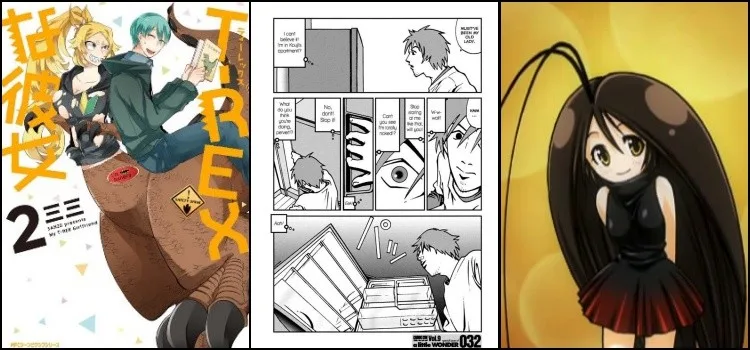
Shinka no Mi (2014): In Miku's light novel series, also known as The Fruit of Evolution, a class full of idols and beautiful students is sent to another world. Seiichi Hiiragi, the outcast mocked for his looks and smell, lands somewhere else and meets Saria, a gorilla who turns out to be the story's heroine.
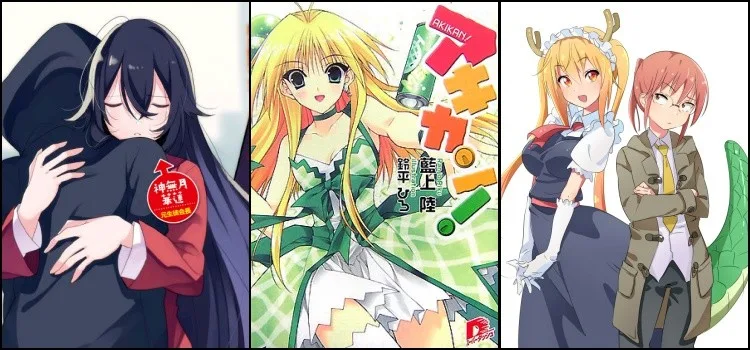
Akikan! (2007): Riku Ranjō's light novel series starts when a melon soda can turns into a girl named Melon. An anime adaptation followed in 2009.
Miss Kobayashi's Dragon Maid (2013): Coolkyousinnjya's manga, adapted by Kyoto Animation in 2017, gives the dragon Tohru a job as the maid of office worker Kobayashi. A second anime season arrived in 2021.
The strange things get even stranger
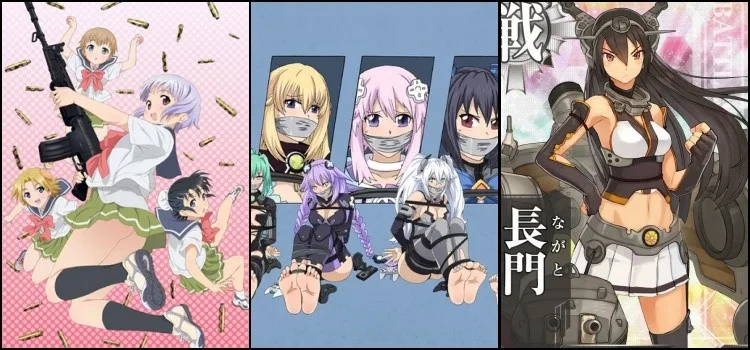
Upotte!! (2009): Firearms become students at Seishou Academy in Kitsune Tennouji's manga, which was adapted as an ONA in 2012. Assault rifles and sniper rifles each have their own class.
Hyperdimension Neptunia (2010): The role-playing games by Compile Heart and Idea Factory personify game consoles as the goddesses who rule the land of Gamindustri. An anime adaptation aired in 2013.
Kantai Collection (2013): The browser game by Kadokawa and DMM gives World War II warships the bodies of girls, with personalities drawn from each ship's history. KanColle grew into a franchise with manga, novels and anime.
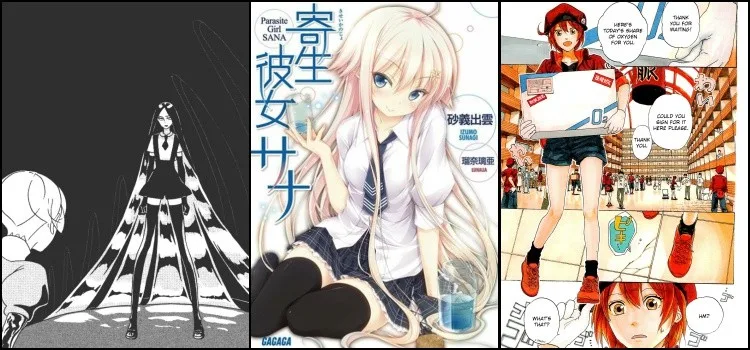
Kisei Kanojo Sana (2011): An award-winning light novel series published by Gagaga Bunko features Sana, a parasite that evolves into a girl and lives inside student Karato Masukawa, protecting him in exchange for nutrients.
Land of the Lustrous (2012): Haruko Ichikawa's manga is set in a world inhabited by immortal humanoids made of gemstones, from diamond to phosphophyllite. Studio Orange adapted it into 3D animation in 2017.
Cells at Work! (2015): Akane Shimizu's manga personifies the cells of the human body. The 2018 anime brought red blood cells, white blood cells and platelets to the screen.
Binchō-tan (2003): Takahito Ekusa's character is a small girl made of binchōtan charcoal. Her friends include Chiku-tan, named after bamboo charcoal, and a girl named Aloe.
Windows 10 (2015): Even operating systems join in. Microsoft Japan's campaigns for Windows 7 and Windows 8 created the mascots Nanami Madobe, Yū and Ai, and a Japanese dealer campaign for Windows 10 added Tōko Madobe, a character that Microsoft itself does not officially recognize.
Midori Days (2002): Kazurou Inoue's manga replaces the right hand of tough student Seiji Sawamura with Midori Kasugano, a girl who loves him from afar. The anime followed in 2004.
The list keeps growing. Tsuburaya's Ultra Kaiju Anthropomorphization Project turns Ultraman monsters into the Kaiju Girls, whose short anime began in 2016, and Kemono Friends made girls out of animals of every kind in its 2017 anime. Catgirls remain the most familiar version of the idea, and new examples appear every season.


Community
Comments
0 comments
There are no published comments in this language yet.
Send comment