
Scroll far enough on YouTube or TikTok and you will eventually land on a Japanese high school clip that feels completely unhinged: students dancing in matching uniforms, a festival stage packed with classmates, a song that treats English words like a comedy routine. From outside Japan, the first reaction is often the same — “what am I even watching?”
That shock is part of the appeal. Japanese high school life sits at the center of anime, commercials, and internet culture, so ordinary school events can travel the world looking stranger than they feel at home. Once you know the settings behind the camera, the “bizarre” videos start to look less random and more like Japan’s school calendar doing what it has always done — only now with global comment sections.
Contents 8
Why Japanese high school clips travel so fast
High school students occupy a special place in Japanese pop culture. Uniforms, club rooms, and campus festivals already carry story energy in movies and TV dramas. Online, that same imagery becomes a ready-made thumbnail: synchronized dance, bright gym lights, a whole class performing as if the hallway were a stage.
Foreign viewers often meet these clips without the school calendar that produced them. A routine filmed for a cultural festival, a sports event, or a club showcase can look like a random flash mob when it appears alone on a phone screen. The strangeness is real — but it is usually social, not supernatural.
Bunkasai stages, not random street chaos
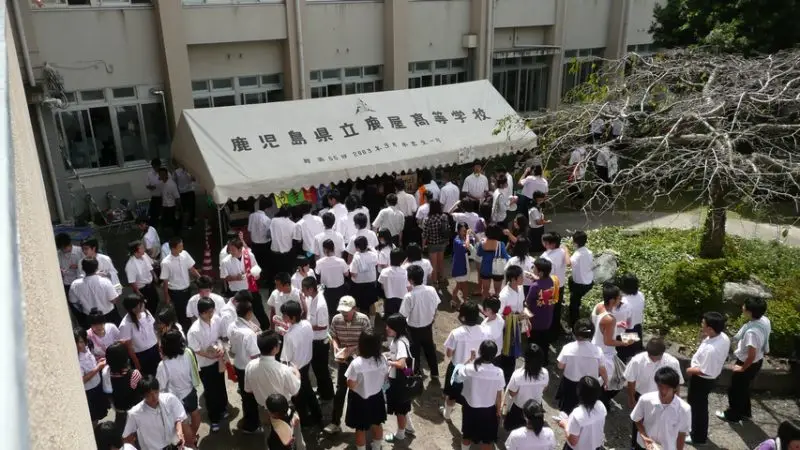
Many of the wildest school videos come from bunkasai (文化祭), the annual cultural festival held at most Japanese schools. Classes turn classrooms into cafés or exhibits, clubs put on concerts and dances, and the school opens to parents, alumni, and sometimes the public. It is part of the school year, not a one-off stunt for the internet.
That context matters. A polished stage performance by a girls’ dance club can look extravagant online because festival week is designed for spectacle. The same students may spend months rehearsing for a single afternoon. If you want the wider picture of how these events work, the deeper guide on bunkasai in Japan fills in the school-life side that short clips skip.
Dance clubs that become internet legends
Japan has serious high school dance culture. Clubs train for regional and national contests, and occasionally a routine escapes the gym and lands on national TV or YouTube. One of the clearest examples is Osaka’s Tomioka High School dance club and its “Bubbly” routine — a retro, bubble-era performance that racked up millions of views after circulating from competition footage into wider internet fame.
Watching it with context changes the joke. The costumes, timing, and camp aesthetics are deliberate craft, not accidental weirdness. What looks “too much” from another country’s school culture is often exactly what a dance club is trying to achieve: precision, nostalgia, and a performance that stays in your head.
Club life itself is a whole ecosystem — long practices, senior-junior hierarchies, and weekends that revolve around the gym. For that system, see the overview of bukatsu school clubs in Japan.
Baseball energy and the school sports soundtrack
Baseball is not a side hobby in Japan; high school tournaments such as the summer run toward Koshien still dominate sports media every year. Alongside the games comes a soundtrack: brass bands, coordinated chants, cheer squads, and stadium-side dance that can look theatrical if you grew up with quieter bleachers.
When a baseball-related dance or cheer clip goes viral, outsiders sometimes treat it as pure novelty. Inside Japan it sits closer to sports ritual — loud, rehearsed, and meant to keep energy high for nine innings or a whole tournament week. The moves may still be ridiculous in the best way. The point is that the ridiculousness has a home: school sports culture, not a random costume party.
When the “schoolgirl video” is really a language lesson
Not every clip with uniforms is a pure school performance. Malaysian artist Namewee’s Tokyo Bon 2020 (also known as “Makudonarudo”) exploded as a Japanglish earworm: English words pronounced through Japanese sounds — McDonald’s as Makudonarudo, Google as Guguru, Seven-Eleven, Starbucks, and a parade of everyday loanwords — set against a Bon Odori-style dance feel.
The music video leans on high-school imagery and a guide figure in uniform while teaching outsiders how English becomes part of Japanese daily speech. It is comedy, tourism-adjacent branding, and language play at once. That mix is why it still gets shared as a “weird Japanese school video” even though the star is the language gag, not a real class project.
If the festival beat of the song makes you curious about the real summer tradition behind Bon dancing, start with Obon and Bon Odori in Japan.
The “secrets of youth” layer people keep projecting
Japanese media loves the idea that schoolgirls and schoolboys carry private worlds — crushes, club rivalries, soft supernatural moods, or just the feeling that something is about to change after graduation. Ads, dramas, and short online videos borrow that atmosphere even when the plot is thin.
That is why some clips feel mysterious even when nothing “happens.” A quiet hallway shot, a half-explained joke, or a performance that never names its school can still hit the same emotional button anime trained audiences to press. The mystery is often aesthetic: youth as a mood, not a conspiracy.
It also explains the gap between fiction and campus life. Anime compresses festivals, confessions, and club climaxes into neat arcs; real schools still host those events, but with homework, weather, and imperfect choreography. Comparing the two is half the fun of watching real Japanese school content online — and a fair question for anyone who has only met Japanese schools through fiction, as in the comparison of Japanese schools versus anime.
How to watch without missing the joke
A few habits make these videos less confusing and more interesting:
- Look for the occasion. Bunkasai, sports day, club contest, TV challenge, or music video? The label changes what “normal” means.
- Read the song choice. Retro J-pop, stadium chants, or Japanglish comedy each signal a different kind of performance.
- Separate school life from costume fantasy. Uniforms on camera can mean a real student event — or a commercial concept wearing the same silhouette.
- Expect polish and silliness together. Japanese school performances often aim for both: strict timing and unapologetic camp.
None of that ruins the humor. It just stops you from treating every clip as proof that Japanese high schools are permanently absurd. Sometimes they are simply putting on a show — and the internet is sitting in the cheap seats without a program.
What stays bizarre, even with context
Context does not sand every edge smooth. Some choreography still looks unhinged. Some songs still take a hard left into “please never explain this lyric.” Some staging still feels like a fever dream of gym mats and LED lights. That is fine. The goal is not to make Japanese school videos boring; it is to enjoy them with enough background that the surprise lands where it should — on the performance, not on a misunderstanding of the country.
Keep watching the festival stages, the dance clubs, the stadium noise, and the occasional Japanglish earworm. Japan’s high school calendar keeps producing them. The internet will keep calling them ridiculous. Both reactions can be true at the same time.



Community
Comments
0 comments
There are no published comments in this language yet.
Send comment