
If you watch anime regularly, you will have noticed that Japanese schools always have school clubs. This article looks at Japanese school clubs in depth: their structure, the different types, and the curiosities of this part of school life.
These clubs provide plenty of experiences and unforgettable memories. They are taken seriously because they serve as training for the future career and adult life. In some schools, it is mandatory to join a club.
Contents 6
What are kurabu and bukatsu?
School clubs, often called kurabu (クラブ), are extracurricular activities that the students themselves develop and organise. In high school the term bukatsu (部活, literally "club activity") is also widely used.
Each club usually has its own room or facility. It needs a counsellor (a teacher) to supervise and advise the club, as well as a president (kaichō). Some schools require a minimum number of members (usually around five).
Not everyone loves the idea of clubs, because it can take a lot of time depending on which club you join. Some students stay at school into the evening; others have to attend meetings or matches on weekends.
Club activities take place after class and usually last about five to seven hours; sometimes the group meets even before school starts.
That is why some students end up creating and joining a club that does practically nothing and has few attendance requirements — such as a reading club or even a napping club.
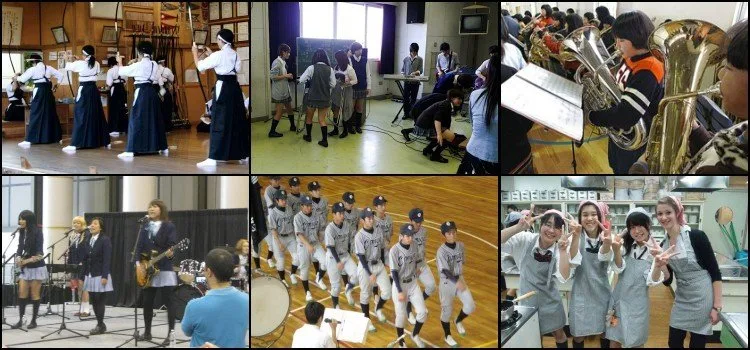
It is very common for students to feel stressed about choosing a club, because that choice shapes their academic performance and the friendships they form with other kōkōsei (high-schoolers).
Many clubs run recruitment campaigns, because the risk of having to close for lack of members is real. Members can leave and join another club at any time. The main goal of clubs is not only to promote activities such as sports, games, the arts, music and the like, but also to foster intense socialisation.
How school clubs work in Japan
Some schools require participation in club activities; others leave it optional or leave the decision to the club itself. Many high-schoolers have a part-time job, which can get in the way of clubs that demand a lot of dedication, such as sports clubs.
Students who do not belong to any club or skip club activities are called kitakubu (帰宅部). The possibilities for starting a club are virtually endless. There are sports clubs, art clubs, cooking clubs, kendo, manga, animation clubs — or anything else the students are interested in.
To set up a club, you need the required number of members, a counsellor, a proposal and an objective, and sometimes a sponsor or a volunteer from the college.

The limits and rules for creating and managing clubs are set by each school. Sometimes the student council is responsible for approving and overseeing new clubs.
The level of commitment required for bukatsu is notoriously rigorous. Some foreign observers criticise the system for the time demands it places on students.
In school clubs, alongside the bonds between students, the senpai and kōhai culture is also practised. Many newcomers who join a sports club wait for years before they are allowed to take part in inter-school competitions.
Some members develop their skills to a professional level, and some schools have teams that go on to compete at the national level. Others join simply for the hobby or to be with their friends.
When students move on to higher education, they can often earn credits for their achievements in school clubs. Some schools do not set a minimum number of members, but there is usually a maximum cap.
Occasionally members are asked to leave the club because of lack of experience or because they joined too late.
Curiosities about school clubs in Japan
The suffix -bu (部) is used to refer to clubs, such as the baseball club (yakyūbu). Others prefer the suffix -kai, meaning "association" or "society". Here are a few more terms:
- undō-bu — 運動部 (sports clubs);
- bunka-bu — 文化部 (cultural clubs).
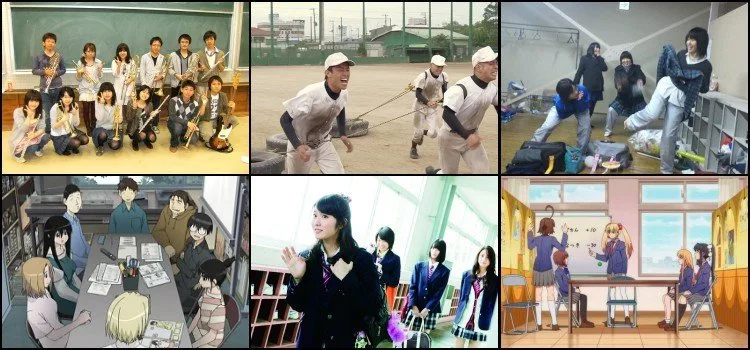
Sports clubs are clubs that require physical activity; cultural clubs are any club without a sports focus — even chess or classical music fall into this category.
Are Japanese school clubs really unsupervised? If you watch anime, you may have noticed how little screen time the counsellors and teachers who run the clubs get.
In reality, many Japanese schools want to encourage students to become autonomous, make their own decisions, handle paperwork, manage money and develop leadership skills.
- School clubs are also available in college.
- Club members often go on trips for activities during school holidays.
Here are some examples of common school clubs:
- Sports: basketball, dance, badminton, handball, rugby, baseball, swimming, athletics, table tennis.
- Arts: theatre, film, photography, painting, dance, literature.
- Traditional Japanese arts: kimono, tea ceremony, ikebana (flower arrangement), Japanese calligraphy.
- Humanities (common in colleges): history, philosophy, politics, sociology.

Animes about school clubs
Every year, several animes come out that depict the activities of school clubs. Practically every anime set in a school features a kurabu or bukatsu at some point. Putting together a definitive list is therefore impossible, but here are some of the best animes that show student life through the lens of a school club:
- The Melancholy of Haruhi Suzumiya (SOS Brigade);
- Kuroko's Basketball (basketball);
- Ace of Diamond (baseball);
- Haikyuu!! (volleyball);
- Free! (swimming);
- Charlotte (student council);
- Hyouka (classic literature);
- Love Live! (idol);
- K-On! (light music);
- My Teen Romantic Comedy SNAFU (volunteer service club);
- Chihayafuru (karuta);
- Boku wa Tomodachi ga Sukunai (neighbours' club);
- Kokoro Connect (cultural research club);
- SKET Dance (school helper club).

Have you ever taken part in a club? Is there a club you would love to join? Or do you remember an anime about Japanese school clubs that we missed? We would love to read your comment and see you share the article! Thanks!
Related articles on skdesu.com:
- Japanese school uniform — are the skirts really that short?
- Are Japanese schools the same as in anime? A comparison
- Sukumizu — school swimwear in Japan
- School subjects in Japan: Japanese vocabulary
Are school clubs mandatory?
School clubs (bukatsu) are not strictly mandatory in Japan, but they play an important role in students' lives and in school culture. Participation is strongly encouraged and highly valued, both by the schools and by Japanese society at large.
Some schools may require you to choose an extracurricular activity, but if you do not want to spend most of your time at school or at weekend events, there are clubs that demand far less commitment.
Time commitment
The time and effort required varies from club to club, and some clubs are clearly more relaxed than others. Generally, clubs that focus on recreational and casual activities tend to ask for less from their members, while highly competitive and specialised clubs may demand a lot more dedication. The following types of clubs typically require less:
- Recreation clubs: game clubs, hobby clubs, and other clubs that focus on casual activities tend to be the most relaxed. Examples include chess, photography or cooking clubs.
- Cultural clubs: clubs that focus on culture, language or the arts (theatre, music, dance, poetry) offer a creative environment and — while rehearsals are required — are usually less time-pressured than competitive sports clubs.
- Volunteer clubs: these tend to have flexible schedules that let students take part in their own time.
Note that the availability of clubs and the intensity of participation vary widely from school to school, depending on student demand. It is always a good idea to check the specific club options at your school and to talk to the club leaders or advisers to understand the actual requirements and expectations.




Community
Comments
0 comments
There are no published comments in this language yet.
Send comment