

Yuki and Yuuki sound almost the same, but they are two different words and two different names. 雪 (yuki) means snow, while 勇気 (yuuki) means courage. Both words are common in Japanese. The names Yuki and Yuuki are also common, and there the kanji decides what the name means. In this article, we look at the two words, how the pronunciation differs and which spellings you are likely to meet.
The difference is the length of the u. ゆき (yuki) has a short u, while ゆうき (yuuki) has a long one. In romanization you will also see Yūki with a macron, which marks the same long vowel. Spoken, the distinction is clear. Written, it can pass unnoticed if you are not paying attention, especially in names.
Names work differently from ordinary words. A word like 雪 has a fixed meaning. A name can be written with several kanji, and each choice brings its own meaning. The same sound can therefore point to completely different names, which is why the pronunciation alone rarely tells you what a Japanese name means.
Yuki can also work as a nickname. Our article on Japanese nicknames explains how shortenings and suffixes such as -chan and -kun work.
Yuki: snow and a common given name
雪 (yuki) is the everyday word for snow. You will meet it in compounds such as 初雪 (hatsuyuki, the first snow of the season), 雪国 (yukiguni, snow country) and 雪見 (yukimi, snow viewing). The last one names the custom of stopping to watch a snowy landscape.
Yuki works as a name for girls and boys. Behind the Name lists 幸 (happiness) and 雪 (snow) among the kanji used for the name, along with combinations such as 由 (reason, cause) plus 貴 (valuable) or 紀 (chronicle). Other combinations also exist. The parents choose the kanji, and those characters carry the meaning.
A familiar example is Yuki Sōma from Fruits Basket, whose name is written 由希: 由 for reason and 希 for hope. Another is Yuki Amane (阿万音 由季) from Steins;Gate 0, where the second kanji is 季, season.
Snow also appears in Japanese folklore. Yuki-onna (雪女) is the woman of the snow, a figure who appears on snowy nights in a white kimono, with pale skin and black hair. In many versions she freezes travelers with her icy breath or leads them off the path until they die of exposure. The best-known version comes from Lafcadio Hearn: two woodcutters, Minokichi and Mosaku, take shelter in a hut during a storm. Yuki-onna kills the older man and spares Minokichi because he is young. Years later he marries a woman named O-yuki, who turns out to be the same snow spirit. When he finally tells her the story, she tells him to care for their children and disappears.
The legend has reached anime and games. Froslass, the Ice and Ghost-type Pokémon introduced in the fourth generation, is based on Yuki-onna. Its Japanese name is ユキメノコ (Yukimenoko), from 雪 (snow) and menoko, an old word for girl.
Yuuki: courage and a name with many spellings
勇気 (yuuki) covers courage, bravery and nerve. It shares its sound with unrelated words: 幽鬼 (yuuki) is a ghost or revenant, and 有機 (yuuki) means organic, as in 有機化学 (yuuki kagaku, organic chemistry). Context usually makes the meaning clear, but the difference matters when you read a name or a sign.
Common spellings of Yuuki include 優希, 悠希, 優輝 and 悠生, as listed by Behind the Name. The kanji bring meanings such as gentleness (優), calm (悠), hope (希), brightness (輝) and life (生).
In Sword Art Online, Yuuki Konno writes her name 木綿季, where 木綿 means cotton and 季 means season. The pronunciation is the same as 勇気, but the kanji give the name a different meaning.
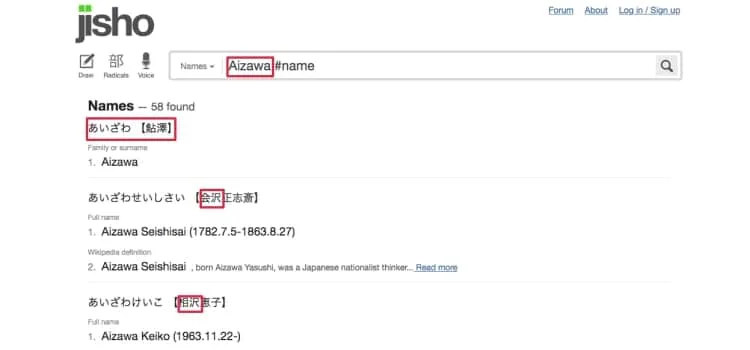
Names that sound alike can also be checked in a name dictionary. The screenshot below shows a search for Aizawa on jisho.org, with 58 name entries and several kanji variants for the same surname, among them 鮎澤, 会沢 and 相沢.
The next time you meet a Yuki or a Yuuki, the pronunciation gives you only part of the information. Ask how the name is written, or look up the kanji, and the meaning becomes specific: snow, happiness, hope, courage or something else entirely. If you want to go further, our guide on how to discover the meaning of Japanese names explains where to look.




Community
Comments
0 comments
There are no published comments in this language yet.
Send comment