
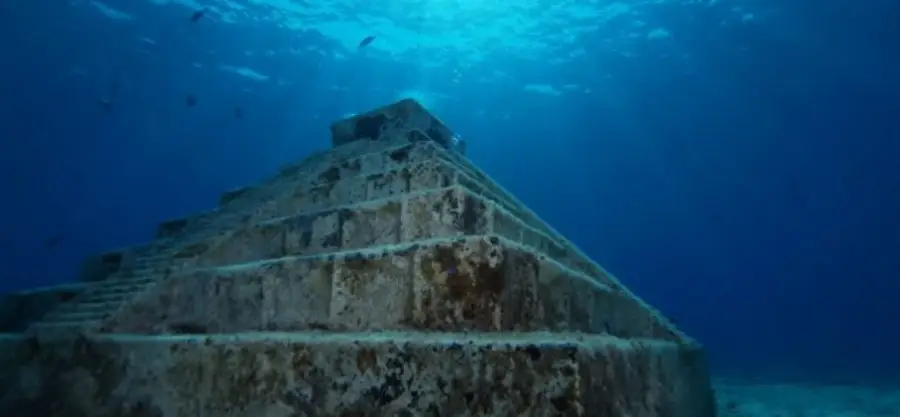
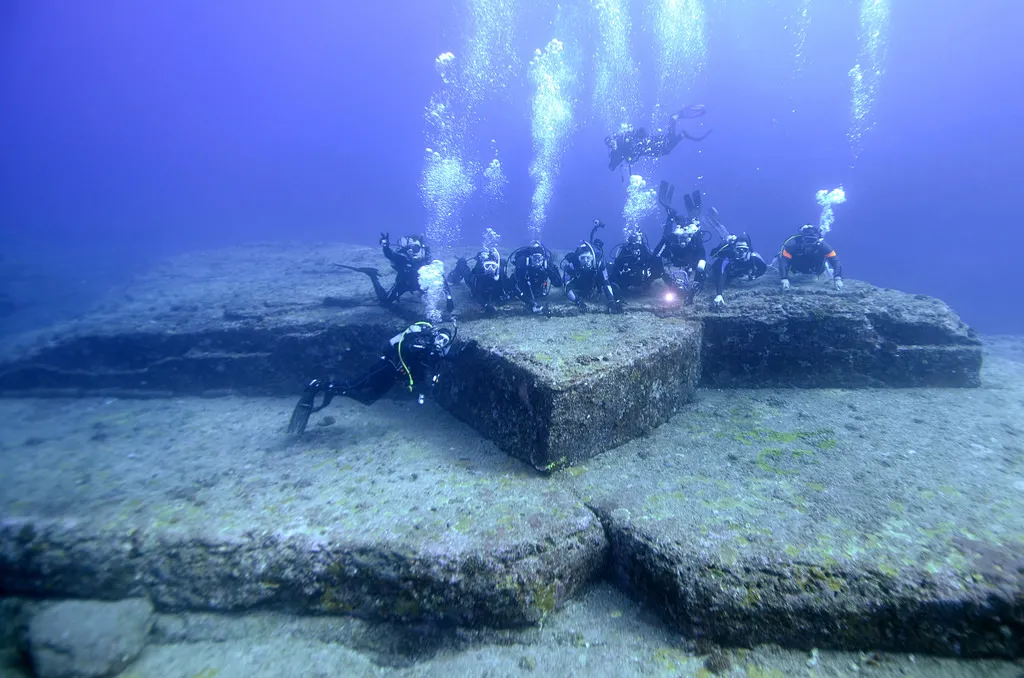
Some believe they are construction remnants, while others see them as a pyramid. It is unknown whether their formation was natural or man-made. Have you heard of the Yonaguni Ruins?
The gigantic structure is called Yonaguni-jima (与那国島 / よなぐにじま) because it is the closest place to the island of Yonaguni.
This structure is also referred to as the Lost City or Japanese Atlantis. This was one of the greatest archaeological discoveries on the planet and attracts attention due to its complexity.
Let's embark on this underwater adventure to learn more about this archaeological fact.
Contents 6
The search for the lost city of Yonaguni
In 1986, diver Kihachiro Aratake discovered the ruins while making an unpretentious dive in the area.
In 1992, the scientist, physicist, and professor Dr. Masaaki Kimura began studying the ruins. He dedicated nearly twenty years to diving and researching the site.
Since 1995, divers and scientists have begun to study this underwater construction in depth.
Dr. Masaaki Kimura believes that these ruins belong to the Ice Age, meaning they could be over eight thousand years old.
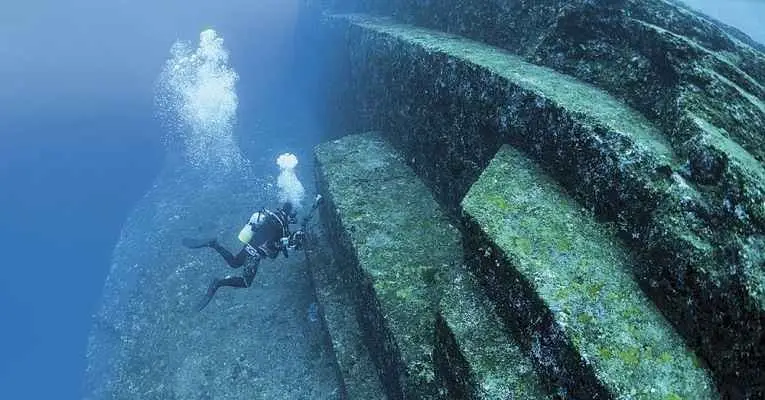
The idea arose from the notion that all the world's water was concentrated in the northern hemisphere during this period.
Geology professor at the University of Tokyo, Teriaki Ishii, believes that the structure submerged during the last ice age, meaning it is over ten thousand years old, making it twice as old as the pyramids of Egypt.
In 1997, Dr. Masaaki published a study on the lost civilization called A Continent Lost In The Pacific Ocean. In the study, he advocates for the existence of a place with a well-developed civilization.
On May 4, 1998, the islands of the ruins experienced tremors caused by earthquakes.
After the phenomenon, underwater filming was conducted, and to intrigue even further, more structures resembling ziggurats (similar to a temple) from Mesopotamia appeared.
With the tremor, stones with carvings, tools, and staircases emerged, making the idea of everything being shaped by nature increasingly distant.
Location of Yonaguni
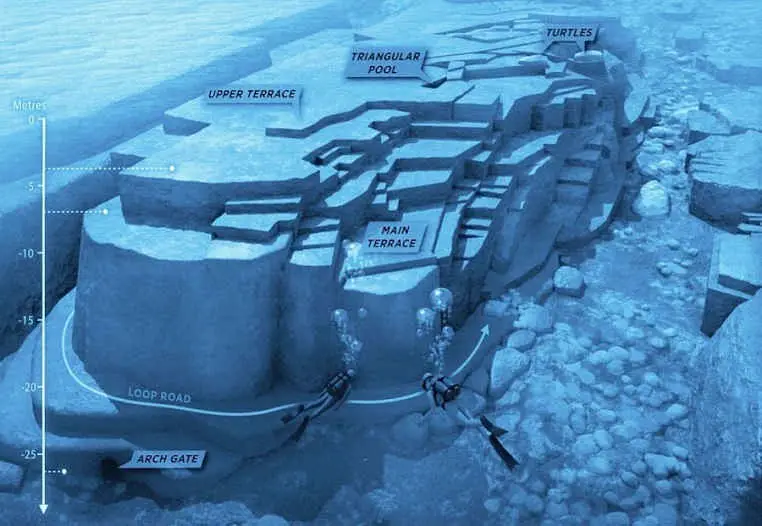
The ruins are located one kilometer from the island of Yonaguni, on the western part of Japan, south of the Ryukyu Islands.
This island is the westernmost of Japan. Its area is 28.88 square kilometers and it has about one thousand seven hundred and forty-five inhabitants.
The ruins are located at depths ranging from twenty-five to one hundred meters.
Theories surrounding the origins of Yonaguni
The origin of these monuments remains a mystery that intrigues archaeologists and scientists! But this monument is estimated by researchers to date back to 8,000 B.C.
On one hand, archaeologists and geologists believe it is merely a rock formation created by nature through the action of ocean currents over a long period of time.
A researcher from the University of Ryukyu named Takayuki Ogata believes that the structures are naturally formed because there are other similar formations on land.
Others argue that humans themselves created it due to the perfectly fitted geometric structures.
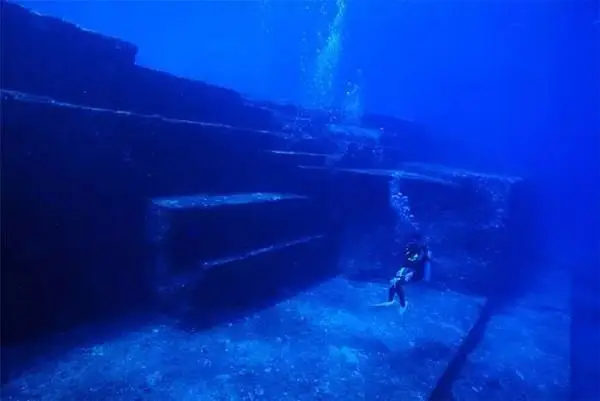
Other evidence suggesting the existence of an ancient civilization includes unknown writings on the walls, towering sculptures, staircases, roads, and ramps, which may indicate that people lived in a community.
The comparison is made with the Inca ruins located in Peru. The structure itself is very similar. These ruins are even among the most visited destinations on the continent.
In videos, divers also show the existence of channels that could have been used for water transportation.
Characteristics of the Yonaguni structure
The ruins are one hundred meters long and fifty meters wide. The highest point of the structure is approximately thirty meters. The main structure is over 150 meters long.
Writer Graham Hancock, author of several books on ancient constructions around the world, stated that there are specific and complex structures around the ruins that are inexplicable for modern man's understanding.
Therefore, significant investment and years of research are needed to gain insight into how all this emerged and its importance for us today.
Why is this finding ignored by the media?
Knowing exactly how these ruins came to be contradicts everything that is known about human history.
The oldest architectural complex is located in Sumer and is only seven thousand years old, while the pyramids of Egypt are four thousand years old.
If Yonaguni is indeed over eleven thousand years old, as many geologists estimate, it will significantly change the history of civilization as we know it today. This would mean revising everything we know about history.
The Japanese government also does not invest in scientific research related to the submerged pyramids nor recognizes it as a determining historical factor.
Dr. Masaaki Kimura claims that there may still be at least ten structures similar to Yonaguni to explore and understand more about how we arrived at our current place in human history.
Myths and legends behind Yonaguni
Since the Yonaguni ruins are a mystery, there are certainly many myths and stories surrounding them that may even be fanciful.
But as we are dealing with the unknown, it is impossible to know how much of it may be true or not. One of the legends says that these structures were built by aliens!
There are also others that say the island is located in a dangerous area with supernatural activities. Other legends speak of ships that disappeared in the region and were never found again.
What is your theory about how this structure came to be?





Community
Comments
0 comments
There are no published comments in this language yet.
Send comment