
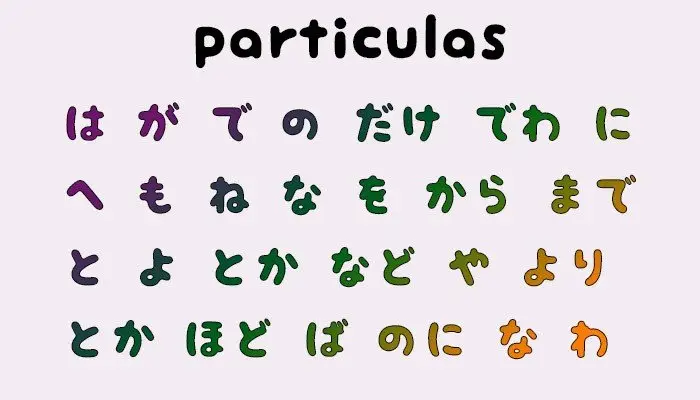
When we study Japanese, we learn that the particle wa [は] is the topic marker, ga [が] is the subject marker, wo [を] is the object marker, ni [に] and de [で] are location markers, and he [へ] is the direction marker. We use the particles を, に, and へ before verbs, but can we use the particles wa [は] and ga [が] with Japanese verbs?
In this article, we will understand when to use the particles wa [は] and ga [が] to mark verbs in the Japanese language. First, we must remember that Japanese grammar works with an SOV (subject-object-verb) system. With this in mind, let's analyze when to use the particles は and が before verbs or instead of particles like を.
One of the most obvious situations is when the sentence has no object, only a subject. Sentences like [I run] have absolutely no object to be indicated by the particle wo [を], because the subject is the object that is running. This is one of the situations where we can use は and が before the verb without fear of making a mistake.
If you have questions about when to use the particles, you can read our: What is the difference between the particle は(wa) and が(ga)

When to use ga [が] or wa [は] instead of wo [を]?
The particle [が] is often used instead of [を] when the verb is an abstract, mental, or non-physical action. This also happens when the verb is in the potential form, as it indicates that the action is possible and not a reality. Intransitive verbs also tend to use the particle が.
There is also a class of Japanese verbs (usually predicates) whose subjects and objects take が instead of を. These verbs often relate to conditions or occurrences that happen independently of human decision, will, or volition, such as understanding, necessity, or ability.
Some sentences in the table below represent well the use of the particle ga [が] before verbs in Japanese:
日本語 が分かる
Nihongo ga wakaru
I understand Japanese
肉が食べられない
Niku ga taberarenai
I cannot eat meat
In the case of the particle wa [は], we will rarely need to use it together with a specific verb. We will only use it in sentences where there are no objects and the subject is performing the action. In these cases, we can think that は can express contrast. Thus, we must decide between wa and ga according to the objectives of each of them.
Using を or が can change the meaning of the sentence
There are situations where が and を are interchangeable, but there are moments when one particle can completely change the meaning of the sentence. An example of a sentence where it doesn't matter whether to use wo or ga is ピアノ[を/が] 弾ける [piano_hikeru]. It doesn't matter which particle you use, the sentence will still mean I play the piano with the subject being implicit and piano being the object.
An example that shows how particles change the meaning of the sentence is in the phrase 魚が食べる [sakana ga taberu] which we can understand as the fish eat. If we swap が for を, it will mean to eat fish. The ga indicates that the fish is the subject and that it is performing the action of the verb. While wo indicates that the fish is the object that is being eaten.
Potential verbs that use the particle が tend to focus on the noun, while using を shifts the focus to the entire sentence. This can drastically change what we are trying to say. Of course, there are countless other situations we must be attentive to regarding the correct use of particles, but I hope this small article has helped to understand a bit.
We appreciate the comments and shares and recommend reading:




Community
Comments
0 comments
There are no published comments in this language yet.
Send comment