
Have you come across the word pantsu somewhere? Or the term panchira? Do you know what shimapan, misepan and panmoro mean? This article looks at these words and at the history of underwear in Japan.
Panchira is the Japanese word for a brief glimpse of a woman's panties, which are called pantsu. Shimapan, misepan and panmoro describe specific types of underwear or the situations in which they become visible.
These words appear constantly in anime, manga and everyday conversation, and their history says a lot about how underwear became ordinary in Japan. Their story runs from a department-store fire in 1932 to a 1969 television ad.
Contents 5
What pantsu means
The word pantsu (パンツ) comes from the English "pants". In American English, pants usually means trousers. In Japanese, pantsu is mainly used for underwear, whether panties or boxers.
English uses panties or knickers for women's underwear and underpants or briefs for men's. In Japanese, pantsu can also mean trousers, but in that case another word usually defines the garment.
Compounds such as ショートパンツ (shōto pantsu, shorts) and 海水パンツ (kaisui pantsu, swimming trunks) show how the same word changes meaning with a modifier. Depending on the context, pantsu can refer to shorts, culottes, trunks and other clothing worn on the lower body.

Striped panties are called shimapan (縞パン), and many other words specify a type of underwear. Pantsu itself carries no gender; the context or a modifier makes clear what kind of underwear is meant.
How underwear became common in Japan
Traditionally, Japanese women did not wear underwear under the kimono; some wore a zurōsu (ズロース), a kind of bloomer. Underwear is thought to have become common only after World War II, with Western influence.

There is a well-known story about the fire at the Shirokiya department store in Tokyo on December 16, 1932. According to the legend, some saleswomen died because they held their kimonos closed while climbing down ropes and lost their grip. The fire killed 14 people and injured 67. The historian Shōichi Inoue has questioned the story, arguing that most people were rescued by firefighters and that the detail about modesty was embellished for Western readers.
Newspapers at the time urged women to wear drawers, yet a survey by a Fukuoka newspaper in 1934 found that 90 percent of the women asked still did not wear them. Television programs and commercials later turned the lifted skirt into a familiar image. In 1969, an ad for the oil company Maruzen Sekiyū featured Rosa Ogawa in a miniskirt that blew up in the wind, and the image helped popularize the term panchira.
What panchira means
Panchira (パンチラ) is a portmanteau of "panty" and chira, the sound-symbolic word for a quick glance. It refers to the brief glimpse of a woman's underwear. Japanese women also use the term to warn a friend whose underwear is showing. It resembles the English word upskirt, but panchira assumes that underwear is actually visible.

The term appeared as underwear became common in Japan. A scene from The Seven Year Itch (1955), in which Marilyn Monroe's dress blows up over a subway grate, is often cited as the start of the panchira craze. According to Inoue, magazines of the period even published articles about the best places to catch a glimpse.
The idea of the fleeting look already had a name: chirarizumu (チラリズム), usually traced to actress Mitsuyo Asaka, whose stage performances in the 1950s made a brief reveal into a talking point. Censorship of explicit adult content in Japan gave the concealed glimpse a particular weight, and anime, manga and film turned it into a recurring visual language. The short school-uniform skirts common in Japan fit that habit.

Shimapan, misepan and panmoro
Shimapan (縞パン) means striped panties. The kanji 縞 means stripes, and pan is a shortening of pantsu. The classic version is white with sky blue horizontal stripes, and the pattern appears so often in anime and manga that it became a trope in its own right.
Misepan (見せパン) combines mise (見せ, "show") and pan. The word refers to underwear that is meant to be seen, usually shorts worn under a skirt so that nothing embarrassing shows when someone sits or moves. It can also describe underwear designed to look like panties in a scene.
Panmoro (パンモロ) combines pantsu and moro ("completely"). It describes the full view of the underwear, usually when a skirt flips up far enough to reveal it directly. Panchira is the glimpse, panmoro the unobstructed view.
Why I wrote about underwear
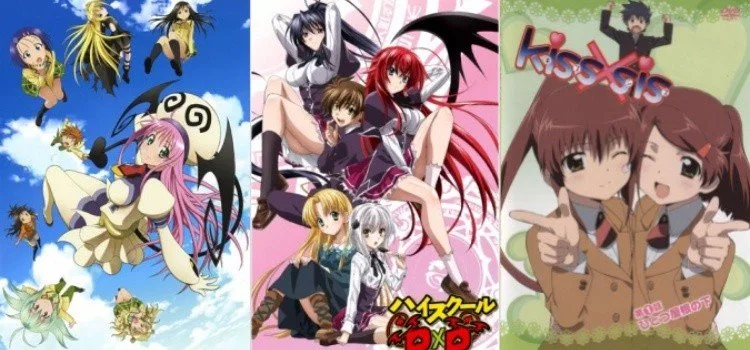
I started with an article about pantsu, and panchira came along because the word is at least as familiar to otaku. By the 2000s, when I was watching anime regularly, underwear appeared often enough that pantsu and panchira felt like part of the vocabulary of the medium.
The concern about secret photography is strong enough that Japanese carriers adopted a voluntary guideline in the early 2000s: phones and tablets sold for the Japanese market keep a camera shutter sound, even in silent mode. The rule comes from the Telecommunications Carriers Association, and manufacturers have followed it ever since. My iPad still clicks when I take a picture.
I wrote the article because these terms turn up all the time and many viewers recognize the scene but not the vocabulary. In Chobits, I heard the word pantsu more often than in any other anime, usually from Chi. The series also makes clear that pantsu can mean panties or boxers depending on the context, and it includes a panchira moment or two.
On a trip to Japan, I once sat across from a woman on a train. She smiled, and when she moved, her underwear was briefly visible. I still do not know whether it was intentional. Maybe it was a joke at my expense, maybe just an accident.
Pantsu, panchira, shimapan, misepan and panmoro: five words, one long story about a garment that was once unusual in Japan, became ordinary after the war, and then turned into a visual language in manga and anime. The next scene that uses one of them reads a little differently.

Community
Comments
0 comments
There are no published comments in this language yet.
Send comment