
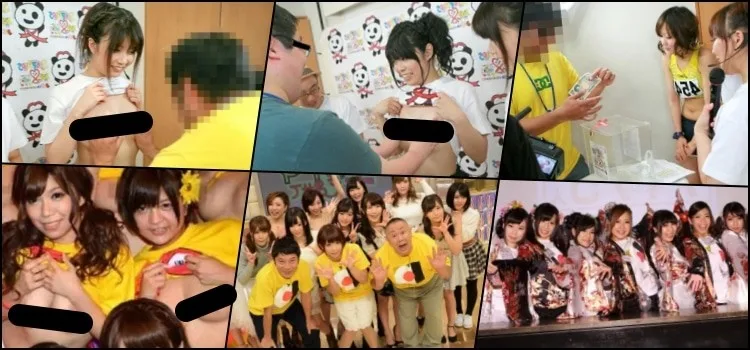
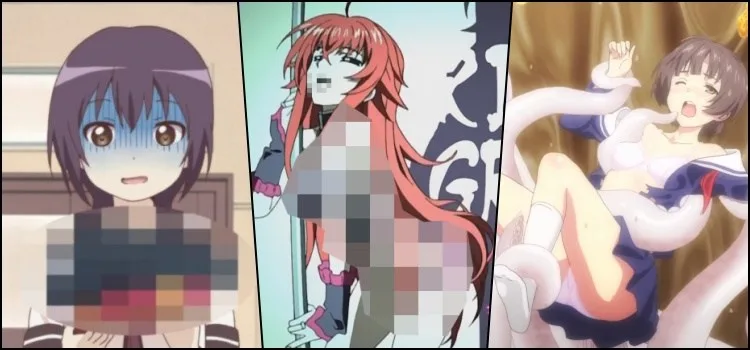
For some strange reason, any erotic and pornographic material officially released in Japan still has the genitals censored. Publishers simply leave pixels, bars, mosaics, and blurred squares over the intimate parts.
The breasts are one of the few things that usually escape Japanese censorship. In this article we will see why that law exists and what the industry does to get around it. Let's start by looking at how censorship began in Japan.
Contents 4
How did censorship in Japan begin?
To better understand why pornography is censored in Japan, we have to go back to the Meiji Restoration that began in 1868. Edo-period Japan had licensed pleasure quarters, shunga prints, and a public erotic culture that later moral campaigns tried to bury. The Tokugawa government already seized erotic books when it wanted to.
Sexuality sat closer to everyday life in many Edo settings, and prostitution was a regulated business. There were erotic religious stories and records involving samurai, geisha, and same-sex relationships.
In the push to modernize Japan, Meiji lawmakers borrowed a Victorian-style public morality that treated sexual images as a state problem. The 1880 Penal Code already punished the public sale of obscene material. Article 175 of the 1907 Penal Code kept that crime and is still the main rule: a person who distributes or publicly displays an obscene document, drawing, or other object can face up to two years in prison, a fine of up to 2.5 million yen, or both. In 2011 the Diet added electronic records and distribution over a network.
The statute never defines "obscene." Courts filled the gap. In 1957 the Supreme Court, in the Chatterley case, reused a three-part test: a work is obscene if it arouses sexual desire, offends a common sense of shame, and violates accepted sexual morals. In practice, visible genitals and, for a long stretch, pubic hair were treated as the dangerous details. Artists and publishers pulled back rather than risk a raid.
Before the Pacific War, censorship reached far beyond porn, into newspapers, political writing, and some nudity. After 1945 the Allied occupation wrote freedom of expression into Article 21 of the Constitution and dismantled the wartime propaganda offices. Occupation censors still watched the press, and Article 175 was left standing. By the late twentieth century, erotic films, magazines, and animation were selling widely, as long as the genitals stayed covered.
Bypassing Japan's censorship
Article 175 hits the sale and public display of an obscene object inside Japan. That is why uncensored Japanese works, especially hentai, used to be easier to find in the West than on a domestic shelf. In the 2000s those overseas copies were common. The window later narrowed, in part because domestic fans noticed the uncensored versions and stopped paying for the blurred ones at home.

To get around the rule, artists in the 1980s leaned on tentacles. Toshio Maeda, the mangaka behind Urotsukidōji, has said he used tentacles because they are creature limbs, so editors could argue they were creature body parts. That trick helped a wave of hentai filled with aliens, demons, and monsters, the same current that still feeds the question of why Japanese people like tentacles.
Until the early 1990s, pubic hair itself was often treated as obscene. Artists answered by drawing bodies with almost no hair, a visual habit that lingered in adult manga and anime even after magazines started showing hair more freely around 1991. The mosaic on genitals stayed.
Sex toys show up constantly in both hentai and live-action adult video, partly because a toy can carry the scene while the body stays under pixels. Japanese viewers have largely gotten used to the blur. Some commentators even argue that the bars and mosaics let a reader keep a little distance from the act, the same way many Western films will show sex as long as the genitals stay out of frame. Japanese directors still have a long list of ways to keep a scene erotic without breaking the rule.

Japanese censorship gave rise to other fetishes
Japan is known for a huge range of fetishes, and genital mosaics are one reason the camera has to linger somewhere else. If official films and anime cannot show genitals clearly, they load attention onto clothing, thighs, faces, and props.
That is how a glance at the skin between a miniskirt and knee-high socks picked up a name of its own, Zettai Ryouiki, the "absolute territory." Foot close-ups, long clothing play, and delayed sex scenes also come from what the frame can still sell.
Bukkake and exaggerated squirting shots became easy to read on camera for the same reason: the visible fluid does the work the mosaic denies to the genitals. Costumes and role-play eat minutes of a Japanese adult video because fabric, curves, and posing stay legal to show in detail.
Faces took on the same job. The over-the-top climax look called ahegao turns the expression into the peak the mosaic hides. A glimpse of pantsu or an uncensored breast has to carry more weight than it would in an uncensored Western video.
Even with that law, Japan still runs a large commercial adult-video industry, with a domestic pipeline from rental shops to streaming that never needed to copy American gonzo. The mosaic is the price of selling that catalog in Japanese shops and on Japanese sites.
Is censorship really that bad?
The same pressure that frustrates overseas viewers also pushes authors to invent. When the genitals cannot be the whole show, the story, the costume, the monster, or the face has to do more work. Censored hentai often reads closer to a long fantasy than to a close-up of anatomy.
Publishers still get arrested when the mosaic is too thin, as in the 2004 Misshitsu manga trial and the 2013 Core Magazine case. The blur is an industry custom built on court tests. The statute never names mosaics. For a reader inside Japan, the mosaic is simply how legal adult media looks. For a reader outside, it is the strange signature of a 1907 crime that the country never repealed.




Community
Comments
0 comments
There are no published comments in this language yet.
Send comment