

Have you ever wondered why the Japan national team plays in blue? The flag of Japan is red and white, and blue appears nowhere in it. The color dates from 1930, when Japan assembled its first national squad from across the country for the Far Eastern Championship Games in Tokyo and dressed it in light blue. A university connection, a famous comeback in Berlin and a fan vote in 2005 explain how that choice became the Samurai Blue identity.
Japan is one of several teams whose colors do not match the flag. The Netherlands play in orange for the House of Orange, and Italy wear azzurro, a blue tied to the House of Savoy. Japan's blue has a different origin, and the Japan Football Association (JFA) has documents that trace it to a specific tournament.
Contents 3
Why did Japan choose blue in 1930?
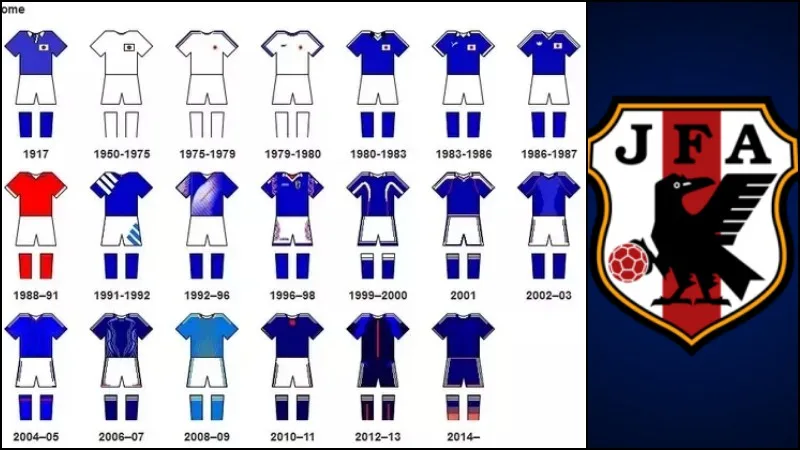
Japan's first international match, in 1917, was played in the wine-red shirt of Tokyo Higher Normal School, the school that represented the country at that tournament. Before 1930, a domestic qualifying tournament decided which team would play for Japan, and the players wore that team's kit. Blue only became the national team's color in 1930.
The 1930 Far Eastern Championship Games were held in Tokyo, and the JFA used the event to form a team drawn from across the country. It selected players from several universities and clubs and made a new light blue shirt. Twelve of the players came from Tokyo Imperial University, now the University of Tokyo, whose own shirt was light blue. That coincidence is the root of the most popular explanation.
The JFA's records present two possibilities. One is practical: the national team borrowed the color of the university that supplied so many players. The other comes from a manuscript by Tanabe Gohei, then vice-president of the JFA. In Fukushokukō (服色考), he wrote that the uniform color was fixed for the first time at the 1930 tournament in Tokyo. Because Japan is surrounded by the sea, he explained, the shirt around the flag was seen as the sea, and the color became blue.
The JFA notes that no document proves the university theory. The sea explanation survives because Tanabe wrote it down. I find the two compatible: the sea gave the choice a meaning, and the university gave it a convenient color. The exact reason is still unknown, which is why the story invites so many versions.
The 1936 Berlin Olympics produced one of the color's most famous matches. Japan trailed Sweden 0-2, came back to win 3-2 and reached the quarterfinal, where Italy beat Japan 0-8. The comeback is known in Japan as the Miracle of Berlin. Kawamoto Taizo scored the first goal of the comeback. The team wore a darker blue than in 1930.

Where does the name Samurai Blue come from?
The name is much newer than the shirt. In October 2005, the JFA held a public vote on five candidate slogans for the 2006 World Cup. "SAMURAI BLUE 2006" won with more than twice the votes of the next option, and the JFA announced the result on January 27, 2006. On October 19, 2009, "SAMURAI BLUE" became the official nickname of the national team. English media often call the team Blue Samurai.
The name joins two ideas: the samurai image Japan already had abroad, and the blue shirt. The 1936 match did not create it. My reading is simple: a country famous for samurai, a team dressed in blue. The name makes sense as a modern label; the 1936 game explains why the color feels lucky.
Blue has been the main color, though Japan has worn others. The 1964 Olympic team played in all white, and the 1968 team wore white shirts. In 1988, coach Kenzo Yokoyama changed the shirt to red and white, the colors of the flag, following the example of European teams. The JFA emblem with the three-legged crow went on the chest at the same time. Japan missed the 1990 World Cup, and in 1992, under Hans Ooft, the team returned to blue. The 1992 Asian Cup, Japan's first, was won in blue. The J. League, founded in 1993, gave Japanese players a professional stage; Japan reached its first World Cup in 1998.
The women's team has a name of its own. Nadeshiko Japan takes its name from Yamato nadeshiko, the old ideal of the Japanese woman. Nadeshiko is a flowering plant in the Dianthus genus, part of the carnation family. The team plays in blue like the men, with pink accents in some kits. Their passing game at the 2011 World Cup, which Japan won, drew comparisons with Barcelona. The nickname came from the language and the national image; the Barcelona comparison came from the way they played.
What does the three-legged crow have to do with the shirt?
The emblem on Japan's shirt shows a three-legged crow. The bird is Yatagarasu (八咫烏), a figure from Japanese mythology. According to the Kojiki and other early texts, it guided Emperor Jimmu through the Kumano region. It is also described as a messenger of the Kumano deities. In Japanese football, the crow is the emblem of the JFA, not a national symbol like the flag.
The emblem and the blue shirt have been worn together for decades. The crow went on the chest in 1988, when the shirt turned red. It stayed when blue returned in 1992. The shirt came first, the symbol later, the nickname later still.
Some fans read the crow as a lucky sign for the blue shirt. The JFA's own history does not make that claim. The crow stands for guidance and good fortune in the mythology, and the blue stands for the sea in Tanabe's note. The combination works as symbolism, even if no document says the two were designed together.
So why does Japan play in blue? The best answer is 1930: a new national team, a light blue shirt and a university link whose role the JFA cannot prove. The 1936 comeback made the color memorable, the 1988 red experiment showed that the color could change, and the 2005 vote gave it a name. The flag remains red and white, and the blue shirt has become part of the same identity. If you know another version of the story, especially one tied to a school, a club or a family memory, I would like to hear it.






Community
Comments
0 comments
There are no published comments in this language yet.
Send comment