
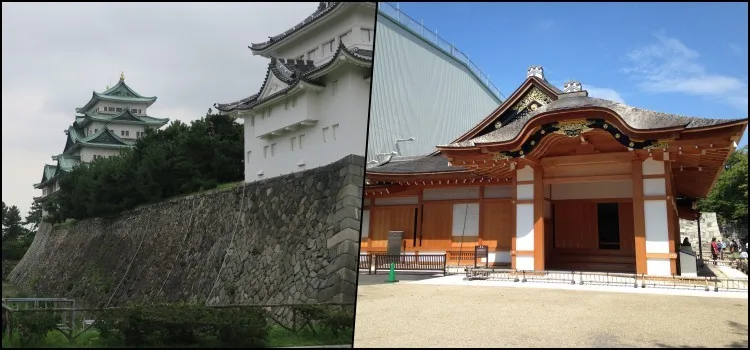
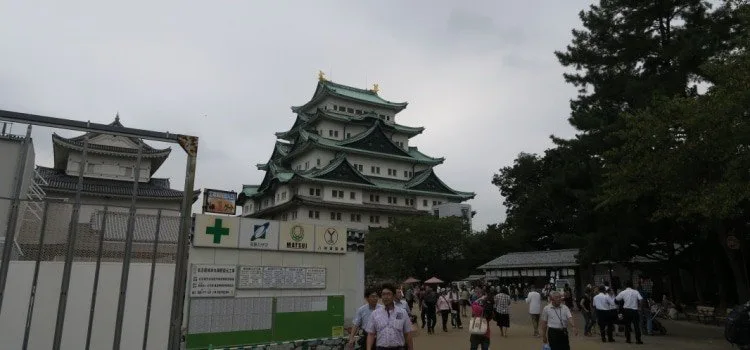
The postcard of Nagoya Castle is always the keep: white walls, green copper roofs, two gold Kinshachi on the ridge. Older write-ups still send you up five floors to stand beside them.
That climb has been off-limits since May 7, 2018. A 500-yen ticket still gets you through the gates. The rooms worth slowing down for sit in the Hommaru Palace, rebuilt in wood after the 1945 fires — not in the concrete tower you photograph from the garden.
Contents 8
History of Nagoya Castle
The fortress visitors walk today is Tokugawa Ieyasu's project. After Sekigahara, he ordered a new castle in Owari in 1610 and put former enemy daimyo to work on the stone. The main keep was finished in 1612. The Hommaru Palace, residence and government hall of the Owari Tokugawa, was completed in 1615. For about 260 years the site was the seat of that house. People from the castle town of Kiyosu were moved here, and that forced relocation is how modern Nagoya took shape.
An older castle stood on what is now the Ninomaru. Castle materials say Oda Nobunaga lived there until 1555. That earlier Nagoya — written with different characters — is not the 1610 keep, and the two should not be collapsed into one origin story.
Like many Japanese castles, Nagoya Castle burned in the air raids of 1945: keep, palace, and the original Kinshachi. Residents funded a steel-reinforced concrete rebuild of the keep in 1959, matching the old silhouette with a museum inside. The Hommaru Palace was reconstructed in wood from Edo-period drawings and photographs and opened to the public in 2018. Himeji Castle still has its original wooden keep; Nagoya does not. What you see from the moat is the postwar tower.
Highlights of Nagoya Castle
Golden Kinshachi
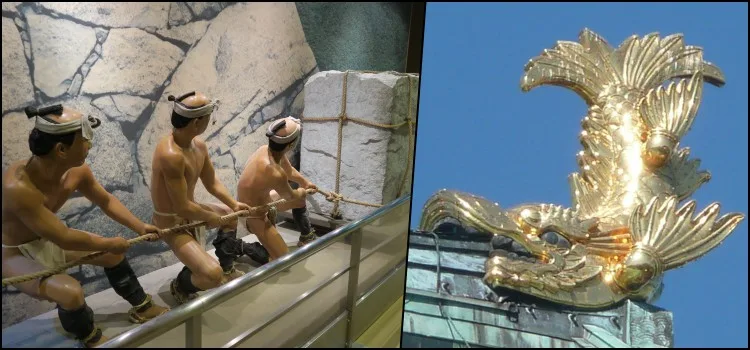
The pair of Kinshachi on the keep are tiger-headed carp — shachihoko — not dolphins, even if tourist English still uses that nickname. They stand for protection against fire. The male on the north side is 2.621 meters tall and weighs 1,272 kilograms; the female on the south is 2.579 meters and 1,215 kilograms. Their scales are covered in 18-karat gold. You photograph them from the grounds. You do not stand next to them on a fifth-floor deck.
Hommaru Palace
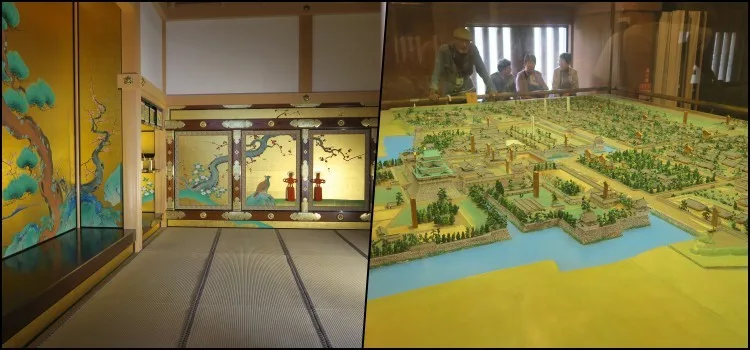
The Hommaru Palace is the indoor visit that still happens. Completed in 1615 as the official residence and offices of the Owari Tokugawa, it was among the first castle buildings designated a National Treasure, then destroyed in 1945. The 2018 rebuild used surviving floor plans and painted screens stored in the Nogi-soko storehouse during the war. Entry is included in the castle ticket; there is no second fee. Last admission is 4:00 p.m., and the walk from the Main Gate or East Gate takes about ten minutes. Arriving at the castle gate at 4:00 p.m. is how people miss it.
Kaya-no-Ki tree and Kiyomasa Stone
On the grounds stands the castle's kaya tree, a National Natural Monument thought to be more than 600 years old. Its nuts were considered auspicious food for the Owari lords. Nearby, the largest stone in the walls is the Kiyomasa Stone, named for Kato Kiyomasa, the castle builder who, legend says, brought it to Nagoya. The walls themselves carry the carved marks of the 20 daimyo ordered to supply stone.
Gardens and gates
The Ninomaru gardens north of the old residential precinct were, in their day, Japan's largest garden attached to a lord's living quarters. Restored gates and corner watchtowers (yagura) still ring the Hommaru. Several of those towers are Important Cultural Properties and are usually closed on the inside; they still give the stone platform its silhouette.
The keep you photograph from outside
The 1959 keep is currently closed. Official castle pages cite age and earthquake resistance. Nagoya City is planning a wooden reconstruction of the towers; those pages do not currently give a year when the interior will reopen. Plan the visit around the palace, the walls, and a keep you see from outside.
The old floor-by-floor museum — armor on one level, a city model on another, an observation deck at the top — is not a tour you can take today. Some of that material still appears in displays around the grounds and in the palace area. Do not budget time for a tower climb.
Hours, tickets, and how to get there
Nagoya Castle is open from 9:00 a.m. to 4:30 p.m. Last entrance to the castle is 4:00 p.m. Last admission to the Hommaru Palace and the Nishinomaru Okura Museum is also 4:00 p.m. The grounds close December 29 through January 1.
| Ticket | Through September 30, 2026 | From October 1, 2026 |
|---|---|---|
| Adult | 500 yen | 1,000 yen |
| Nagoya City senior (handbook required) | 100 yen | 300 yen |
| Junior high and younger | Free | Free |
| Tokugawaen combination (adult) | 640 yen | 1,040 yen |
Tickets bought before the change remain valid. Junior-high students and younger stay free either side of the date. Cash, credit cards, and transit IC cards are accepted at the ticket window. The Tokugawaen combination ticket is cash only.
The closest subway stop is Nagoyajo (M07) on the Meijo Line, a short walk to the East Gate. Some older English maps still print the former name, Shiyakusho; look for 名古屋城 on the Meijo Line. The Me-guru sightseeing bus stops at the Main Gate. From Nagoya Station, the subway is usually simpler than driving: paid parking at the Main Gate is 250 yen per 30 minutes for a standard car.
If you have a half-day in Nagoya, go to the palace first, then loop the walls for the Kinshachi and the Kiyomasa Stone. The keep still dominates every photograph. It just is not a building you enter.



Community
Comments
0 comments
There are no published comments in this language yet.
Send comment