

Thanks to Western movies, we inherited a rather black-and-white feud: noble samurai on one side, silent killers in black on the other. The split looks clean on a poster. It does not survive the first page of a war chronicle.
The word that actually shows up in period Japanese is shinobi (忍び): someone who hides, endures, and — in wartime — slips into a castle to see what the enemy is eating. Hollywood kept the mask. Japan kept the job description.
They differed in weaponry, combat, clothing, and the moral code later attached to the warrior estate. They also worked the same wars. Samurai were soldiers of a lord or a shogun. Shinobi were hired — sometimes from the same social world — to gather intelligence, start fires, and, when the contract demanded it, kill.
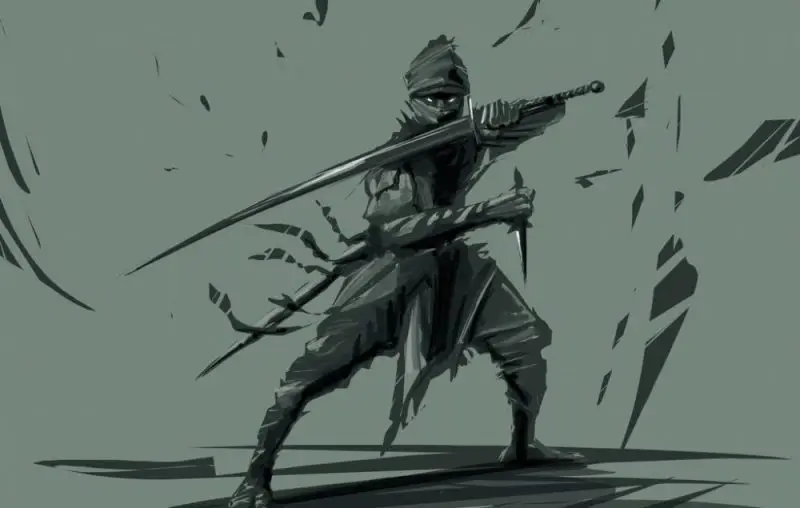
Because of those myths, some people still treat ninjas as a cartoon that never happened. The craft is documented across centuries of Japanese warfare. The problem is not existence. It is the costume the stories put on it.
Contents 5
Were ninjas evil assassins?
Myth! Ninjas were not evil assassins who killed at will. That is still the most widespread story about them. In films they drop from the rafters to chop up the heroes. In the record, their main work is closer to reconnaissance: terrain, food stores, passwords, the layout of a castle.
Assassination existed as a tool, not as a personality. A spy who leaves a trail of bodies is a loud spy. Later schools of ninjutsu often frame combat in a blunt order: escape if you can; if you cannot, you finish the fight. That is survival talk, not a license to hunt for sport.
The ninja (忍者) is often called shinobi (忍び) in Japanese. The verb shinobu is to hide, to steal away, to endure. It is a job description more than a bloodline — which is why the next myth, the one about a separate caste of “evil mercenaries” fighting samurai as a class, falls apart as soon as you look at Iga and Kōka.
Where did historical shinobi actually come from?
The districts that stuck to the name are Iga, in today’s Mie Prefecture, and neighboring Kōka (often written Kōga) in Shiga. Mountain country, close enough to Kyoto to hear the news, far enough for a lord’s authority to thin out. Local jizamurai — landed warriors who also farmed — formed leagues, sold guerrilla and intelligence work to nearby daimyō, and became the people later called shinobi.
The fourteenth-century war epic Taiheiki already uses shinobi for agents who slip in at night and set fires. A Jesuit Japanese–Portuguese dictionary printed in Nagasaki in 1603 defines xinobi as a wartime spy who enters a castle by night or infiltrates enemy ranks for intelligence. That is not a comic-book assassin. It is a military job.
The manuals everyone quotes — the Bansenshūkai (1676) and the Shōninki (1681) — were compiled in peacetime, after the Sengoku wars, so they mix field craft with later philosophy. They are still the closest thing to a handbook: disguise, tools, weather, breaking in, and how not to get caught. They are not proof of magic, flying, or an 800-year super-school with a single uniform.
Were all ninjas men?
Myth! The Western default is a man in a black mask. Popular culture filled the gap with the kunoichi, a female ninja who seduces, poisons, and disappears. The kanji joke is real and worth keeping: kunoichi (くノ一) can be read as the three strokes of the character for woman (女). The history under the joke is thinner.
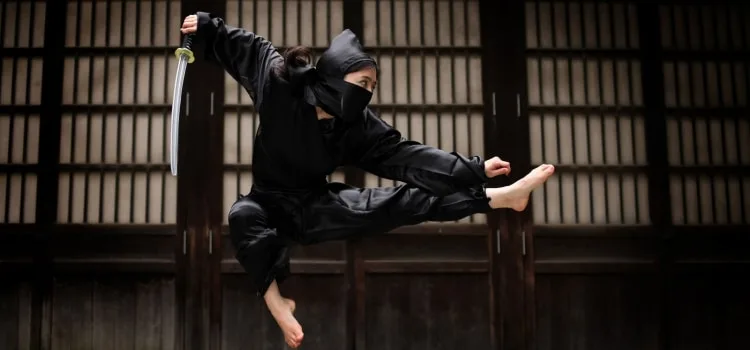
In the Bansenshūkai, kunoichi-no-jutsu is the technique of using a woman — a servant, a lady-in-waiting, someone who can walk into rooms a man cannot — to gather talk and open a door. Historians at Mie University have argued there is no solid record of women trained as field shinobi the way men from Iga and Kōka were. The female assassin corps is largely a twentieth-century invention, boosted by novels such as Futaro Yamada’s ninja fiction.
That does not mean women never carried messages or listened in kitchens. It means the garrote-and-distress-damsel routine belongs to cinema, not to a documented school of “lady ninja.”
Is the ninja uniform a black outfit and mask?
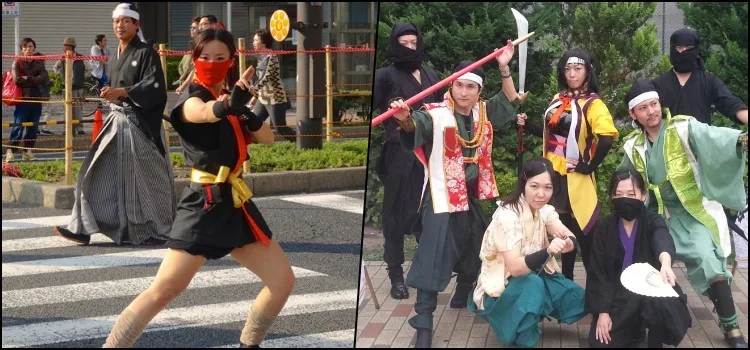
Myth! They dressed for the job. Infiltrating a compound meant looking like the people already inside: a porter, a monk, a craftsman, a retainer. Night work favored dark clothes that disappeared into shadow. Snow work favored white. There was no franchise uniform.
So when do we get the black hood? Kabuki. Stagehands called kuroko wear black so the audience agrees to treat them as invisible. Dress a killer in the same black and a character can “die from nowhere.” The look stuck, then movies exported it. Deep black also throws a hard silhouette in moonlight; dark indigo farmer’s cloth disappears better at night than costume black.
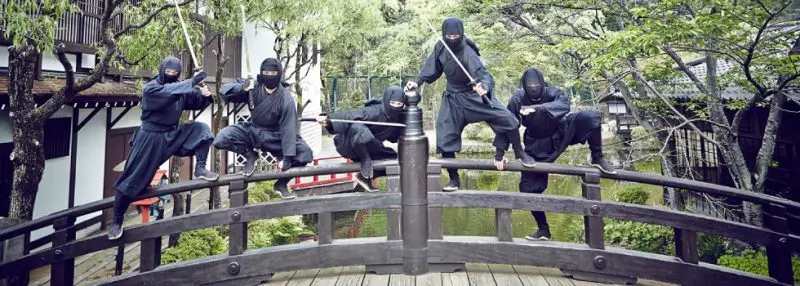
The same logic wrecks the smoke-bomb teleport. Distraction was practical: a shuriken, sand in the eyes, a fire in the wrong courtyard. They ran like other humans. They did not hop three-meter walls because the script needed a stunt.
Did ninjas only use shurikens and swords?
Bladed tools were in the kit. They were not the religion. Depending on the night, a shinobi used whatever was already in the room: a sickle, a ladder, a lantern stolen from the enemy’s crest, a climbing hook, a bag of caltrops. The point of ninjutsu, in the old sense, is discretion and getting home with the information.
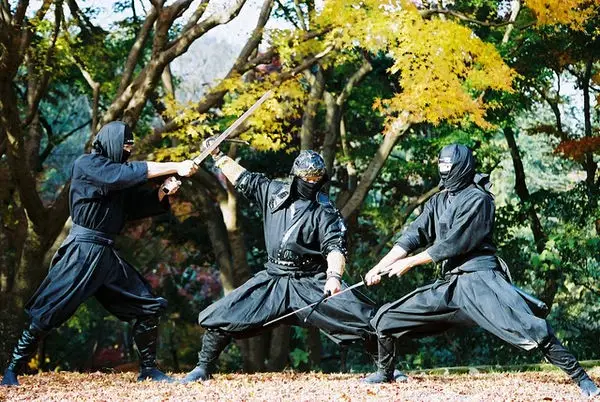
Historical manuals spend as much ink on disguise, explosives, geography, and weather as on swords. Modern martial-arts schools later packed that inheritance into a wide curriculum — hand-to-hand, spear, naginata, kusarigama, horsemanship. That is a living art, not a documentary of 1560. Cinema still shows maybe a tenth of the job, and it is usually the loud tenth.
If the black-and-white feud still feels true, it is because theater needed a foil for the samurai. The shinobi of Iga and Kōka were not that foil. They were the people you hired when the map of the enemy castle mattered more than a duel in the courtyard.

Community
Comments
0 comments
There are no published comments in this language yet.
Send comment