
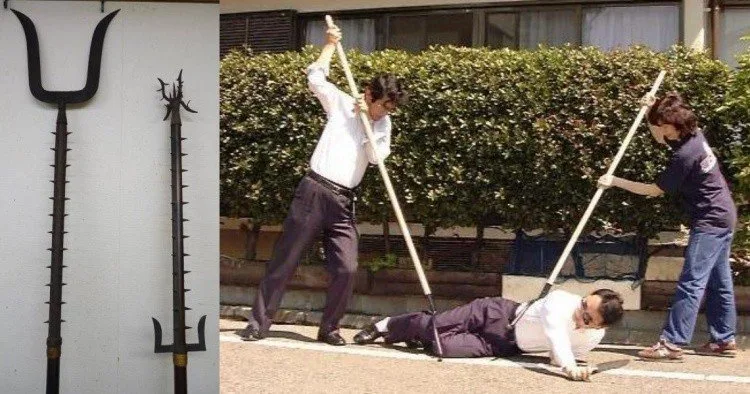
The Sasumata (刺股) is a forked polearm from feudal Japan, developed to immobilize adversaries without seriously injuring them. Used by samurai and later by the police, it was part of a trio of non-lethal weapons alongside the Tsukubo and the Sodegarami. Its design combines a long staff with two forward-pointing prongs and lateral crossbars, which prevent the target from grabbing the weapon or pushing past it.
Although it dates back to the shogunate era, the Sasumata is still present in modern Japan, especially in schools and public facilities, where it is used to safely restrain intruders.
Contents 9
What is a Sasumata?
The Sasumata is a dedicated distance and control weapon, not a cutting tool. A trained user stays several steps away from the target and uses the fork to pin the torso or shoulders, keeping the aggressor at arm's length. The staff was long enough in feudal Japan to hold an armed samurai at a safe distance, which is why the weapon is closely tied to the tradition of non-lethal confrontation in Japanese martial culture.
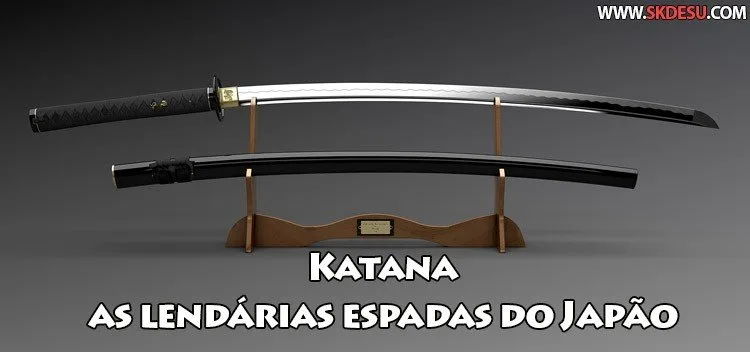
The name itself spells out the function: 刺 (sa, "to pin, to intercept") and 股 (mata, "thigh, fork"). It is built to catch and hold, not to slash, which sets the Sasumata apart from cutting and thrusting weapons like the katana or the yari.
Design and function
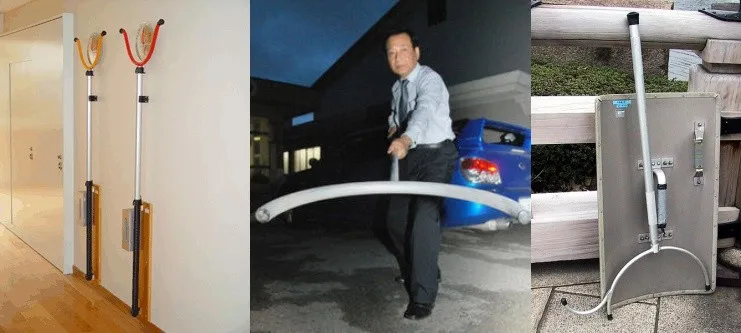
A typical Sasumata has three parts: a long wooden or metal shaft, a U-shaped fork with two prongs at the front, and lateral crossbars or spikes that block the target's hands. Once the fork is set, the aggressor can no longer lunge forward, reach a knife, or grab the staff.
Modern versions are often made of aluminum rather than wood, the prongs are blunt, and the whole construction is lighter than historical examples. The goal is no longer combat but a fast, controlled hold until the police arrive.
History and use
The Sasumata emerged during the height of the shogunate, when non-lethal weapons were needed to subdue rioters, unarmed attackers, or deserters without killing them. Three such weapons formed a standard set that police and city guards switched between depending on the situation:
- Tsukubo - a striking rod with a heavy iron head, used to stun the aggressor or knock them off balance.
- Sodegarami - a pole with a chain or net at the tip, used to entangle the opponent's sleeves or sword.
- Sasumata - the forked staff, used to pin the aggressor's body at a distance.
Together they were known as the "Three Great Peaceful Weapons" and were carried by police units, town guards, and temple administrators. Samurai used them when a target had to be taken alive - to question a prisoner, end a hostage situation, or settle a dispute among retainers.
From feudal police to modern times
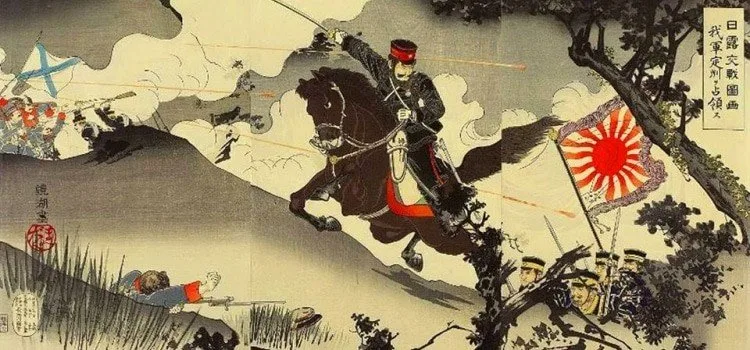
When the shogunate ended in the nineteenth century, the Sasumata briefly fell out of use. Early in the twentieth century, the Japanese police reintroduced similar equipment for crowd control, especially at demonstrations and festivals with high alcohol consumption, where the priority was to minimize injuries.
That logic still shapes modern policing. The Sasumata-style pole carried by officers today is a visible, non-cutting tool that signals de-escalation while still giving the officer a clear way to intervene.
Sasumata in Japanese schools
Japan has a very low rate of firearm violence by international standards, but knife attacks at schools and train stations make the news often enough to keep safety planning active. With that in mind, many schools keep a Sasumata as part of their emergency kit, alongside protective shields and basic restraint materials.
The reasoning is practical: in countries where firearms are rare, knives are the most common attack weapon. A forked staff keeps the aggressor at a distance without slashing, and gives staff time to move students to safety and call the police.
School and station equipment
The pole is usually stored together with a protective shield, in the staff room or a locked security cabinet. In an emergency, a pre-assigned team takes the shield and the Sasumata, forms a line, and drives the intruder back until the police take over.
Hospitals, community centers, and larger train stations also keep Sasumatas on hand. In places with high foot traffic, the visible presence of the pole sends a clear message: no shooting here, just containment.
Real cases: defense with the Sasumata
Several well-known incidents in recent years show the pole working in real conditions. In Aichi, a 62-year-old man armed with a knife entered a school in Ichinomiya. Three teachers used Sasumatas to pin him at a safe distance and hand him over to police, before any injuries occurred.
A similar case took place in Tokyo, where three teachers restrained an armed intruder with the same tool. According to the principal, the staff had completed a dedicated Sasumata training course beforehand, which allowed a fast and coordinated response.
These incidents are not proof that weapons in schools are a good idea, but they do show that non-lethal tools can serve as a realistic stopgap in a country with low firearm rates, until the police arrive.
Technique and training
The basic technique is easy to describe but hard to master: two people work together, one handling the Sasumata and the other the shield. The pole is set from below or from the side, the fork locks around the torso, and the shield covers the other flank. Once the aggressor is pinned, staff use restraints or simple body pressure to keep them on the ground until the police take over.
Schools and local communities rehearse the procedure regularly, often only a few times a year. Teachers practice opening the cabinet quickly, forming a line, setting the fork without hurting the aggressor, and coordinating with the police. Three training sequences documented online are embedded below.
Limits of the weapon
The Sasumata is no silver bullet. It only works when staff have trained in advance, when several people can move in a coordinated way, and when police can arrive within a few minutes. In rural areas with long response times, the time window remains the biggest problem. Those are exactly the schools that also lean on locked doors, emergency alert systems, and regular evacuation drills.
Readers curious about the everyday life of the samurai will find more context in that piece. And anyone interested in the related non-lethal weapons can see Tsukubo and Sodegarami in museums dedicated to the history of the Japanese police, such as the Samurai Museum in Tokyo.

Community
Comments
0 comments
There are no published comments in this language yet.
Send comment