
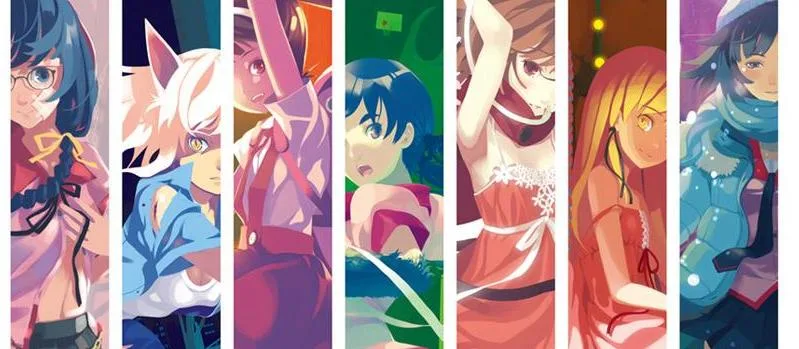
Who doesn't know—or at least has heard of—the Monogatari series? For many people, the terror of those full-screen text cards in the middle of a scene is etched into the soul (guilty as charged). Sometimes you spend more time pausing to read the on-screen wordplay than watching the action itself.
Still, the series has a strong story and a cast that sticks. What throws newcomers is the timeline: the anime rarely walks in straight chronological order, and that can feel uncomfortable until the arcs start locking into place.
And just to put it on the record—the most famous nekomata in anime, in my book, is Hanekawa. The same classmate the protagonist keeps circling around, to the everlasting frustration of a good chunk of the fandom.
Contents 19
What is the Monogatari series?
The Monogatari anime comes from a light novel series written by Nisio Isin and illustrated by Vofan. The first novel volume, Bakemonogatari, hit Japanese shelves in November 2006 under Kodansha Box.
Success led to the first anime adaptation on July 3, 2009—produced by Shaft. That first run had 15 episodes: 12 on television and the last three released online. It did not look like a “safe” hit on paper, but the franchise kept expanding with more seasons, short films, ONAs, and movies.
Titles share the -monogatari suffix (“story”), and each installment usually focuses on a different girl, oddity, or slice of Koyomi Araragi’s strange high-school life. Below is a practical map of the animated adaptations so far—and two sensible ways to watch them.
How to watch Monogatari (two solid routes)
There is no single “official” path that every fan agrees on. For a first watch, most people pick one of these two routes and stick to it.
Novel / author-friendly order (closer to how Nisio Isin released the books; places Kizumonogatari early):
- Bakemonogatari
- Kizumonogatari (film trilogy)
- Nisemonogatari
- Nekomonogatari Black
- Monogatari Series: Second Season (with Hanamonogatari slotted after the Mayoi Jiangshi arc if you want novel placement)
- Tsukimonogatari
- Koyomimonogatari
- Owarimonogatari I & II
- Zoku Owarimonogatari
- Monogatari Series: Off & Monster Season (and later batches as they air)
Anime broadcast order (how many viewers met the series as it came out; Kizumonogatari arrives late as a “missing origin”):
- Bakemonogatari → Nisemonogatari → Nekomonogatari Black
- Monogatari Series: Second Season → Hanamonogatari
- Tsukimonogatari → Owarimonogatari I
- Kizumonogatari (films) → Koyomimonogatari → Owarimonogatari II → Zoku Owarimonogatari
- Off & Monster Season
Pure chronological order exists, but it chops seasons into pieces and is better as a rewatch experiment than a first run.
1. Bakemonogatari (2009)
Released July 3, 2009—the first anime adaptation. Twelve episodes aired on Japanese TV; the last three arrived online later (complete the full 15 if you can).
The story follows Koyomi Araragi, a third-year high school student who is still dealing with vampirism. One day the withdrawn Hitagi Senjougahara falls into his arms on a staircase—and seems to weigh almost nothing, light as a feather. She threatens him to stay quiet; he ignores that and offers help instead. From there the series opens into other girls and “oddities” tied to trauma, secrecy, and Japanese folklore imagery.
2. Nisemonogatari (2012)
Picks up after Bakemonogatari. The focus shifts to Koyomi’s younger sisters, Karen and Tsukihi, and the oddities around them—especially the Karen Bee and Tsukihi Phoenix arcs. Con artists, family chaos, and more folklore-tinged trouble enter the frame, while Hitagi remains a sharp presence in Koyomi’s life.
3. Nekomonogatari (Black) (2012)
A prequel set before Bakemonogatari. After daily life with his sisters, Koyomi runs into classmate Tsubasa Hanekawa, bandaged and exhausted. What follows is her possession by a cat oddity and a much darker look at the “best girl” many fans already think they know.
4. Nekomonogatari (White) (2013)
Opens Monogatari Series: Second Season and the second school semester. Tsubasa faces a white-tiger spirit and a house fire; with Hitagi’s help she digs into whether the two disasters are connected—and how much of her old “Black Hanekawa” self is still in play.
5. Kabukimonogatari (2013)
Last day of summer vacation. Koyomi looks for Mayoi and crosses paths with Yotsugi Ononoki. Homework pressure and a reckless idea lead him and Shinobu through a time portal—aiming for one day back, landing about eleven years earlier instead.
6. Otorimonogatari (2013)
Centered on Nadeko Sengoku as her body and identity twist under a snake-goddess path. The cour opens with high-stakes confrontation energy (including Shinobu and Koyomi in the crossfire) before rewinding to the days that got her there—Halloween and the choices that followed.
7. Onimonogatari (2013)
Continues threads from Kabukimonogatari. Back in the present, Koyomi returns Mayoi’s backpack, but a darkness Shinobu last saw centuries ago begins to stalk the city. If nothing is done, the threat is not personal drama—it is catastrophe.
8. Koimonogatari (2013)
New Year’s. Hitagi calls the con man Kaiki Deishuu and forces him into a job he would rather refuse. Blackmail, old scams, and loyalty collide as the Second Season’s “Hitagi End” line of the story tightens.
9. Hanamonogatari (2014)
With Koyomi’s generation graduating, the camera stays on Suruga Kanbaru in her third year. Her monstrous left hand and a campus “devil” rumor pull her into a story that is less Araragi-centric and more about the debt she still carries.
10. Tsukimonogatari (2014)
Valentine’s Day chatter with Karen and Tsukihi gives way to a hard fact: after a bath, Koyomi has no reflection. His vampire side is winning again, and the experts around him—including Ononoki—stop treating it as a joke.
11. Owarimonogatari I (2015)
Koyomi’s path crosses Ougi Oshino more directly. Bizarre classrooms, buried memories, and “formula” mysteries force him to face what he has been avoiding while the Final Season machinery starts to turn.
12. Koyomimonogatari (2016)
A short-episode ONA of side cases. It jumps around the timeline—often between or during other arcs—opening with Koyomi and Tsubasa finding a strange stone in the school garden and then spinning through smaller oddities that color the bigger series.
13. Owarimonogatari II (2017)
The Final Season escalates: death, hell, Mayoi’s guidance, and choices about what Koyomi is willing to become again. It is denser and more conclusive than the early cour, so it lands best after Owarimonogatari I (and, depending on your route, after Kizumonogatari).
14. Kizumonogatari (films, 2016–2017)
Three theatrical films adapt the prequel novel of the same name—the spring break when Koyomi first meets the legendary vampire Kiss-shot Acerola-orion Heart-under-blade (later Shinobu) and is dragged into vampirism. Parts: Tekketsu, Nekketsu, and Reiketsu. A compilation recut, Kizumonogatari -Koyomi Vamp-, also exists for a single-sitting version.
In broadcast order the films arrive late; in novel order many fans place them right after Bakemonogatari. Either way, they are the origin of the vampire problem the whole franchise keeps chewing on.
15. Zoku Owarimonogatari (2018–2019)
Once announced as “coming soon,” Zoku Owarimonogatari is long out: a theatrical special in 2018 with a six-episode TV broadcast in 2019. It continues after Owarimonogatari’s climax rather than serving as a soft reboot—mirror worlds, residual mysteries, and the aftertaste of the Final Season.
16. Monogatari Series: Off & Monster Season (2024–)
Shaft returned with an adaptation of Off Season and Monster Season material. A first batch of 14 episodes aired from July to October 2024 (arcs such as Orokamonogatari / Tsukihi Undo, Nademonogatari, Wazamonogatari, and Shinobumonogatari among the early stretch), licensed internationally with Crunchyroll carrying the series in many regions. Further Off & Monster episodes have been announced beyond that first wave, so the list is still growing.
Off Season novels fill gaps after the Final Season; Monster Season pushes the story further. Novel readers also know a later Family Season line (for example Ikusamonogatari), which is still mostly book territory as of this writing.
Style, talk, and why people stay
Part of the pull is design and direction: Shaft’s compositions, the on-screen typography, and character looks that make even antagonistic figures hard to hate at a glance. The other half is conversation—endless banter, puns, and monologues that treat dialogue like a sport.
If you came here only for the list, the short version is: start with Bakemonogatari, pick novel order or broadcast order on purpose, do not skip the Kizu films forever, and treat Off & Monster as the current frontier—not a rumor from “next May.”


Community
Comments
0 comments
There are no published comments in this language yet.
Send comment