
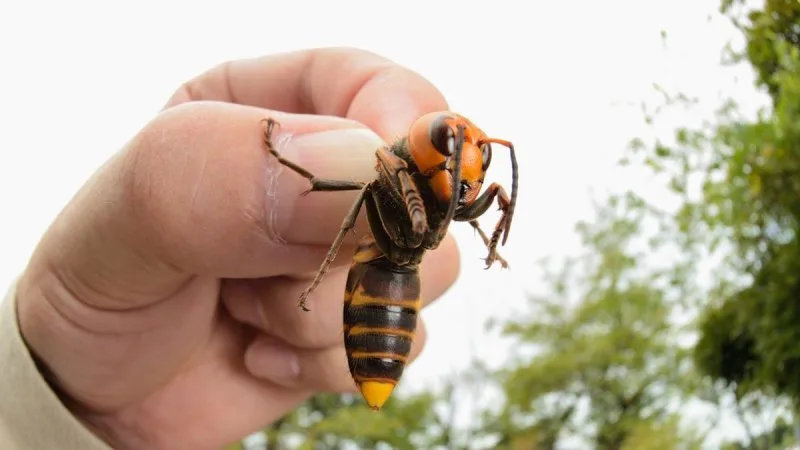
If one day you go to Japan and encounter one of these wasps, it's not your lucky day. The Asian giant hornets or mandarin wasps inhabit some of the best Asian travel destinations. Even if you are not afraid of such insects, you might start to rethink that.
Just to give you an idea of the lethality of these "killer bees," let's consider the case from 2013 in southeastern China. A swarm of them killed more than 40 people. Those who survived the stings were left with wounds resembling bullet holes. Moreover, many suffered kidney damage and lifelong sequelae.
Another factor that differentiates them from other bees is that they do not lose their stingers when they sting someone. They can sting and hurt you multiple times if they are agitated. So, if you are lucky enough to encounter just one of these, know that it can be very dangerous and risky. Let's learn a little more about the mandarin wasps.
Contents 4
Getting to know the mandarin wasps
The mandarin wasps, or as they are known in Japan, ōsuzumebachi (オオスズメバチ), are generally found in Asia. From Taiwan, China, western India, Nepal, but they are more common in the mountains of Japan. They were first classified around 1850 by a British man named Frederick Smith.
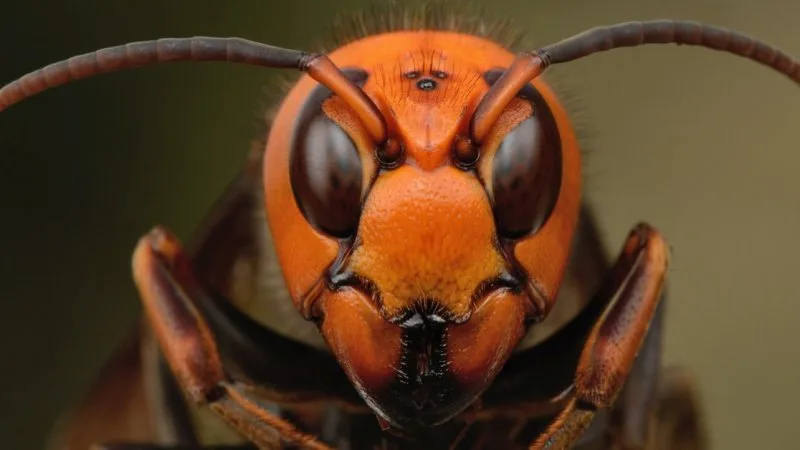
This species of wasp is considered the largest existing. They have two larger compound eyes. In addition to these, they also have three simple eyes on the top of their head (each with a single lens).
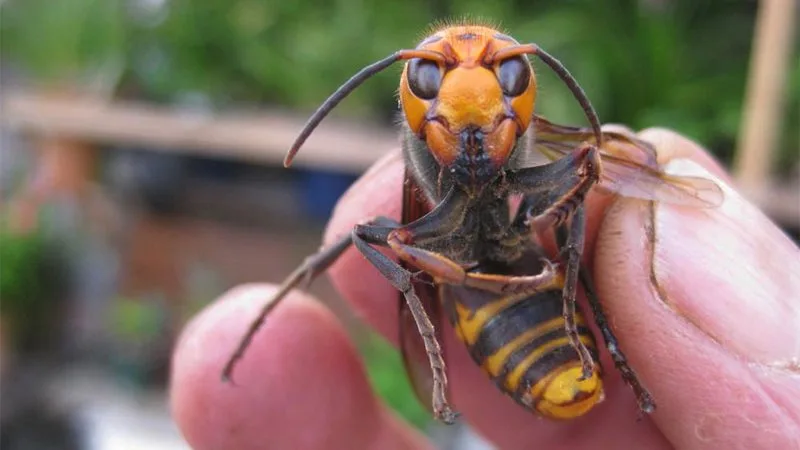
Males grow on average between 2.5 cm and 4.5 cm in length with a wingspan reaching around 7 cm. Queens can grow up to 5.5 cm, their heads are orange, with black jaws and a body that is black with gold.
As already mentioned, unlike other species of bees, their stinger is not barbed, so it remains attached to their body even when used. They can sting their victims multiple times repeatedly. The injected venom is known to contain eight distinct chemical substances.
Habitat and development of the mandarin wasps
The mandarin wasps inhabit and build their nests in high-altitude forests, in tropical and temperate areas. They prefer forests or the foothills of low mountains. The nests are established by already fertilized wasps that select a location to start their own colony. They dig their nests near the roots of decaying trees or take advantage of existing holes or tunnels made by rodents.
After building their nests, the queen lays an egg in each cell, which hatches after about a week at the beginning of spring. The larvae undergo a five-stage metamorphosis until they reach adulthood, a process that takes 14 days. After that, the hive already has its first team of workers.
By the end of summer, the colony reaches a peak of 700 workers, the majority being females. Males leave the hive when they become adults and die after mating. By autumn, both the workers and the current queens die, leaving behind the young fertilized queens. These survive the winter, restarting the process again in spring.
Behavior of the mandarin wasps
Their behavior is described as aggressive, so much so that they frequently attack other species of wasps and bees. They also attack other bees to obtain larvae, pupae, and even adults to feed on. They use their jaws, strength, and agility to kill their victims. They can even kill larger insects.
They can kill about 40 bees per minute. They cannot digest solid proteins, so they only consume the fluids of their victims. They can wipe out an entire colony in just a few hours. They can fly at about 40 km per hour and can cover a distance of more than 140 km in a day.
Even so, they are very social among themselves, working very well within the colony and in the search for food. They are also known to favor and defend their young. They are considered predators in their environment, which is why they have no natural predators.
Did you know that there is also a rock band called Vespas Mandarinas? If you search for it on Google, you'll find more music-related content than about the wasps themselves.
Threat and defense of the mandarin wasps
Humans, in turn, represent the greatest threat to them. They are often consumed as food, either fried or served as sashimi. Therefore, their numbers have been significantly decreasing over the years. But the main threat is uncontrolled deforestation, leading to the loss of their natural habitat.
The mandarin wasps have a stinger about 6.25 mm long. The venom contains eight distinct chemical substances, each with a specific purpose. Ranging from making breathing difficult, skin tissue degeneration, attacking the nervous system, and even attracting other wasps to the victim. The stings can even cause kidney failure. About 40 people die each year due to attacks from these wasps.
However, humans are not the favorite prey of these wasps. Even so, we should be careful when walking in areas that are their habitat. Because those who have felt their sting claim that the pain is very intense and unbearable.





Community
Comments
0 comments
There are no published comments in this language yet.
Send comment