
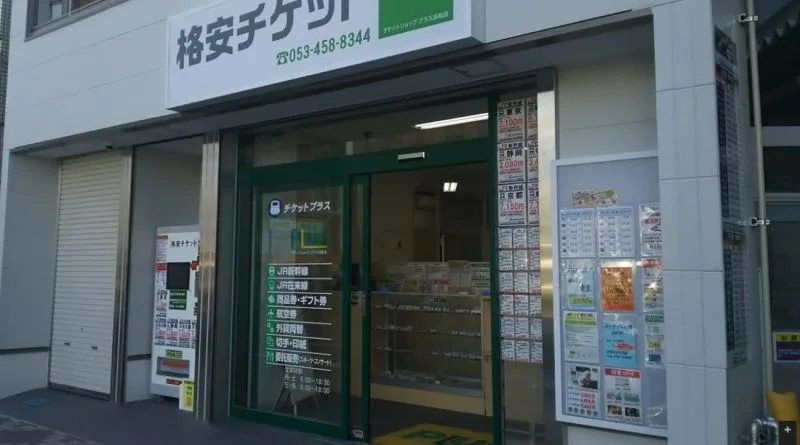
There are several ways to get a discount on train tickets and the shinkansen in Japan. Some people buy a day pass or a seasonal pass, others buy online in advance, but what many do not know are the Kinken Shop counters near major stations and tourist spots.
A Kinken Shop [金券ショップ] buys unused tickets and coupons, then sells them again under the printed price. On a train ticket the cut is often a few percent, and on some routes it gets closer to a tenth of the face value. The same counter may also carry bus tickets, cinema vouchers, restaurant coupons, gift certificates, and admission for Tokyo Disney Resort or Universal Studios Japan. Daikokuya, Kounan Ticket, Sun Ticket, Marutoku Ticket, Yasui Ticket and Tokai Ticket sell that same sort of paper under their own names.
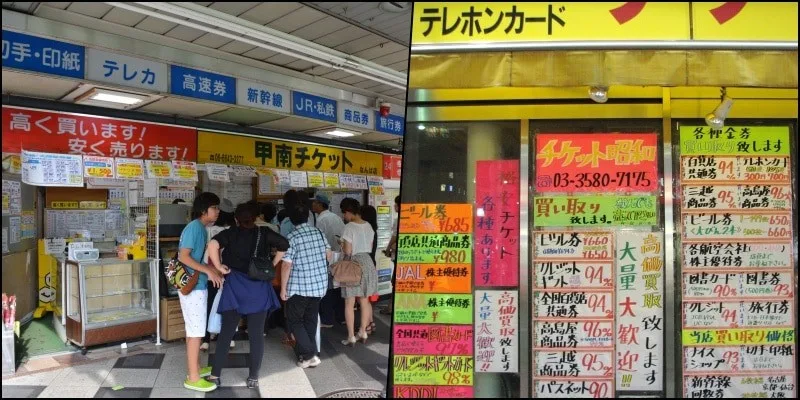
The dates, routes and conditions on those papers are written in Japanese. At a busy counter you will usually have to read them yourself. Check the stations and the last day on the sheet. Hours belong to each branch. Kounan Ticket's Midosuji Namba branch, for example, posts 10:00 to 19:00 and keeps a vending machine running before the counter opens and after it closes. These shops will also buy an unused ticket or a gift certificate from you. The boards in the photo list what that counter pays for cards and certificates, and what it charges for them.
Tips about discount stores in Japan
Each sheet in the window is its own product. The words on it tell you the stretch, the days and the hours you are actually buying.
- Futsū kaisūken (普通回数券) is the ordinary coupon booklet: classically 11 rides for the price of 10, on one fixed stretch of a local train. Shops sold the leaves one by one, which is why a short hop could look cheap. JR East, JR Central, JR West and JR Shikoku ended the regular booklet on 30 September 2022. JR Hokkaido followed on 30 November 2022, and JR Kyushu had ended in 2021. Discounted booklets for disabled passengers and for eligible students stayed on sale. A private railway may still sell a booklet of its own.
- Jisa (時差), donichi (土日) and kyūjitsu (休日) are coupons that work only in the hours or on the days printed on that sheet: off-peak on a weekday, or weekends and holidays. A board marked 昼特 is that shop's daytime special. Follow the hours on that board. A 10:00 to 17:00 window belongs to the railway that printed it.
- Shinkansen paper in these shops used to be one leaf from a booklet, often six leaves. The station sold the booklet whole, and the shop split it. JR Central stopped selling the ordinary-car non-reserved booklet, 新幹線回数券(普通車自由席用), on 22 December 2024, along with the Kodama Green booklet, the Tokyo non-reserved Shinkansen coupon and the Fujikawa non-reserved limited-express coupon. The last day those tickets could be used was 31 March 2025. Reserved-seat Shinkansen booklets on the Tokaido and Sanyo lines had already ended in 2022. A commuter coupon tied to a season pass is a separate product, for people who already hold that pass. One product a shop can still post for the bullet train is a shareholder coupon for one JR company. You take that coupon to a JR window, and the discount applies to the company named on it.
JR Central replaced that non-reserved booklet with a fare on Express Reservation and Smart EX called EX Hayatoku 1. You can reserve it from six days before travel until the day before. The seat is an ordinary-car non-reserved seat on Nozomi, Hikari or Kodama, and the crowded days of New Year, Golden Week and Obon are left out. The announcement of 24 January 2024 printed sample fares and said those numbers could change, so the price that matters is the one the site shows for your date.
Ask the shop what it will do if your plan changes, while the ticket is still in the case. A station refund follows the rule for the ticket the station sold. A single leaf the shop has already split stays the shop's sale.
I used these shops a lot in Japan. On one trip I bought the ride from Kakegawa to Disney as a Shinkansen ticket into Tokyo, plus the Keiyo Line from Tokyo to Maihama, for 6,000 yen. The ordinary price of that combination was usually over 8,000 yen, so the saving was about 2,000 yen. Maihama, on the Keiyo Line, is the station for Tokyo Disney Resort. Mihara is another station, on the Sanyo Shinkansen in Hiroshima Prefecture. The 6,000 yen is one trip from the years when a Shinkansen booklet still turned up in the window.
Cinema vouchers often sit a few hundred yen under the adult price at the theater. A same-day leftover can fall much further, and at some counters it has gone to around half, depending on what is still unsold that night.
Before you hand the money over, match the stations, the last valid day, and the trains or hours printed on that sheet. For a Shinkansen ride, set the shop's price next to EX Hayatoku 1, or next to another early reserved fare, for the same day. A day pass, or a JR Pass on a long itinerary, still belongs in the same comparison. Buy at the shop when the paper in front of you costs less than those fares and the date on it matches your trip.

Community
Comments
0 comments
There are no published comments in this language yet.
Send comment