
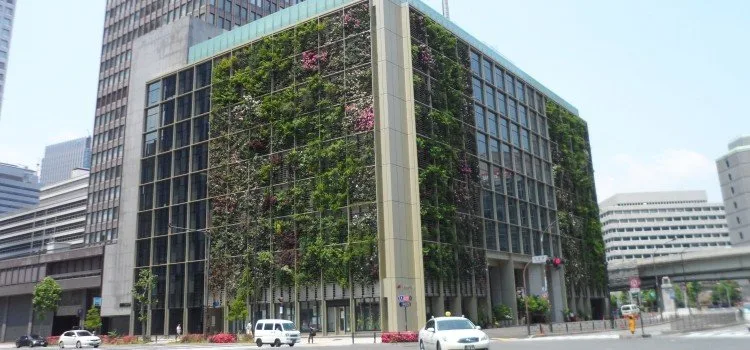
When we think we've seen it all, Japan surprises us. In Tokyo's Otemachi district, in Chiyoda, a staffing company once put a farm in a former bank vault. Not a terrace garden. A basement.
Pasona called it O2 — Ōtsū (オーツー) in Japanese. Rice thickened under sodium lamps. Roses sat under white LEDs. You reached it through one elevator, because the floor had been built for a bank's bullion, not for visitors. The mix-up the green-façade photos still invite: that underground farm and the later nine-story office wrapped in plants were two different buildings.
What Pasona O2 actually was
O2 opened in February 2005 on the second basement of the Otemachi Nomura Building, at 2-1-1 Otemachi. The room had been a vault for Resona Bank, formerly Daiwa. Pasona, a recruitment group, leased about 1,000 square meters — not the 4,000 often attached to this story — and split the space into six greenhouse rooms. A 27-story office sat on top of it.
The harvest was never the product. Pasona wanted city workers to see farming as a job you could walk into, not as something locked inside rural families. Yasuyuki Nambu, the group's founder, had toured Japan looking for work that still needed people. Japan grows only a slice of the grain it eats. A high-tech farm under the financial district was the company's showroom: agriculture plus lamps, sold as a career.
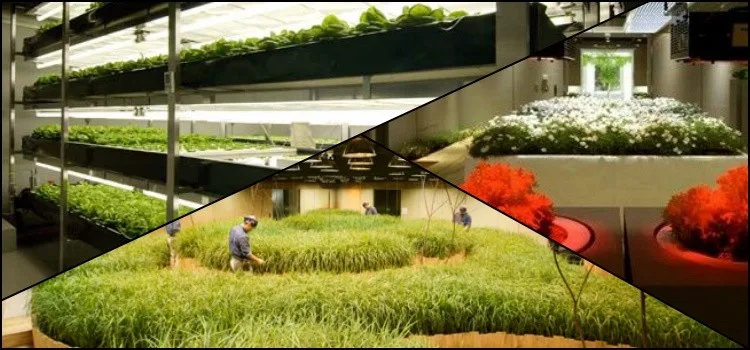
With no sun, the rooms ran on a mix of lamps. Flowers sat under LEDs. Rice took metal halide and high-pressure sodium. Lettuce and tomatoes took fluorescent tubes, some of them bounced off foil-covered walls. Computers held temperature, humidity, and carbon dioxide. Tomatoes climbed out of nutrient tanks toward the ceiling — hydroponics, with almost no soil — so fruit could come year-round. A 2005 report described the basement as pesticide-free: no insects down there, so no spray.
A 2008 walk-through listed the six rooms in order:
- Flower field
- Rose and herb garden
- Terraced rice paddy
- Fruiting vegetables
- Vegetable field
- A “21st-century” cultivation room
Seeds germinated in trays to save floor. Tomatoes hung from the ceiling. Rice sat on shelves in a room held around 28°C, fast enough for three harvests a year. Lettuce stacked four high. More than fifty kinds of roses and other flowers grew under white LEDs. Salad greens were sometimes offered as a taste on the tour.
The rice made the news because nobody expected a paddy without a sky. In its best twelve months the plot still yielded only about 60 kilograms — not enough rice for one average Japanese eater for a year. Building the place cost around 180 million yen; keeping the lights on ran about 20 million yen a year. Pasona treated that bill as training and publicity, not as a food factory. In the early months more than a hundred people a day came through. Over four years of operation, later counts put visitors above 70,000, including Japan's prime minister at the time.
In 2008 the rooms were open on weekdays from 11:00 to 18:00, last entry 17:30, a short walk from Tokyo Station if you knew which elevator to take.
The nine-story Urban Farm people mix it up with
By spring 2009 the underground rice was already winding down. In March 2010 Pasona opened a larger experiment: the Urban Farm, its headquarters in a renovated nine-story office at 2-6-4 Otemachi, designed with Kono Designs. That is the building with branches and leaves coming out of the windows — a double-skin façade of roses, wisteria, and orange trees that people photographed from the street.
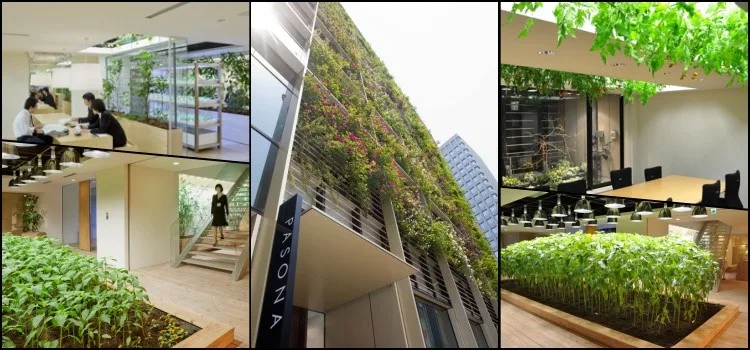
Inside, about 3,995 square meters of a 19,974-square-meter office were planted: more than 200 species, tomato vines over conference tables, lemon and passion-fruit trees as partitions, bean sprouts under benches, a rice paddy in the lobby. Crops were harvested, cooked, and served in the staff cafeteria. Employees tended the plants with agricultural specialists. Those 4,000 square meters and nine floors belong to this headquarters, not to the vault.
The Urban Farm closed in June 2017. The Gofukubashi Building was later demolished, and Pasona moved. You cannot visit either site now. What remains is the argument they were making: that a recruitment firm could grow rice under Otemachi and still call farming a future, in a country that imports most of what it eats.
If you go looking for a green wall next to Tokyo Station today, this one is gone. The vault went back to being a basement, the later office was pulled down, and the thing left to look at is the idea — a staffing company that grew rice where money used to sit.

Community
Comments
0 comments
There are no published comments in this language yet.
Send comment