
Beards are rare in Japan, and the reason has little to do with biology. Japanese men can grow facial hair; the clean-shaven look became the norm through centuries of etiquette, status rules and workplace expectations. The story runs from the samurai topknot to the office dress code, and it explains why a beard can still look like a small act of rebellion.
Contents 3
Why are beards uncommon in Japan?
In Japanese, facial hair is hige [髭]. The word covers a beard, a moustache or sideburns. When the distinction matters, people say kuchihige for a moustache or agohige for a chin beard. The pronunciation also invites a wordplay: hige [髭] sounds like hige [卑下], which means self-deprecation. The pun is real, but it reveals nothing about how the language views beards; it is a coincidence of pronunciation.
The idea that Japanese men simply cannot grow beards is a stereotype. Facial hair varies widely in Japan, as it does everywhere, and plenty of Japanese men can grow a full beard. Many men shave by choice or because a workplace expects it. The clean-shaven face says more about social norms than about genetics.
A beard also carries a visual message. A clean-shaven face reads as tidy, young and professional; a beard can suggest age, stubbornness or rebellion, especially in customer-facing jobs. Some people still treat facial hair as a sign of poor hygiene, even when it is carefully trimmed. That association is old, and it survives in small comments and company manuals.
The strongest pressure comes from company rules, not from national law. Many Japanese employers set grooming standards, and some still ask men to be clean-shaven. The rules are common in food service, manufacturing, retail and traditional office environments, where a uniform look is part of the brand. International companies, tech firms and creative studios tend to be more relaxed.
The history of beards in Japan
In the medieval period, a full beard and long hair were marks of a warrior. Samurai were expected to grow them, and a man with thin facial hair could wear a false beard, a tsukehige, to complete the image. Toyotomi Hideyoshi, who reportedly had little facial hair, is one famous example. Facial hair signaled strength, experience and the authority to lead men in battle.
That changed when the country entered a long peace. The Tokugawa shogunate promoted a more orderly, civilian image, and beards came to be seen as a relic of the Warring States. Under shogun Tokugawa Ietsuna, the Ōhige Kinshirei, or Great Beard Prohibition, ordered men to shave. By the 1660s, the rule applied to samurai and commoners alike. The chonmage, with its shaved pate and topknot, became the standard male look. Facial hair could mark a man as out of step with the official order.
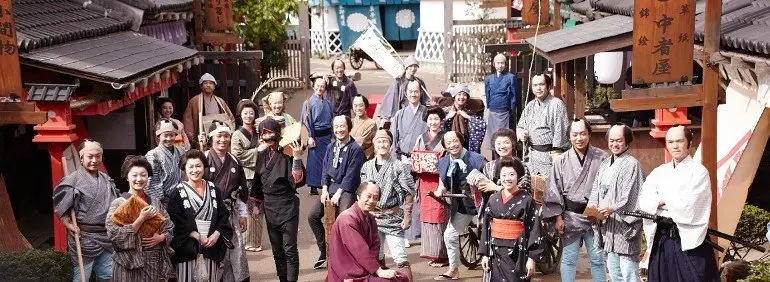
The Meiji Restoration of 1868 overturned the old order. In 1871, the Dampatsurei edict told samurai to cut their topknots, and Western dress and grooming spread through the elite. Beards returned as a symbol of modernity and authority. Emperor Meiji was known later in life for a large beard, and military men such as Nagaoka Gaishi turned facial hair into a personal trademark. Gaishi grew a moustache so long that it was nicknamed the "propeller beard", and his son cut it off after his death and buried it in a separate casket.
The pressure to conform had a darker side. Ainu men traditionally wore full beards, and Ainu society treated shaving as disrespect to the gods. In Japanese paintings from the Edo period onward, bearded Ainu men without topknots were depicted as barbarians, which fed prejudice against them. The derogatory word ketō [毛唐] for Westerners reflects the same prejudice, and the article on the word gaijin traces a related history.
By the early 20th century, the Western fashion cycle had turned again: in Europe and the United States, clean-shaven faces were becoming the mark of the professional man. Japan followed in the postwar decades, and the salaryman look made the clean-shaven face a virtual uniform. Beards survived among artists, actors, older men and people outside the corporate mainstream.
How are beards viewed in Japan today?
The clean-shaven ideal is not absolute. Hayao Miyazaki, Hideo Kojima, Takashi Murakami and actor Takayuki Yamada are among the well-known men who wear beards or moustaches. In those circles, a beard can read as experience rather than neglect. Itsuo "Joe" Okada, the Kyoto tour guide known for his katana performances, is another example; his white beard is part of the persona.

Among younger men, the pressure is different. Many fashion and beauty campaigns favor a clean, youthful face, and a beard can look older or too assertive. The style is often described as a "cute" face, a look explored in the article on male beauty in Japan. That preference changes by city, industry and social circle.
Company policy remains the biggest obstacle. Japan Post introduced new grooming rules in 2004, and a 55-year-old Osaka postman named Noboru Nakamura was told to shave a moustache he had worn since 1990. The Osaka Bar Association called the order irrational and a violation of his human rights. In 2010, a court ordered the postal company to pay compensation for a low evaluation given because of a beard.
Grooming codes remain common. A 2019 survey by Rengō, the Japanese Trade Union Confederation, asked 1,000 workers about grooming rules. Of them, 571 said their workplace had such rules, and many reported beard rules. A total of 111 said violations could lead to penalties, including written apologies, dismissal or contract termination. At the same time, 549 said the rules should be kept to a minimum, and 181 said the decision should be left to the individual.
The trend is toward looser rules, especially in tech, media and international companies. Beards are no longer a reliable sign of rebellion; they can be a style choice, a family trait or simply a preference. In daily life, a well-groomed beard rarely causes trouble for visitors. The old assumption that a beard equals laziness is fading, though it has not disappeared.

There is no law against beards in Japan, and the preference is cultural, historical and corporate. It varies by generation and workplace. I would not read a beard as a sign of laziness. If you are visiting, wear your beard as you would at home. If you are job hunting, check the company's grooming policy before the interview. What do you think about the Japanese preference for the clean-shaven look?




Community
Comments
0 comments
There are no published comments in this language yet.
Send comment