

The first thing people notice about a lot of Japanese hair is not a miracle oil. It is how the strands sit: straight, dark, and visually dense, as if each fiber occupies more space than it should.
That look is only half habit. Fiber diameter in East Asian hair is often larger to begin with. What Japanese bathrooms actually change is how much of that fiber you keep — shine, fewer snapped ends, a scalp that is not fighting yesterday's product. The six notes below are about that second half.
Contents 7
First of all, what makes hair look thick?
Most of the time, hair is already thick at the root. Researchers have tied East Asian hair diameter to variation in a gene called EDAR, which helps explain why a Japanese strand can look fuller than a European one even at similar length. Density — how many hairs sit on a square centimeter of scalp — is a different measurement, and it is not automatically higher.
Shaft versus look: a thicker fiber is mostly inherited. Color, bleach, tight elastics, and plastic brushes chew the same fiber until it looks thinner than it is.
What does change after birth is the cuticle. Why Japanese hair so often looks straight and thick is mostly a genetics story. The bathroom story is about not wasting that fiber.

Tip 1: Add B-complex foods, not only a bottle of vitamins
A hair vitamin has a job when a blood test shows a real gap. Day to day, the Japanese table already leans on the same building blocks: rice, leafy greens, eggs, seaweed, and fish. Those plates carry B vitamins and protein the follicle uses to grow the next segment of shaft. They do not rewrite the diameter you were born with.
A simple bowl that actually shows up at dinner — rice, grilled fish, spinach or komatsuna — does more honest work than a capsule marketed as an Eastern secret. If you live far from that market, the principle still holds: protein and B vitamins from food first, a supplement only when a clinician has a reason.

Tip 2: Wash often — then protect with tsubaki
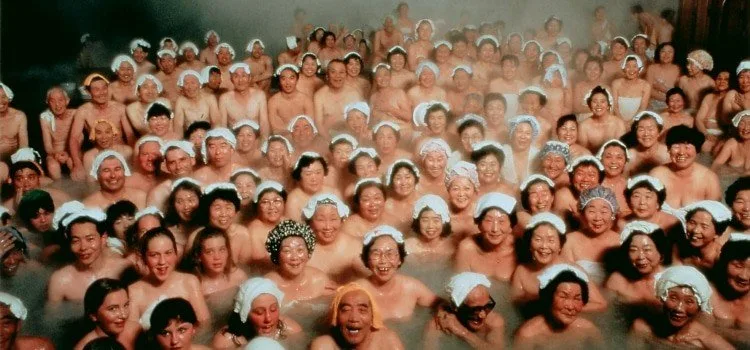
Many people in Japan wash their hair daily. Humidity, sebum, and city air make that feel normal. Copying the frequency with a harsh shampoo is how you get a tight scalp and straw lengths. The Japanese buffer is camellia oil, tsubaki (椿), pressed from Camellia japonica seeds.
Makers such as Oshima Tsubaki treat it as a leave-in, not a kitchen experiment. After you towel-dry, start with one drop on short hair, two or three on longer hair, warmed in the palms and combed through mid-lengths and ends. A heavier oil pack before shampoo, about once a week, is a different ritual: more oil, then a normal wash.
The useful chemistry is oleic acid — the same family of fat already in sebum — so a little oil sits on the cuticle without turning the head into a frying pan. Olive oil can stand in if tsubaki is impossible to find. It is not the same bottle, and it is not a Japanese substitute with another name. For the rest of a Japanese hydration routine, there is a longer walk through how Japanese hair hydration is usually built.
Tip 3: Rinse with sencha, not “any tea”
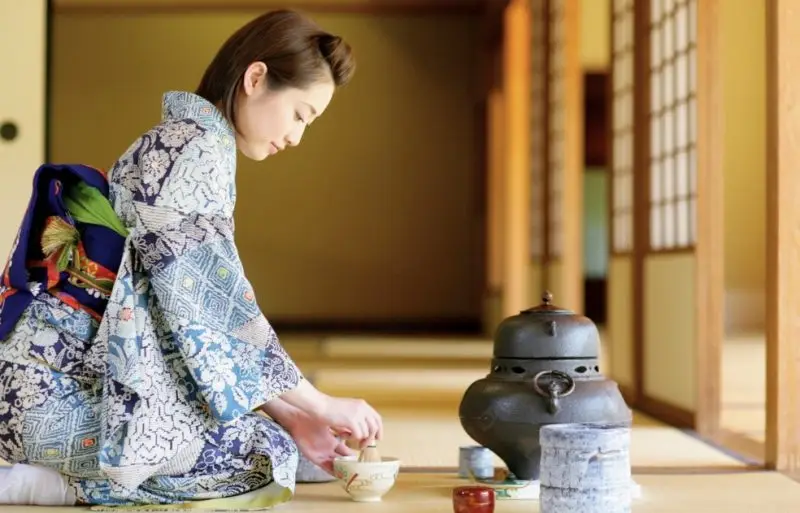
Green tea shows up in Japanese bathrooms because it already lives in the kitchen. Sencha (煎茶) is the ordinary leaf, not a rare spa ingredient. A cooled infusion as a last rinse can leave hair a little glossier and the scalp less itchy. That is a scalp habit, not a way to grow a thicker shaft.
- Brew a strong pot of unsweetened sencha and let it cool completely.
- After shampoo and conditioner, pour it through the hair as the last water.
- Do not leave hot tea on the scalp, and skip any blend you already react to on skin.
Black tea or a random bag from the cupboard will not “thicken” hair because it is tea. Some households also keep the cloudy water from rinsing rice for a final pass; that is a kitchen cousin of the same idea, not a seventh miracle.
Tip 4: Take care of the night, not a pillow potion
This tip is a routine, not a mask. Cotton pillowcases drag on the cuticle for eight hours. A silk or satin case reduces that friction, so the same length arrives in the morning with fewer kinks and snapped ends. That is why silk shows up next to Japanese hair talk. It does not plant a thicker follicle while you sleep.
Dried lavender inside a pillow can help some people fall asleep. Sleep helps every tissue, including hair. The herbs themselves are not a thickening treatment, and stuffing a pillow with them is not a secret Japanese diameter trick.

Tip 5: Mix apple cider vinegar as a clarifying rinse
Apple cider vinegar is good at lifting leftover product and dull film from the root. Used diluted, after shampoo, it can calm an oily scalp and make the next wash feel cleaner. That is a useful home rinse. It is not a Japanese custom, and mixing a splash into the shampoo bottle is not how Tokyo bathrooms work.
If you want it, keep it boring: a tablespoon or two in a cup of water, poured through after the shampoo, then a light conditioner on the lengths. Skip it on a cracked scalp. Do not turn the same bottle into a facial lotion and call that hair care.
Tip 6: Use a tsuge comb, not another plastic rake
Combing often is an old Japanese habit. Doing it with cheap plastic is how you add static and snap the cuticle you were trying to save. The traditional answer is a tsuge (柘植) comb — Japanese boxwood, often hontsuge from Satsuma, finished by hand and soaked in camellia oil so each pass leaves a thin film on the hair.
Craft shops such as Yonoya still sell these combs for daily hair, not only for kabuki, nihon-buyo, or a sumo topknot. Wood does not throw static the way plastic does. Used gently from ends to roots, it makes the same hair lie flatter and look fuller because less of it is frizzed or broken. It will not thicken a fine European strand into an East Asian one over a calendar year.
If a boxwood comb is out of reach, a smooth wooden comb is the honest substitute. The point is the material and the patience, not a brand stamped “organic.”
None of this replaces the genetics you already have, and none of it needs a laboratory in the kitchen. For the other half of the look — the straight fall people try to copy with irons — there is a separate set of habits Japanese women use to keep hair straight. Keep the fiber first. The line comes after.






Community
Comments
0 comments
There are no published comments in this language yet.
Send comment