
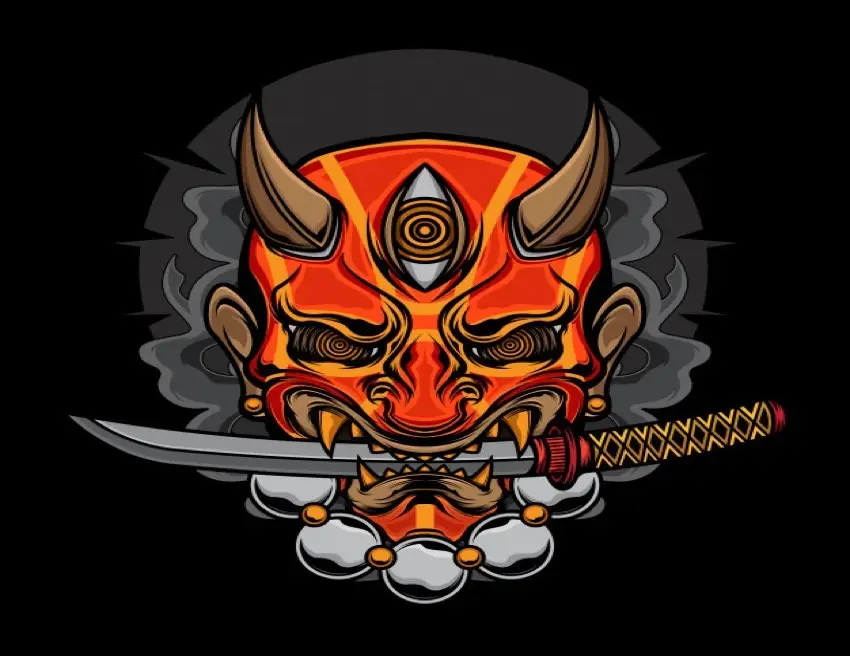
Do you know how to say demon in Japanese? Want to understand the differences between oni, akuma, youkai, bakemono, and others? In this article, we will see 10 ways to say demon in Japanese.
In the Japanese language, it is common to find various ways to express the same idea, because the Japanese language has several concepts for a possibly same idea, but that changes according to the context and the situation.
This means that something said or expressed can have several variations, since to fit the right context you need a different vocabulary. Although this idea is common in languages like English and Portuguese, in Asian languages, more attention is usually given to the historical, written, and period context when you are going to use a certain expression or word.
With the Japanese language, it would be no different; the word “Demon” is a word that appears quite often in books, movies, and elements of Japanese culture, but as explained earlier, with a very different meaning than what is seen in Western culture.
Let’s understand these differentiations and show that the word “Demon” in the Japanese language has more of a folkloric meaning than a strictly religious one as we have in the West.
We also recommend reading:
- 15 monsters, myths, and Japanese legends
- Monster Girls – Animes with monster or anthropomorphic girls
- Shinigami – Do you know these gods of death?
Table of Contents
Akuma [悪魔]
Before we study the word, we need to understand the essence of the kanji. The ideogram “Aku” [悪] represents something “bad, evil, false, or wrong”.
The second ideogram “ma” [魔] means “demon, devil, evil spirit, bad spirit, and negative influence”. So the word Akuma encompasses various types of demons or similar beings.
For example, the word Akuma is often used to refer to the Christian and Jewish Devil. It is also used to refer to Mara in Buddhism, evil spirits, and forces that hinder the path to enlightenment.

Oni [鬼]
The word Oni became popular thanks to the success of the anime “Kimetsu no Yaiba,” also known as “Demon Slayer.” What type of demons does this word refer to?
In the anime, they are villainous creatures with monster-like aspects, with claws, sharp canines, torn skin, and other characteristics of: Ogres and Monsters. In fact, Oni encompasses several types of monsters, even the nice ones.
Oni can be: Ogres, monsters, demons, and spirits of a deceased person. This word can also be used to refer to a ruthless person, as an insult, calling them an ogre.
Another important point about this word is that it also appears in the expression “onigokko” [鬼ごっこ], which is the famous Tag game; it can also have this meaning on its own. Is it a monster that chases its victims?
We recommend reading: The Oni in Japanese mythology

Youkai [妖怪]
Youkai is a word that is quite common in Japanese culture, especially when talking about its folklore, conveying the idea of ghosts, spirits, specters, and apparitions.
If we look closely at the Kanjis of this word, we will notice that “You” [妖] conveys the idea of: enchantment, calamity.
We have the second Kanji, which is Kai [怪], it conveys the sense of: apparition and mysterious. It can be seen in the word “Ayashii” [怪しい], which means: suspicious, questionable, uncertain.
But beyond these meanings in isolated words, Youkai has other meanings such as: creatures that escape from people’s imagination, without explanation. Like, for example, Goblins and Kappas.

Akuryou [悪霊]
This word is sometimes interpreted as demon, devil, but it is important to emphasize that its main idea is: evil spirit, which can also be understood as demon, but then we return to the cultural issue, where it doesn’t always have to be a devil.
Let’s see this word being used in the following sentence:
She seems to be possessed by an evil spirit.
彼女は悪霊に取りつかれているように見える
Kanjyo wa akuryoku ni toritsukareteiruyouni mieru

Deemon [デーモン]
In Katakana, the word Deemon [デーモン] comes from “Demon” in English, which is Demon. Unlike the previous words, this one is quite specific to refer to demons as they are seen in the West.
This word can also appear as a technical term for computers, the (Daemon) used in Linux. The katakana can also refer to the personal name Damon.
Rushifā/ Rushiferu [ルシファー | ルシフェル]
Rushifā or Rushiferu directly refers to Lucifer, Satan in Christian belief. One detail is that Rushiferu [ルシフェル] is an adaptation of the Portuguese itself.
Lucifer is not solely a bad word; it can even refer to the planet Venus. Generally, we see the word being used in animes, even when having no relation to demons.
Kaibutsu [怪物]
This word is not necessarily used to refer to demons, as its main meaning is: monster.
However, the idea of a monster sometimes in context refers to some demon.
It is an expression that is often seen in animes and mangas; for example, in the anime Blue Lock, there is a scene where the protagonist says: I want to know the true form of the monster inside me.
知りたい... 俺の中のかいぶつの正体...
Shiritai... Oreno naka no Kaibutsu no shoutai...

Obakemono [お化け物]
Another common expression to refer to monsters is Obakemono; this expression generally encompasses monsters, such as: Goblins, ghosts, apparitions, and sometimes this word is used to refer to someone’s potential that is so incredible or extraordinary that they would be a monster in what they do; however, be careful when using this expression to refer to someone, as it can sound offensive.
Toorima [通り魔]
Toorima is used exclusively for demons that bring bad luck, misfortune, or calamities to people’s lives or homes. Besides this meaning, it can express something like: surprise attack, assailant.
Obake [お化け]
Obake has more of a sense of Ghost, spirit, something more spiritual. Although it can also be seen with this sense of demon or monster.
Thus, we come to the end of this article. It is clear that in the Japanese language, the word “Demon” is not necessarily what we know in Portuguese or English.
It is something broader and therefore cannot be generalized; thank you for reading this far, I hope this knowledge can help you understand more and more about the Japanese language and culture. Until next time.

Leave a Reply