
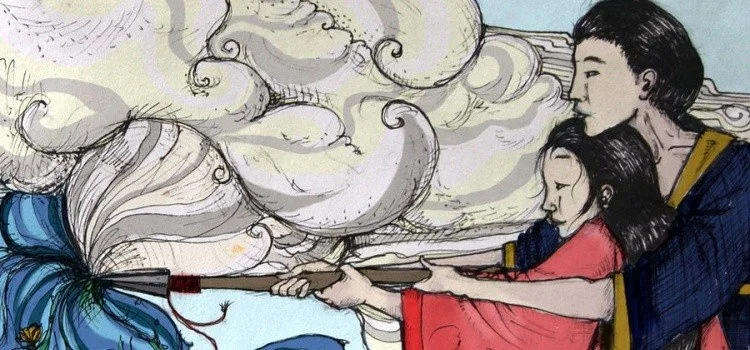
At the beginning of Japanese mythology stands a divine couple who called the islands of the country out of the ocean, gave birth to the sun, the moon, and the storm, and in the end laid the cornerstone of the imperial line of Japan. The pair in question is Izanagi (イザナギ) and Izanami (イザナミ), the creator deities described in detail in the two oldest chronicles of the country: the Kojiki (古事記) of 712 and the Nihon Shoki (日本書紀) of 720. Both names carry a beautiful meaning: Izanagi means "the one who invites" and Izanami "the one who is invited" – the names point to the moment when the higher gods sent them down to earth together. This article retraces the main episodes of their story: the creation of the first island, the birth of the gods, the tragic death of Izanami in the underworld, and the famous purification from which Amaterasu, Tsukuyomi, and Susanoo emerged.
Contents 11
The Stories of the Kojiki and the Nihon Shoki
The myths surrounding Izanagi and Izanami are not free inventions of later centuries. They appear in two works that Japan commissioned in the early 8th century to organize its own origins: the Kojiki ("Records of Ancient Matters", 712) and the Nihon Shoki ("Chronicles of Japan", 720). Both texts were written at the imperial court and contain mythological traditions as well as accounts of the early history of the country. To this day they remain the most important sources for the Japanese creation story and for what we now call Shintō.
Most readers meet the two deities in one of three episodes: the creation of the first island, Onogoro-shima; the tragic death of Izanami at the hands of the fire god Kagutsuchi; or Izanagi's flight from the underworld Yomi, from which the three most famous gods of the Japanese pantheon emerged. Once you understand these three scenes, you have understood the heart of Japanese mythology.
The Sending of the Divine Couple
At the beginning, the chronicles tell us, heaven and earth were already in place. But the higher world of the kami, the Japanese gods, was dissatisfied with the empty ocean that stretched beneath them. The higher gods therefore called a meeting to discuss the fate of the earth. Their decision: they would send two divine beings down to the lower world to create solid land and to populate the country.
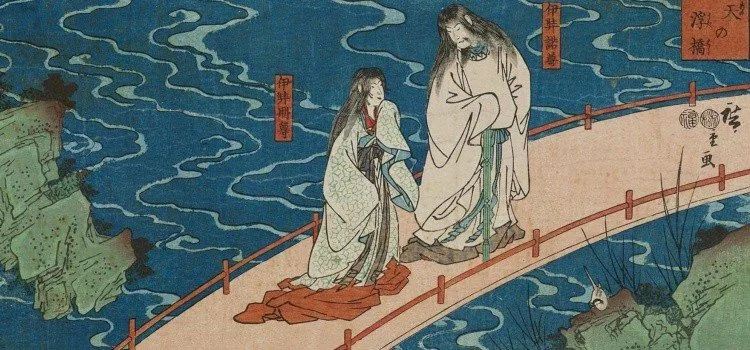
The two chosen ones were Izanagi and Izanami. The higher gods gave them a spear decorated with jewels, the Ame-no-nuhoko (天之瓊矛, "heavenly jeweled spear"), and ordered them to step down from the Ame-no-ukihashi (天の浮橋, the "floating bridge of heaven") into the chaos of the primeval ocean.
The Birth of the First Island
So Izanagi and Izanami stood at the edge of the heavenly bridge, dipped the tip of the divine spear into the churning sea below, and stirred the waves. When they pulled the spear out again, the salty drops that ran off the tip fell back into the water and hardened into an island: Onogoro-shima (磤馭盧島), the "self-forming island." On that small patch of land, born out of nothing, the two decided to marry and to populate the world together.
The wedding ceremony followed a strict ritual. The deities erected a sacred pillar, the Ame-no-mihashira (天御柱), and walked around it in opposite directions: Izanagi to the right, Izanami to the left. When they met again on the other side, Izanami greeted her husband first with the words: "Oh, what a fine young man." Izanagi answered her greeting, but the higher gods were not satisfied with the order of events. In the wedding ritual, the man should have spoken first – not the woman.
The first child born from this union was Hiruko (蛭子), the "leech child": a weak, malformed deity. The second child, the island Awa-shima (淡路島), was also considered imperfect. The couple placed both in a boat and let the currents carry them away from Onogoro-shima. The two went to the higher gods for advice, and the instruction this time was clear: Izanagi should speak first in the next attempt.
The Eight Islands and the Gods
On the second attempt the ritual ran in the proper order. Izanagi spoke first, Izanami answered, and the marriage of the two gods was recognized as valid. What followed was the actual creation of Japan. The two deities gave birth to the eight great islands, the Ōyashima (大八洲), that make up the Japanese archipelago:
- Awaji-shima (淡路島)
- Shikoku (四国)
- Oki (隠岐)
- Tsukushi (筑紫, later Kyūshū)
- Iki (壱岐)
- Tsushima (対馬)
- Sado (佐渡)
- Yamato (大和, later the main island of Honshū)
Beyond the islands, Izanami gave birth to a great number of other deities – gods of the wind, the sea, the mountains, the forests, and the trees. Each of these births mirrored an aspect of the emerging nature. The divine couple thus became the ancestors of the entire Japanese landscape.
Izanami's Death and the Fire God Kagutsuchi
The last child Izanami gave birth to was Kagutsuchi (火之迦具土), the god of fire. The birth was so violent that Izanami suffered fatal burns. The blaze that came with his birth was later regarded as the origin of fire itself – and therefore as the origin of warmth, cooking, and metalwork, but also of destruction.
Izanagi, beside himself with rage and grief, beheaded his newborn son with his sword. From that act, new deities were born: eight sword gods formed from the drops of blood that fell from the blade, and a further eight mountain gods emerged from the dead body. Even violent death, in this myth, gave rise to new divine life – a motif that runs through the whole of Japanese mythology.
Izanami, however, had now entered the realm of the dead for good: Yomi (黄泉), the underworld, a dark, lightless land on the other side of the living.
The Road to the Underworld Yomi
Izanagi could not accept the loss of his wife. He made his way down to Yomi to bring her back. When he found her at the gate of the underworld, Izanami agreed to return to the upper world with him – under one condition: he must not look at her while she left the land of the dead. The food she had already eaten there, however, made it impossible for her to leave right away.
Izanagi waited. Hours passed, and his curiosity grew. Finally he lit the wooden hairpin that held Izanami's hair and used it as a torch to peer into the darkness. What he saw made him shudder: Izanami's body had already begun to decay, covered with worms, snakes, and demonic creatures crawling over it.
The Flight from Yomi
Izanami awoke when the light of the improvised torch touched her. Furious at the broken vow, she sent the dread goddesses of Yomi and a whole army of demons after her fleeing husband. Izanagi ran for his life. Only when he reached the entrance to the underworld did he manage to block the passage with a massive boulder.
From behind the rock, Izanami spoke one last word to him. She swore that from then on she would take a thousand people into death every day. Izanagi answered that he would bring fifteen hundred children into the world every day. From that moment on, the myth says, Izanami represented death – shaped by pride and by the suffering that had been done to her.
Izanagi's Purification and the Three Luminous Gods
Back in the upper world, marked by the horrors of Yomi, Izanagi went to the coast and performed a purification ritual. At each stage of the ritual he cast off the uncleanness he had brought back from the land of the dead – and with each stage, new gods, both negative and positive, came into being.
When Izanagi washed his face, the decisive moment arrived. From his left eye emerged Amaterasu (天照大御神), the sun goddess. From his right eye came Tsukuyomi (月読命), the moon god. And from his nose was born Susanoo (素戔嗚尊), the god of storms and the sea. These "three noble children" (三貴子, Mihashira no Uzu no Miko) became the most powerful gods of the entire Japanese pantheon.
Amaterasu received rule over the high plain of heaven, Tsukuyomi over the night and the moon, Susanoo over the sea. From Amaterasu, the sun goddess, the Japanese imperial line descends through her grandson Ninigi (瓊瓊杵尊). That makes Izanagi the mythic ancestor of the Tennō in a very direct sense.
Meaning for Shintō and Today
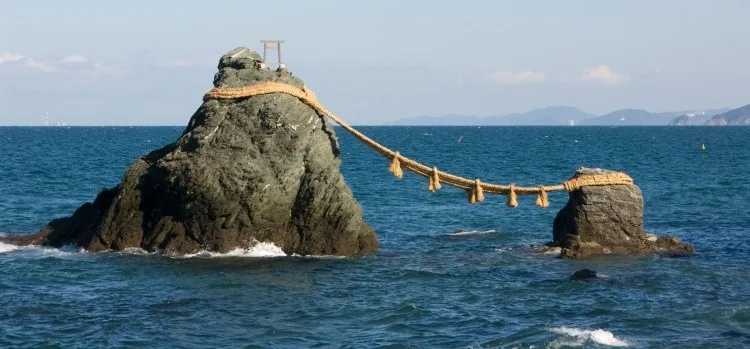
The stories of Izanagi and Izanami are still alive in the Shintō memory. Numerous shrines across the country are dedicated to one of the two, or to their children. The Izanagi Shrine (伊佐奈岐宮) in Hyōgo Prefecture and the Izanami Shrine (伊邪那美神社) in Mie Prefecture are among the best known. The fire god Kagutsuchi and his descendants are also venerated in many local shrines, since fire has always played a special role in Japanese cooking and craft.
In literature, art, and pop culture the figures keep coming back. They appear in classic tales of the underworld, in modern fiction, in manga and anime adaptations of the founding myths, and in video games that draw on Japanese mythology. Once you know the creation story, you recognize its motifs in many later works: the journey to the other world, the glimpse of the disfigured body, the punishment of the gods, the purification and rebirth.
Comparison with Other Creation Myths
The story of Izanagi and Izanami shows striking parallels with other great creation myths of the world. With the Greek pair Gaia and Uranus it shares the idea that the world emerges from a divine union and that heaven watches over the earth. The Norse tale of Ymir, from whose body Odin and his brothers shape the world, also features creation from a divine being – although there it comes from his violent death. Comparable, too, is the Hindu myth in which Brahma, Vishnu, and Shiva bring the world into being as aspects of the divine.
What makes the Japanese narrative special is the way it links creation and loss so tightly. Izanami does not die at the end of the story; she dies in the middle of giving birth. The myth tells of the world not as an unbroken triumph, but as a movement that includes grief, guilt, and purification. Those emotional shades set the Japanese creation story apart from many other myths and make it, to this day, one of the densest chapters of world literature.
Final Thoughts
Izanagi and Izanami stand at the beginning of the Japanese world of the gods. From their union come the islands of Japan, the elemental gods of nature, and – through Amaterasu – the imperial house. Their story is not a distant legend but a foundation that still shapes Japanese culture today. Whether you travel to Japan, visit many of its shrines, or read modern retellings of the old myths, you will meet Izanagi and Izanami again and again – as a quiet echo of a creation that began with a single drop of salt falling from a divine spear.




Community
Comments
0 comments
There are no published comments in this language yet.
Send comment