
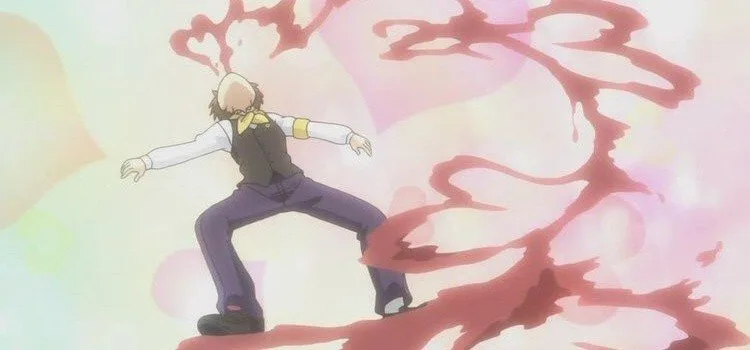
Have you ever wondered why anime characters suddenly bleed from the nose the moment they spot an attractive figure? Welcome to one of the most iconic clichés in the anime and manga world: hanaji [鼻血], literally "nosebleed".
Most of the time, the image shows up to signal that a character is sexually aroused or simply thinking very perverted thoughts. But where did this cliché actually come from? Is there any medical truth behind it? And which anime are notorious for leaning on it? That is exactly what this article is about.
In most works it happens more with male characters, but it can show up with female ones as well. And it does not always mean the person is excited – often a small shock, an embarrassing moment, or a sudden surprise is enough for the nose to start bleeding. You can see the character has barely had time to think and the blood is already running.
Of course, this is mainly a visual cliché, a quick way to show what a character is feeling and thinking in a single image. Still, there are a few real causes and small cultural curiosities hiding behind it.
Contents 5
What is hanaji (鼻血)?
Hanaji (鼻血) is simply the Japanese word for "nosebleed". In the everyday vocabulary of anime and manga fans it has long since become a genre label of its own: a scene in which a character bleeds from the nose is immediately recognizable as a hanaji moment, almost as natural as a chibi reaction frame or a classic tsundere reply.
What makes it stick is that the cliché has quietly become part of the industry's shared vocabulary over time. Anyone watching anime in Japan recognizes the gesture instantly and knows what is meant, without anyone having to explain it. Outside Japan the image works just as well these days – if you watch anime regularly, you have probably seen the hanaji cliché within the first episodes of any typical series.
Where did the cliché come from?
There is no single, well-documented inventor of the trope. It slowly settled into manga, anime and other media over the decades, much like other Japanese storytelling conventions – including the kind of folk belief that says sneezing once means someone is saying something nice about you, twice means something bad, and three times means you are catching a cold.
Several explanations tend to come up for why the image became so popular:
- Visual exaggeration: a nosebleed is instantly visible, needs no words, and works even in short, silent reaction shots. For manga and anime creators it is a simple tool to push an inner state to the outside of the character.
- A history of censorship: older Japanese media faced strict censorship rules around directly showing arousal or sexual thoughts. The exaggerated hanaji image turned into a kind of indirect language that hints without actually showing anything.
- Comedy and slapstick: many creators use the cliché mainly because it is funny. It creates a fast, relaxed break and fits the typical slapstick beats of Japanese comedy.
Another common explanation is medical: sexual excitement briefly raises blood pressure, which could in theory encourage a nosebleed. Blood pressure does rise, but medically it has very little to do with the sudden, exaggerated gush from the nose that animators and manga artists draw. It is, and remains, above all a visual cliché.
A more exotic theory traces the motif back to historical practices in professional combat. In some martial arts, fighters are said to have made small cuts on their forehead to leave dramatic traces if they were injured. Whether that really fed into today's anime hanaji is not actually proven – and in most mainstream explanations that connection is mentioned only in passing.
What really causes nosebleeds
In real life, hanaji has very down-to-earth causes. Anyone who has dealt with sudden nosebleeds in everyday life will usually recognize one of the following triggers:
- irritation from allergies, colds, sneezing, or sinus problems;
- very cold or very dry air, common in winter or in strongly air-conditioned rooms;
- blowing the nose too hard, or picking it;
- injuries to the nose from a bump or a hit;
- a deviated septum;
- chemical irritants, dust, or smoke;
- overuse of decongestant nasal sprays.
Sexual arousal can briefly raise blood pressure, but in medical practice it is not a common cause of nosebleeds. If an anime character still ends up bleeding from the nose, they have almost always just walked into a fanservice scene, watched an embarrassing moment, or simply been hit with an over-the-top reaction shot.
Animes with plenty of hanaji
Putting together a full list of anime with hanaji scenes is almost impossible. The cliché shows up in pretty much every longer series at least once. That said, there are works where it piles up and becomes a regular part of the humor. Baka to Test to Shōkanjū is one of the best-known examples.
Other popular series also treat hanaji as a recurring running gag: Naruto, One Piece, Punchline, Dragon Ball, Gurren Lagann and Charlotte each have at least one memorable scene. Anyone who watches popular shōnen and comedy series in Japan or internationally will struggle to find a long season where the image does not pop up at least once.
Three short clips with especially clear hanaji moments:
Related clichés in anime
The nosebleed cliché does not stand alone. It is part of a whole set of visual shortcuts that anime and manga use to sum up feelings and situations in a single image. If you want to dig into the background, our complete list of anime clichés has many more examples – from tsundere and chibi reactions to typical opening tropes.
Binge-watchers can also zoom out: our guide on filler episodes and how to skip the unnecessary ones shows where in long-running series like Naruto, One Piece or Bleach you can actually save time – and where hanaji scenes are only a small part of the bigger picture.
What do you think of the hanaji cliché? Do you see it as a funny running gag, an unnecessary bit of fanservice, or simply a fixed part of the anime language? Drop your favorite scene in the comments.




Community
Comments
0 comments
There are no published comments in this language yet.
Send comment