
In Japanese schools, clubs and festivals, a coloured band around the upper arm often marks who is in charge. To Japanese viewers it is an everyday sign of responsibility. To many foreign viewers the first association is different, because in Europe and North America a red armband carries heavy political history. The Japanese habit belongs to a wider tradition of the 腕章 (wanshō), an armband that shows affiliation or role at a glance.
This article explains what the armband is, why group leaders wear one, where the colour red comes from, and how anime turned the leader's armband into a recognisable symbol.
Contents 8
What a wanshō is
An armband is a strip of cloth worn around the arm. In Japanese it is called 腕章 (wanshō), and the English loanword アームバンド (āmu bando) is also used. Because the band sits high on the arm and contrasts with clothing, it can be recognised from a distance. That is exactly why organisations use it: it says who belongs, who is responsible and who may give instructions.
Japanese dictionaries and encyclopedias describe the armband as a mark of membership or position, used by police and military units, medical staff, press crews and political groups. The same principle applies on a much smaller scale in schools, where an armband turns an ordinary student into the person in charge.
Why group leaders wear one
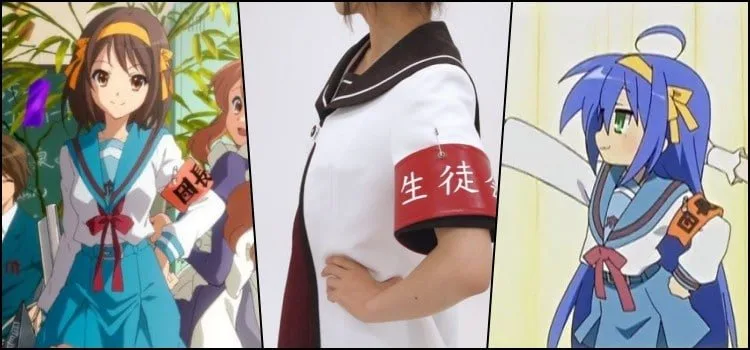
Student councils, club presidents and event committees in Japan often hand out armbands to their officers. The band usually carries the name of the organisation or the person's title, such as 会長 (chair), 部長 (club president) or 団長 (leader). During a sports festival or a school cultural festival, dozens of students may wear them at once, each colour marking a different team of organisers.
The armband also works as a social cue. When a student is approached by someone who does not know the group, the band answers the question before it is asked: this person can decide, explain or give directions.
Why red, and why it can look strange abroad
Red is the classic leader colour in Japanese school culture: it is bright, it photographs well and it reads instantly as a signal. In Japan the association is responsibility and visibility rather than ideology. In Europe and North America, by contrast, red armbands are remembered for the political uniforms of the twentieth century, and for the armbands used to mark persecuted groups. Some Western readers therefore find a red leader armband shocking at first sight.
That difference explains why some Japanese organisers choose other colours for foreign-facing events and why anime often uses red deliberately, as a visual signature that fans already recognise.
The Haruhi effect
For a generation of anime fans, the leader's armband has a specific face: Haruhi Suzumiya, the founder and leader of the SOS Brigade in The Melancholy of Haruhi Suzumiya. Haruhi's band, worn on the upper arm while she runs the club, became one of the most copied accessories in cosplay and fan art, and helped fix the red armband in the international image of Japanese school life.
The detail works because it is realistic: Japanese clubs really do identify their leaders this way, so the anime is exaggerating a school custom rather than inventing one.
Ouendan cheer squads
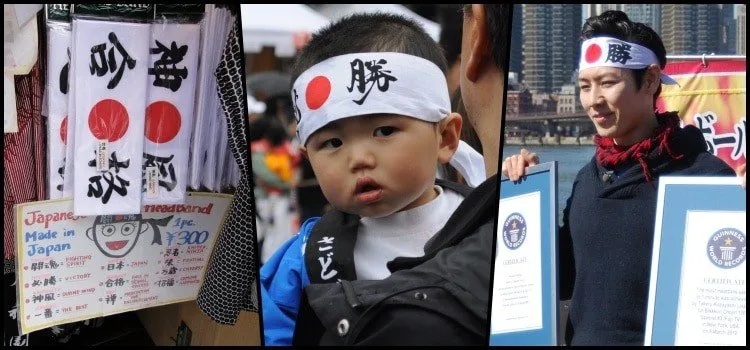
The 応援団 (ōendan), the organised cheer squads of Japanese schools and universities, are another place where armbands appear. Traditional squads wear dark student jackets, white gloves, hachimaki headbands and armbands, and lead the crowd with taiko drums, flags and megaphones. In older groups the armband is treated almost as ritual equipment, cared for like the flags and drums.
Their style is loud and highly choreographed, and it has spread into games and anime. The rhythm game Osu! and many school series use ōendan characters, usually with the red band clearly visible.
Other colours and other jobs
Not every armband means leadership. In Japan, press crews wear bands reading PRESS, 報道 or 取材 so that police and officials can identify them at a disaster or crime scene. Traffic officers and crossing guards use a green band with two white lines, a design said to come from tram tracks. Black armbands mark mourning at funerals, memorial events and sports matches.
Anime has adopted the same logic for fictional organisations. In Toaru Kagaku no Railgun the student council member Kuroko Shirai wears a green band; other characters wear yellow or striped ones. In Seitokai Yakuindomo the student council officers wear their own bands, and in Katekyo Hitman Reborn! the disciplinary committee is marked by red ones.
Studying the detail
Games pick up the same grammar of colour. Yandere Simulator gives several club leaders a red armband, and Danganronpa uses a red band for its army committee. The band is a shortcut: it tells the player who has authority before a single line of dialogue is spoken.
Wearing and buying an armband
Most bands are simple cloth strips held by a safety pin or an elastic band. In Japan they are sold in school supply shops and festival markets, and custom versions with a club name or a title are easy to order. Fans who cosplay a leader usually make or buy one with the matching characters, because the exact wording is part of the character's look.
Seen this way, the red armband is less a mysterious Japanese symbol than a practical tool that became a cultural icon. It marks responsibility, it survives a photographer's flash and, thanks to anime, it now travels around the world.
Read more: school clubs in Japan, the student council in Japan, hachimaki headbands, the flags of Japan and school gamers in Japan.


Community
Comments
0 comments
There are no published comments in this language yet.
Send comment