
Look closely at a Japanese prefecture flag and it often feels closer to a sharp logo than to a classical banner. That is not an accident: each of the 47 prefectures (都道府県, todōfuken) carries a compact emblem built from color, geometry, and local meaning—sometimes a stylized letter, sometimes a mountain or a river folded into a single mark.
Unlike the national Hinomaru, these designs rarely shout. They whisper through hiragana, katakana, kanji, and landscape shapes. Once you learn the logic, the wall of similar “logo flags” starts to separate into distinct regional stories.
Contents 8
Simple design, deep meaning
Modern prefectural flags usually follow a minimalist recipe:
- A solid field in a color tied to local identity—including hues less common on flags elsewhere, such as purple, orange, brown, or aquamarine.
- A centered mon-like emblem (紋), the visual heir of family crests worn by warriors, refined into a civic mark.
- Stylized writing or landforms that encode the prefecture’s name, geography, or a historical nickname.
That shared graphic language makes them look like a set. The differences appear only when you slow down and read the symbol.
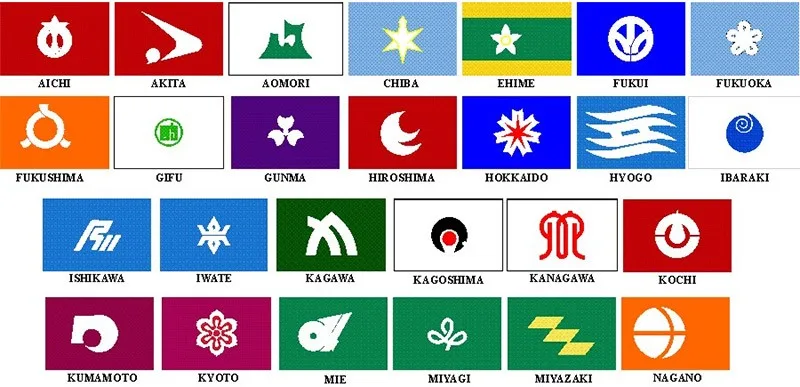
Flags built from hiragana
Some emblems are hidden syllables. What looks abstract is often a letter reshaped into a wave, a flower, or a circle.
- Aichi: a stylized hiragana あ (a). The same mark is read as sunrise and an ocean wave—Aichi facing the Pacific.
- Fukuoka: hiragana ふく (fuku) formed as a plum blossom, the prefectural flower, for peace and growth.
- Fukushima: a circular hiragana ふ (fu), slightly off-center, associated with steady progress—and, for many locals, with the silhouette of a peach, one of the region’s famous crops.
- Kōchi: not only an old place name on display. The design joins と from Tosa (the historical province) with コ from Kōchi into a sword-like emblem of progress framed by a circle of cooperation.
These flags reward anyone studying Japanese writing: the “decoration” is often the language itself.
Flags built from katakana
Other prefectures lean on katakana for a bolder, more graphic silhouette.
- Hiroshima: katakana ヒ (hi) stretched into overlapping crescents—harmony in the ring, progress in the overlap.
- Akita: a dynamic ア (a) on deep red, meant to signal forward motion.
- Chiba: チバ reshaped into a rapeseed (nanohana) flower on blue hope.
- Fukui: フクイ arranged as young leaves, a wish for growth.
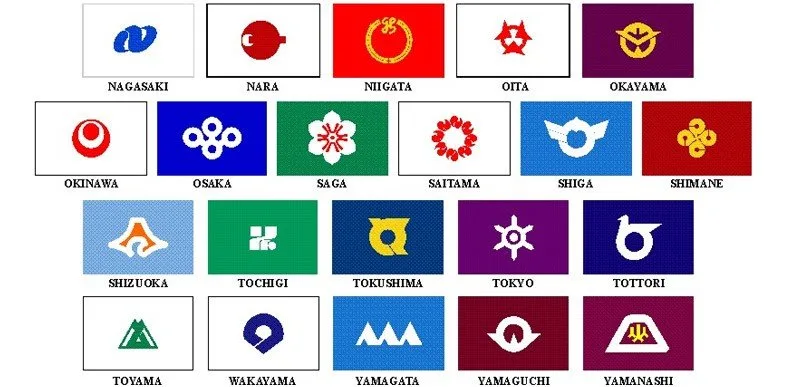
- Shimane: four yellow katakana マ (ma) circling into a cloud-like form—a visual pun on the reading shi for “four,” tied to the name Shimane.
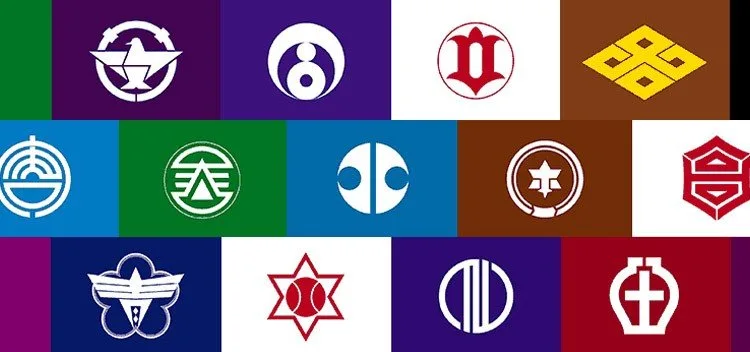
Kanji on the flags
Where a character carries weight, designers often keep only the essential stroke of a kanji and turn it into pure geometry.
- Kyoto: the first character 京 becomes a six-petaled flower with a golden center—courtly unity rather than a plain character dump.
- Okayama: 岡 (oka) rounded into a yellow circle on purple, for civic cohesion.
- Tochigi: a heavily stylized 栃 (tochi) paired with the tree idea of 木 (ki/gi), keeping the full name alive as motion and growth.
- Yamaguchi: 山口 reworked as a bird flying toward the sun.
- Ishikawa: the emblem suggests both the name and the Noto Peninsula jutting into the Sea of Japan, on a clear blue field.
Kanji flags are less “readable” at first glance than hiragana ones, but once the character is revealed, the design clicks into place.
Natural and historical symbols
Not every emblem is a letter. Some prefectures put landscape and memory front and center.
- Yamagata: three white peaks echo the mountain in the name 山 and the valleys of the Mogami River. Blue suggests calm; white carries snow and purity.
- Tokyo: the metropolitan flag shows a six-rayed sun on traditional Edo murasaki (Edo purple). Tokyo also uses a second, widely recognized mark: a green ginkgo leaf that doubles as a “T.”
- Shizuoka: Mount Fuji and the coastal outline of the prefecture fuse into one orange emblem on blue—sky, Pacific, and the iconic peak in a single glance.
- Osaka: three linked circles form the letter “O” and recall the calabash (gourd) associated with Toyotomi Hideyoshi. Blue stands for water, sky, and the “city of water” nickname.
These designs are the easiest for travelers to “feel” without reading Japanese: mountain, leaf, sea, castle-era memory.
When the map becomes the mon
A smaller group of flags almost abandon writing and draw the territory itself.
- Aomori: a green map silhouette of the prefecture on white—hope set against open space.
- Kagoshima: the Satsuma and Ōsumi peninsulas form a horseshoe around a red disc for Sakurajima, with a notch for Shibushi Bay.
- Hokkaido: a seven-pointed star on navy, framed in white: pioneering spirit, snow and light, northern sea and sky.
If you already know the outline of Japan’s far north or the southern volcanoes, these emblems read like tiny cartographic jokes—and that is part of their charm.
Symbolism, dual marks, and modern use
Some designs stack meanings until the geometry feels almost abstract.
- Saitama: sixteen red magatama beads in a ring. The “tama” (玉) of the name literally means bead; the circle also suggests sun, strength, and growth.
- Tokyo again: purple sun for the capital’s Edo inheritance; ginkgo leaf for the metropolitan tree and modern branding—two official faces of the same place.
- Symbol flags (シンボル旗): a few prefectures also keep looser “symbol” flags for informal occasions, separate from the main civic flag.
On the street you may meet these marks on buildings, events, sports kits, and souvenirs long before you see a full-size banner on a pole. They function as identity systems as much as flags in the Western parade sense.
How to “read” a prefecture flag
A practical habit helps: ask three questions. Is there a hidden character? Is there a landform? Is the color local (snow, sea, plum, purple of Edo)? Answer those and the design usually unlocks.
Japan’s administrative map is not a set of “states” in the American sense, nor medieval kuni provinces frozen in time—it is the modern prefectural grid described in guides to the 47 prefectures and the broader division of cities, prefectures, and regions. The flags sit on that modern map, while older banners and national designs tell a longer story in pieces such as the historical flags of the archipelago.
Once you catch the pattern—letter as mon, mountain as mon, color as local weather—the prefectural flags stop looking interchangeable. They become a quiet design atlas of Japan, one simplified shape at a time.




Community
Comments
0 comments
There are no published comments in this language yet.
Send comment