
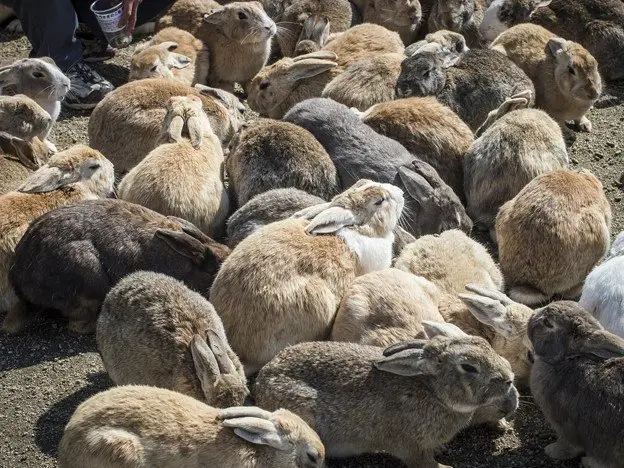
Imagine stepping off a short ferry and being greeted at the dock by dozens of rabbits that hop right up to your feet, sniff your shoes, and wait for a snack. That is the everyday welcome visitors get on Okunoshima (Ōkunoshima, 大久野島), a tiny island in the Seto Inland Sea that almost everyone in Japan knows by its nickname Usagi-jima (ウサギ島), the Rabbit Island. What surprises most first-time visitors is not just how many rabbits live there, but how tame they are, and how the cuddly surface sits on top of one of the most secretive chapters of Japan's wartime history.
Okunoshima belongs administratively to the city of Takehara in Hiroshima Prefecture and lies only a few kilometres off the coast near Mihara and Tadanoumi. The island is small, about four kilometres around, and you can easily cover it on foot or by rental bicycle in half a day. Today it is a relaxed outdoor spot with a campsite, a golf course, a resort hotel, walking trails, a small beach, and the modest Poison Gas Museum that documents what the island was used for between 1929 and 1945.
Contents 4
The Rabbits of Okunoshima
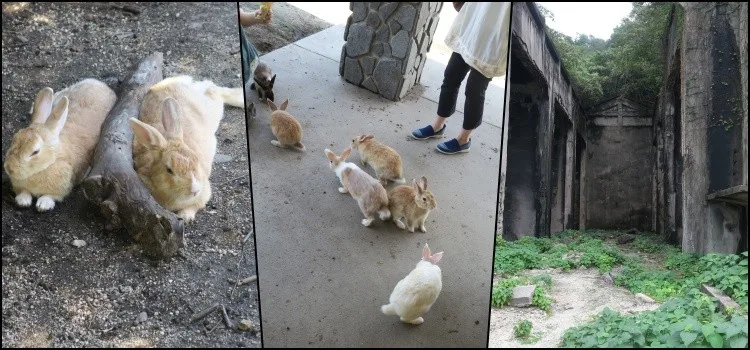
The current rabbit population of Okunoshima is estimated at several hundred animals, all living freely across the island's lawns, paths, and forest edges. For decades, the most popular story has been that these rabbits are direct descendants of laboratory animals used in chemical weapons testing during the war. According to the official line from Hiroshima Prefecture, however, those original test rabbits were euthanised along with the facilities when the site was dismantled in 1945, and the animals you see today descend from a smaller group of rabbits released on the island by schools and private owners in the 1950s and 1960s.
That official explanation has not fully settled the question, and guides on the island still happily tell the older, more dramatic version. Either way, the result is the same: a population of friendly, used-to-humans rabbits that turn the whole island into something close to a petting zoo. To keep the animals and the island's fragile vegetation safe, a few rules are strictly enforced. Hunting, capturing, or holding the rabbits is forbidden, dogs, cats, and other predators are not allowed on the ferries or on the island, and feeding the rabbits with bread, vegetables, or any human food is prohibited. The only food you can give them is the official rabbit pellets sold at the port and at the museum for a few hundred yen a bag.
Okunoshima is far from the only unusual animal spot in Japan. If you enjoy places where animals outnumber cars, the roundup of Nekojima and 20 cat islands in Japan is a good next read, and if you prefer something more mythical, the piece on kitsune and foxes in Japanese culture points to several fox shrines and the famous fox village. A completely different atmosphere can be found in Nara, the city of deer, where the animals roam freely through temple gardens and old town streets.
Poison Gas Museum
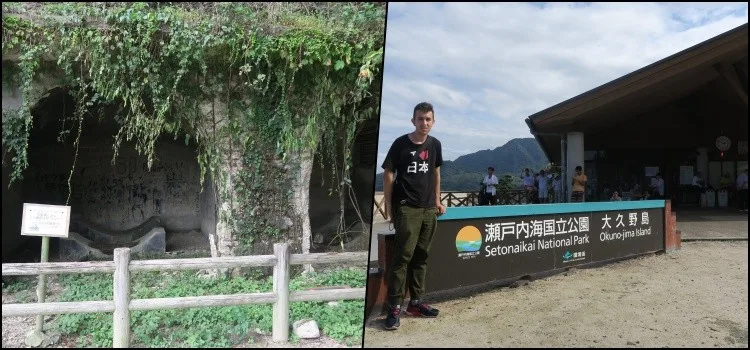
Before the rabbits turned Okunoshima into a tourist attraction, the island was one of the most secretive sites in the Japanese wartime chemical weapons programme. Between 1929 and 1945, the Imperial Japanese Army produced chemical weapons on Okunoshima, including mustard gas (yperite), tear gas, and a range of other agents. At its peak, more than 6,000 workers were based on the small island, and total production is estimated at around 6,000 tons of chemical agents. The Allies later removed Okunoshima from their maps altogether so that enemy bombers could not use the location as a waypoint.
After Japan's surrender in 1945, the production facilities were dismantled, the remaining stockpiles were destroyed, and the island was effectively left to itself. Decades passed before anyone tried to put the story on public record. That changed in 1988, when the Okunoshima Poison Gas Museum (大久野島毒ガス資料館) opened on the island. The museum is small but well done, with bilingual signs in Japanese and English, displays on how the gases affect the human body, surviving pieces of the old plant, and personal stories of the workers and local residents who suffered long-term health consequences. It is a sobering counterpoint to the playful rabbit images, and most visitors agree that the museum is what turns a cute day trip into a real understanding of what the island went through.
Trip to Okunoshima
Okunoshima is an easy day trip from Hiroshima, Mihara, Takehara, or even further afield from Osaka or Kyoto. The most common route starts at JR Hiroshima Station: take the Sanyo Line toward Mihara and get off at JR Tadanoumi Station. With a Japan Rail Pass the train leg is included, otherwise a regular ticket costs only a few hundred yen. From Tadanoumi, a short ferry of about ten minutes takes you directly to Okunoshima, and a return ticket is around 600 yen per person, bought at the pier.
Coming from Osaka on a previous visit, I actually planned to take the Kure Line all the way around, but the route would have taken far too long, so I hopped on a highway bus toward Mihara, switched to a local train, and reached Tadanoumi in a more reasonable time. That side trip is what this short clip is from, and it gives a fair impression of a normal day on the island:
Two to four hours on the island is enough for a quick visit, especially if you are mainly there for the rabbits and a few photos. Animal lovers, photographers, and anyone who wants to read the museum at a relaxed pace usually do better with a full day, including a picnic on the beach or a slow loop around the island by rental bicycle. The island is open year round, but summer gets very hot and humid, so bring water, sunscreen, and a hat. On the island itself there is a small restaurant and a kiosk near the port, but the selection is limited, so most visitors eat in Takehara or Mihara on the way back.
Is Okunoshima worth visiting?
If you like animals, want to see a quieter side of Japan outside Tokyo and Kyoto, and are genuinely interested in the darker chapters of twentieth-century Japanese history, Okunoshima is absolutely worth the detour. If, on the other hand, you are very strict about animal welfare, dislike crowded ferry rides, or simply do not enjoy a destination whose appeal rests on cute wildlife, you will probably get more out of one of the other animal spots in the country.
What makes Okunoshima special is exactly that double layer: a few hours of feeding friendly rabbits in the sun, followed by a slow walk through a small museum about mustard gas, forced labour, and a wartime programme that the post-war government preferred to keep quiet. It is a small, easy trip from Hiroshima, and it tells you more about modern Japan than many longer itineraries do.




Community
Comments
0 comments
There are no published comments in this language yet.
Send comment