
Watermelon is a fruit originally brought from Africa, but known and loved all over the world, especially in tropical countries like Brazil, for example. This is because, due to having a very hot summer, these countries seek options to cool off, and watermelon, in addition to being very good for health, also hydrates and refreshes those who consume it.
We all know the traditional watermelon, with a green rind, red pulp, and plenty of seeds, but now let's get to know a very different variant of this fruit. Have you ever heard of yellow watermelon?
This variation of the traditional watermelon is still little known in Brazil, but it has been gaining more and more space in supermarkets and on Brazilian tables. Very soon it will be easy to find yellow watermelon at fairs or markets across the country, so before you start consuming this fruit, see here everything you need to know about it.
Contents 5
The origin of yellow watermelon
Although it exists in nature, the yellow watermelon that reaches the consumer is actually a variation of the red watermelon created by a company called EMBRAPA, which developed two different types of watermelon: BRS Soleil and BRS Kuarah. Both types were developed as an alternative for consumers.
This watermelon was also developed with the facilitation of its cultivation and transport in mind, as it can be grown in various types of soil and, due to being a bit smaller and lighter compared to traditional watermelons, its transport is also much easier, thus avoiding the premature rotting of the fruits.
In order to achieve these specific characteristics, the watermelon underwent a process of hybridization and conventional improvement, thus giving it a yellowish color, a size and weight different from the conventional ones, and a lower number of seeds compared to the red watermelon.
Yellow Watermelon in Japan?
The square watermelon in Japan has become popular again now, despite existing since the Edo period. Unlike yellow melon, watermelon did not become popular for its color and lighter flavor.
Main characteristics of yellow watermelon
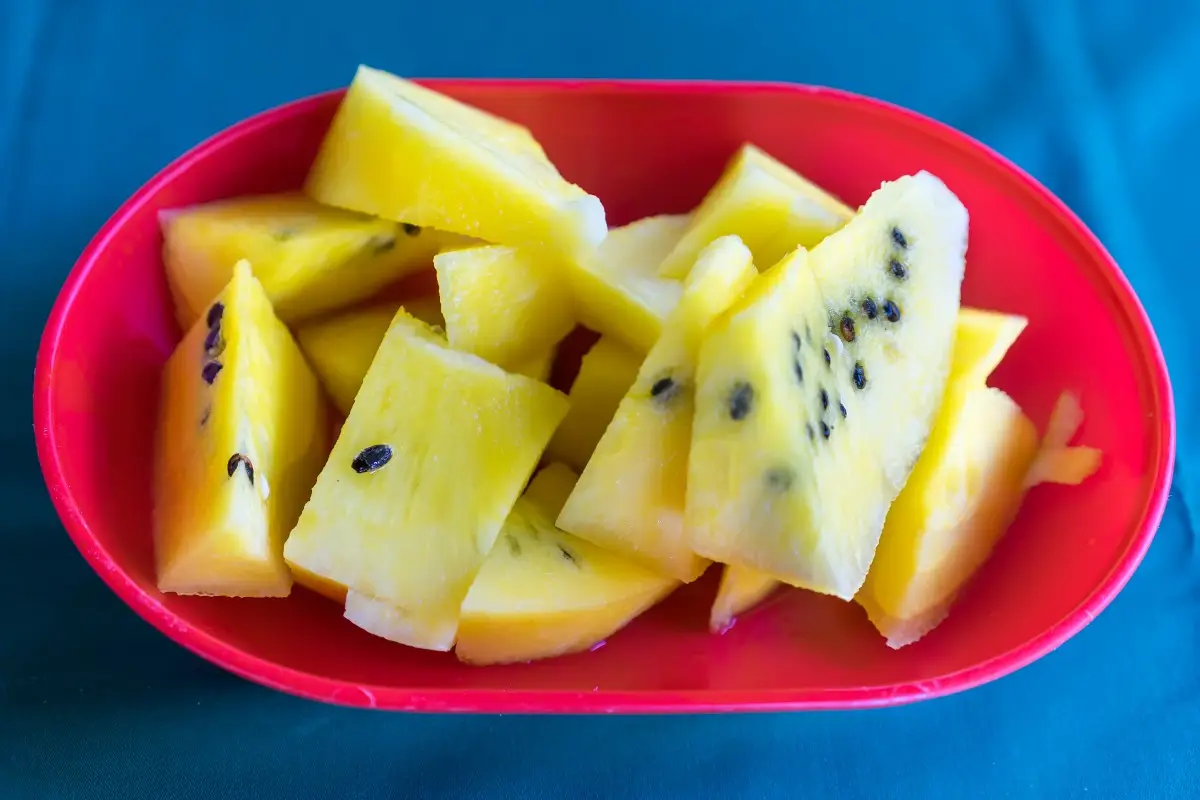
The main characteristic that differentiates yellow watermelon from others is its richness in a pigment called carotenoid. It is this pigment that gives the yellow color to this fruit, and it can also be found in carrots, for example. The red watermelon, in turn, is rich in lycopene, the pigment that gives it the reddish color.
Despite looking quite different, yellow watermelon is also part of the Cucubitaceae family, just like the traditional red watermelon. In this sense, yellow watermelon also differs in size, being a bit smaller than traditional watermelons, and in the number of seeds, with yellow watermelon having far fewer seeds than red watermelon. There are also, in some variations, the presence of edible seeds.
Additionally, this watermelon weighs between two and six kilograms, and it ripens much faster than its red sister. In other words, it can be harvested in less than sixty days, while red watermelon takes around eighty days to ripen and be ready for harvest.
Thus, it is also possible to avoid the appearance of pests and diseases in the crops. Furthermore, yellow watermelon is present in other variations spread around the world, especially in colder countries like Japan and Russia.
Benefits of yellow watermelon
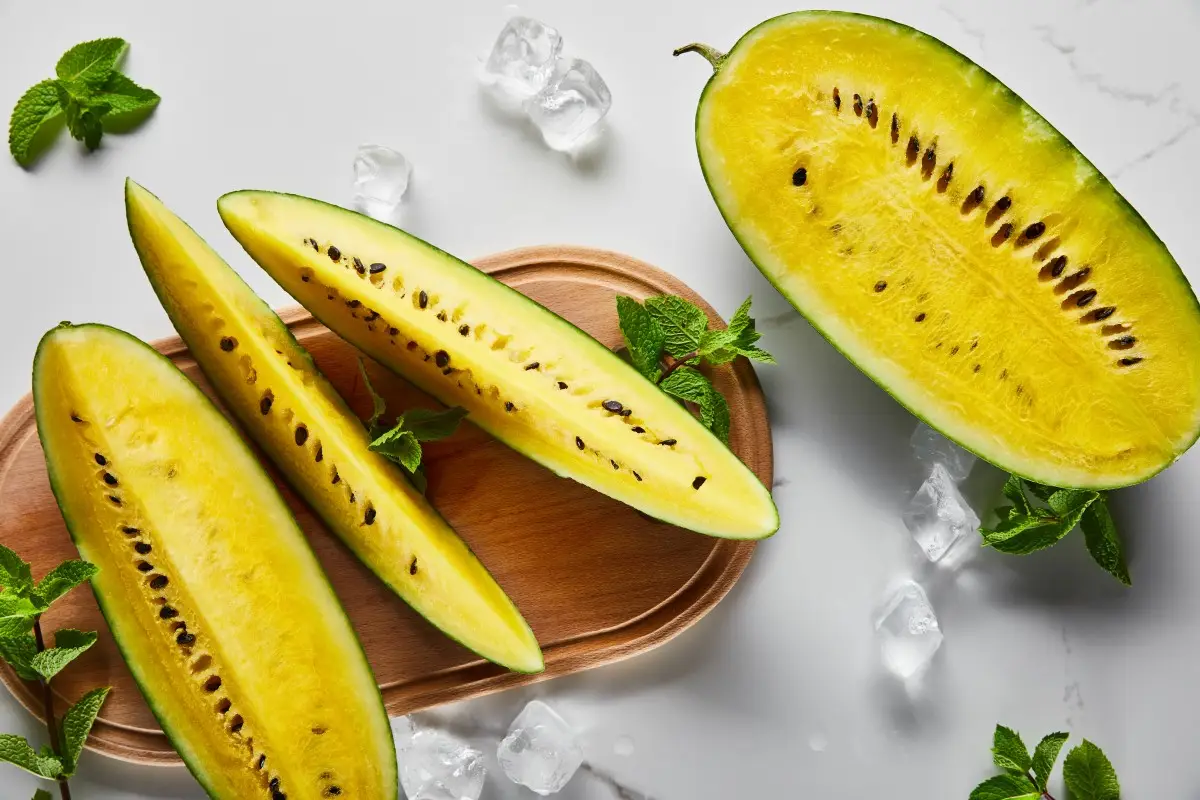
Everyone knows that watermelon brings several benefits to our health, and yellow watermelon is no different. It has all the qualities of regular watermelon, but with the addition of having an abundance of carotenoid, the substance that gives the yellowish appearance to the fruit, transformed in the body into vitamin A, which is mainly associated with the prevention of vision problems.
Moreover, due to having some diuretic properties, it is highly recommended by doctors for people who suffer from any kidney problems. These properties also help people who are in the process of losing weight, for those with high blood pressure and gout.
Another disease that yellow watermelon helps to prevent is asthma. Due to its high zinc and vitamin C content, this fruit helps to maintain and dilate the respiratory tract, thus preventing the recurrence of asthma. It can also help strengthen bones, as it also contains potassium and calcium, which are essential for the growth and strengthening of bones.
Other curiosities about yellow watermelon
There are many ways to consume this fruit, just like red watermelon, it can be added to foods like salads, and fruit smoothies, made into juices, or just consumed normally as one does with red watermelon.
Storing this fruit is quite easy; if it is uncut, it can stay on a counter for up to two weeks. After being cut, it is important to cover the exposed part of the fruit with plastic and store it in a refrigerator, so it will last about 3 to 5 days.
So, are you tempted to try yellow watermelon? If you are thinking of buying or planting yellow watermelon, know that its price in Brazil is around R$ 18.00 for ten watermelon seeds. You certainly won't regret adding this delicious and nutritious fruit to your summer menu.






Community
Comments
0 comments
There are no published comments in this language yet.
Send comment