
A round of golf in Japan can swallow the whole day. Not because eighteen holes are longer here, but because the course expects you to sit down for lunch after nine, change shoes in the locker room, and treat the clubhouse as part of the game rather than a place you rush past.
Japan is still one of the world's largest golf markets after the United States, with around nine to ten million golfers and more than two thousand courses. The first club opened on Mount Rokko, in Hyogo, in 1903, after Arthur Hasketh Groom and a handful of Kobe expatriates cut the earliest holes on the mountain. The score is only half of what stuck.
The sport gained real fame when Torakichi Nakamura, playing with Koichi Ono, won the Canada Cup in 1957. Clubs multiplied. Then the bubble years made membership a corporate trophy, and the crash that followed closed hundreds of courses. The grim side of that story is what made a weekday round reachable for people who never sat on a company board.
Contents 3
How do the Japanese play golf in Japan?
Many Japanese golfers still drive for hours to reach a course. Once they arrive, a round is rarely a sprint. Eighteen holes often take around five hours of play, and the whole outing can fill the day. That is a different rhythm from the American golfer who can finish 18 holes in three hours if the group wants to move.
The detail visitors forget is the lunch. After the front nine, most clubs send the group back to the restaurant for a sit-down meal of about 40 to 60 minutes. Curry, tonkatsu, noodles, a set lunch: it is a real plate, not a sandwich in a cart. Tee times for the back nine are built around that break. Trying to play straight through is the exception, except at some courses in Hokkaido and Okinawa.
Dress codes are enforced. A collared shirt and proper golf trousers or a skirt are the baseline; jeans and metal spikes stay in the bag. Some clubhouses still want a jacket at the door. Golf shoes go on in the locker room, not in the parking lot. At the first tee, a small bow to playing partners is ordinary courtesy, the same quiet respect you see before a match in other Japanese sports.
On the course, a few local marks stand out. A yellow flag often sits on the fairway about 230 yards from the regular tee, roughly where a decent drive should land. Extra yellow tees farther down the hole exist so a ball that went out of bounds does not stall the group. Black and yellow striped stakes mark a one-penalty area: unlike ordinary out of bounds, you take one stroke and play from near where the ball crossed the line.
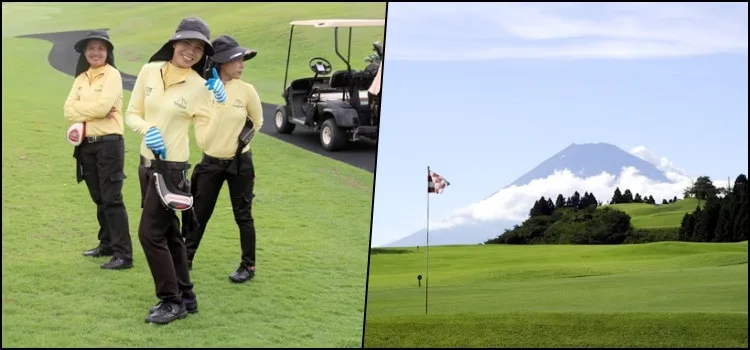
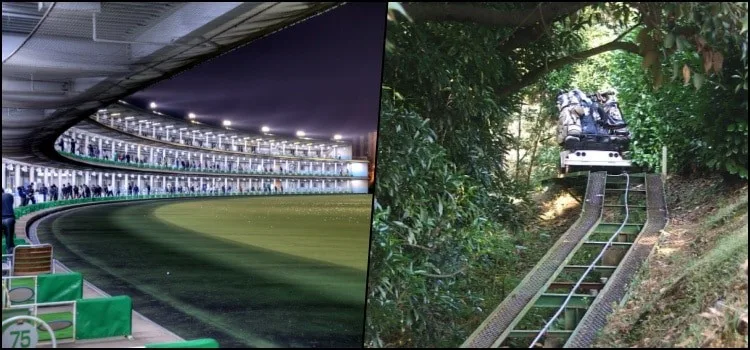
Caddies are still part of the picture at many clubs, and a large share of them are women in uniforms, wide hats, and the blue towels that became a visual cliché of Japanese golf. Some courses run radio-controlled or GPS carts that follow the bags. On steep mountain layouts, you may even find a rail or escalator hauling the cart up the slope. After the 18th, the day often ends in the clubhouse bath, the same logic as an onsen: wash first, then soak.
How much does it cost to play golf in Japan?
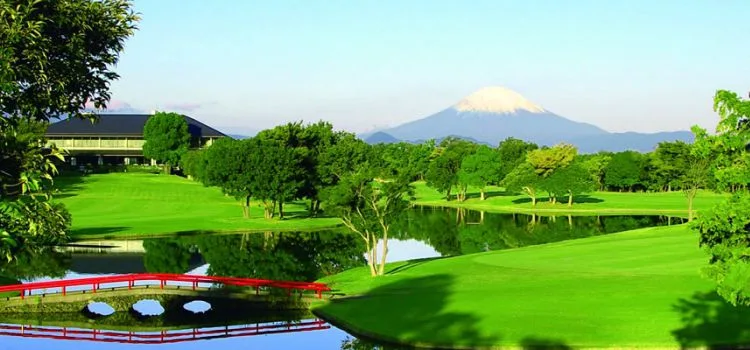
Golf was never a cheap sport in the West, and in Japan land prices made it harsher. In the 1980s a round could cost many times what an American public course charged. Those expensive memberships later collapsed under debt. What remains is a split: high-end private clubs that survived, and a much larger layer of public or semi-public courses you can book as a visitor.
On a regular weekday, an 18-hole package often lands between 7,000 and 12,000 yen per person, usually including lunch and a cart. Weekends, holidays, and courses near Tokyo or Osaka sit higher, often in the 15,000 to 25,000 yen range. Caddies, club rental, and transport stack on top of that. A visitor who needs everything can spend well above the green fee; the old round-number of a few hundred dollars is a ceiling for a full day with extras, not the weekday starting price.
The practical hurdle is booking. Many clubs still expect a reservation in Japanese, and only a handful make English online booking easy. A little language helps, or a hotel concierge, or a golf desk that already talks to the course. Knowing whether you need Japanese to travel is the same question in miniature: you can get by, but the phone call is smoother if you are not guessing every word.
If eighteen holes and a lunch break sound like too much calendar, the driving ranges are the other Japan. Hundreds of them sit behind green nets, sometimes two or three stories high, even in the middle of a city. Automatic tees spit a new ball every few seconds. A typical charge is about 10 yen per ball, cheaper or dearer depending on the neighborhood and the hour.
Curiosities involving golf in Japan
- In 2010, a golfer in Sendai sparked a fire in extremely dry grass with a shot; a stretch of the course burned.
- Golf became popular enough to get its own guardian. At Zenshoji temple in Annaka, Gunma, a stone Kannon holds golf clubs behind her back: the Golf Kannon, or Gorufu Kanzeon Bosatsu, put up in 1990 for the safety of course workers and a better score for the people who play.
- Perfect Liberty Kyōdan, a Japanese new religion, teaches that “life is art” and treats golf as a form of that art. Its headquarters in Tondabayashi, Osaka, sits beside a golf course, a school famous for baseball, and the tall Peace Tower.
- When the bubble burst, most of the roughly 2,400 clubs were in debt. By 2005 hundreds of courses had closed; some of the land became resorts or solar farms. The surviving map is still dense: Japan remains among the countries with the most golf courses on earth.
A Japanese golf day is closer to a small ceremony than to a quick nine after work. Have you ever had the chance to play in Japan? Or even somewhere else, with a lunch break waiting on the 10th tee?



Community
Comments
0 comments
There are no published comments in this language yet.
Send comment