
Magome (馬籠宿) is one of the best-known villages in Japan, and the reason is less a single building than the setting. The village hangs on a slope in the Kiso Valley, the main street climbs steeply, and the wooden houses still look the way people imagine an Edo-period post town. Coming from Nakatsugawa, a visitor steps into the nineteenth century within half an hour. Look closer, though, and the picture turns out to be maintained: much of the village burned down in the twentieth century and was rebuilt later. This article explains what Magome is, what is original and what is reconstruction, and how to plan a visit.

Contents 9
What Magome is
Magome-juku was one of the 69 post stations (shukuba) on the Nakasendō, the mountain route between Edo, today's Tokyo, and Kyoto. The road crossed the provinces of Musashi, Kōzuke, Shinano, Mino and Ōmi; Magome lies in what is now Nakatsugawa, Gifu Prefecture, at 611 metres above sea level and 326.7 kilometres from Edo. It belonged to the old province of Mino and was the last stop before the road entered Shinano.
The name Magome appears in Kamakura-period records from 1215, when the area is mentioned as part of the Tōyama Shōen granted by Minamoto no Yoritomo to Kikuhime, the half-sister of Minamoto no Yoshinaka. It became a planned post station only with the creation of the Nakasendō in the Edo period.
The Nakasendō and the post-station system
The Nakasendō was one of the five centrally administered roads of the Edo period and, together with the Tōkaidō, one of the two links between Edo and Kyoto. Sixty-nine stations lay between the two cities. They served travellers, but also the movement of goods and government communication. Every station had lodgings for travellers of different status, horses and porters.
A survey from 1843 survives for Magome. At that time the village had 717 inhabitants in 69 houses, including one honjin for high-ranking guests, one waki-honjin as an alternative, and 18 hatago, simple inns. The numbers show how precisely the system worked: each station had a fixed role and a fixed set of buildings.
Fires and reconstruction
With the arrival of the Chūō Main Line, the Nakasendō lost its function in the nineteenth century and Magome grew poor. Many of the old houses were destroyed by fires in 1895 and 1915. Much of what visitors see today is therefore reconstruction: in recent decades the village was restored to look like an Edo-period post town again. The central row of houses along the old road is rebuilt and follows the slope.
That is not a deception. There is, however, a reason to know the difference. Magome is a carefully reconstructed streetscape, not an untouched eighteenth-century village. Knowing this changes the way you look at the houses and explains why the place feels so tidy.
Shimazaki Tōson and the Kiso Valley
The area also became known through a writer. Shimazaki Tōson was born in Magome and grew up there. His novel Before the Dawn (Yoake mae) appeared between 1929 and 1935 and describes the upheaval of the Meiji period in the Kiso Valley. Tōson is buried in the village's small cemetery, and a museum commemorates him.
Anyone who only walks down the street misses this part. The link between landscape and literature is one reason why the stretch between Magome and Tsumago is now considered the best-known section of the Nakasendō.
The walk to Tsumago
East of Magome lies the next station, Tsumago-juku. Between the two villages travellers had to cross a pass of about 800 metres. Today a hiking trail crosses the ridge, and it can be started from either end. It is the best-known part of the Nakasendō in the Kiso Valley and can be walked in half a day.
On the way you pass forest, small streams and old road markers. In summer, start early, because the paths fill up later and the heat stays in the valley. Sturdy shoes make sense even though the route is not a high-mountain path.
What to do in Magome
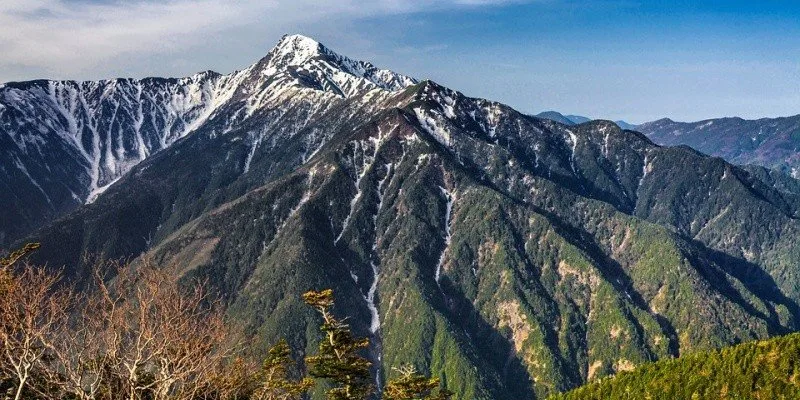
The village is small, and that is part of its character. The main things are quickly listed: the restored street with its shops, the Tōson Museum, the view of Mount Ena at 2,190 metres, and a pause in one of the cafés that serve local sweets and tea. A watermill and old workshops are part of the picture too.
With more time, walk down to Nakatsugawa or continue to Tsumago. The combination of a quiet village and a hike is the real reason to come here. For a single photo of the street, the trip would hardly be worth it.
Practical tips
Magome is reached via the Chūō Main Line to Nakatsugawa and from there by bus. Coming from Nagoya or Matsumoto, plan the day around the bus, because services are not frequent. Arriving early has two advantages: fewer people and better light on the row of houses.
For the walk to Tsumago: if you are travelling with luggage, leave it at the hotel or send it ahead. Weekdays are much quieter than weekends, and November and April are the most attractive months, which is also when most visitors come.
When to go
Every season has its own appeal. In spring the trees on the slopes bloom, in summer everything is green and warm, in autumn the forests change colour, and in winter snow often lies on the roofs. The street itself can be walked all year, but in snow and ice the route to Tsumago should only be attempted with proper equipment.
Conclusion
Magome is a post station that lost its form and regained it in the twentieth century: first through the railway, then through fires, finally through deliberate reconstruction. Visiting the village with that history in mind gives you more than a pretty picture. And walking the route to Tsumago shows why the Nakasendō in the Kiso Valley is still considered the most beautiful section of the old mountain road.
Read more: the five roads: Tōkaidō and Nakasendō, the Edo period and its shogunates, a trip to the Edo of the past, places and villages in Japan and the Meiji period.





Community
Comments
0 comments
There are no published comments in this language yet.
Send comment