
On a Friday afternoon in March, a stretch of ocean floor off Japan’s Tōhoku coast lurched with a force few living people had ever felt. Within minutes, the quake was rewriting maps; within hours, a wall of water was rewriting towns. The figures that follow are not a body count for shock value—they are the scale of what Japan faced on 11 March 2011, and why the disaster is still measured in “before” and “after.”
Official tallies, scientific estimates, and the long cleanup after the tsunami all point to the same truth: the Great East Japan Earthquake was not one crisis. It was three, stacked—earthquake, tsunami, and nuclear emergency—and the numbers only make sense when you hold them together.
Contents 5
The earthquake: scale you can measure
The mainshock struck at 14:46 JST on 11 March 2011. Japan’s meteorological services and international agencies place the magnitude at about 9.0–9.1, the strongest earthquake ever recorded in Japan and among the most powerful instrumentally measured worldwide since 1900. Ground shaking lasted roughly six minutes in many places—long enough for people to realize this was not a short jolt you wait out under a desk.
The rupture shifted Japan’s main island, Honshu, roughly 2.4 meters eastward. Seismologists also estimated a shift of Earth’s axis on the order of 10–25 centimeters and a tiny shortening of the day—about 1.8 microseconds—as the planet redistributed mass. Those planetary details sound abstract until you remember they come from the same slip that moved hundreds of kilometers of seabed.
Offshore, a broad swath of seafloor was displaced by several meters, feeding the tsunami that followed. Japan’s early-warning network—already among the most advanced in the world—gave Tokyo residents roughly a minute of notice before strong shaking arrived. That margin saved lives in tall buildings and on trains; it could not stop what the sea was about to do farther north.
Aftershocks were not a short epilogue. In the hours after the mainshock, multiple aftershocks of magnitude 7 or higher struck. Over the following years, thousands of smaller shocks continued—a long tail of geological stress release that kept reconstruction teams and coastal communities on edge.
The tsunami: the wave that did most of the killing
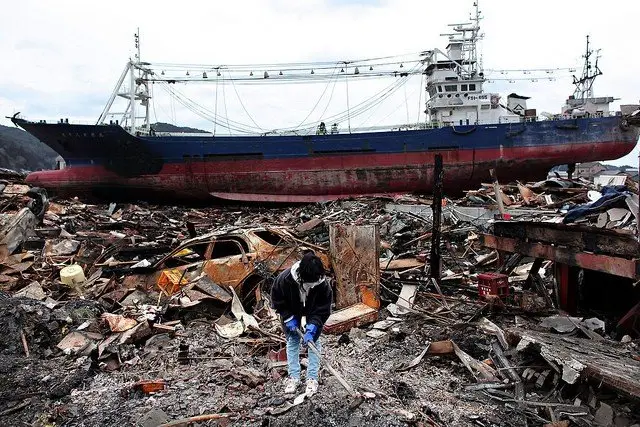
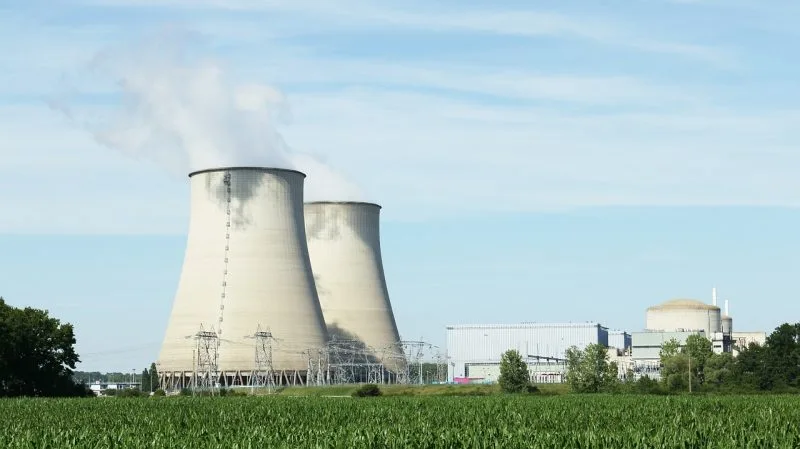
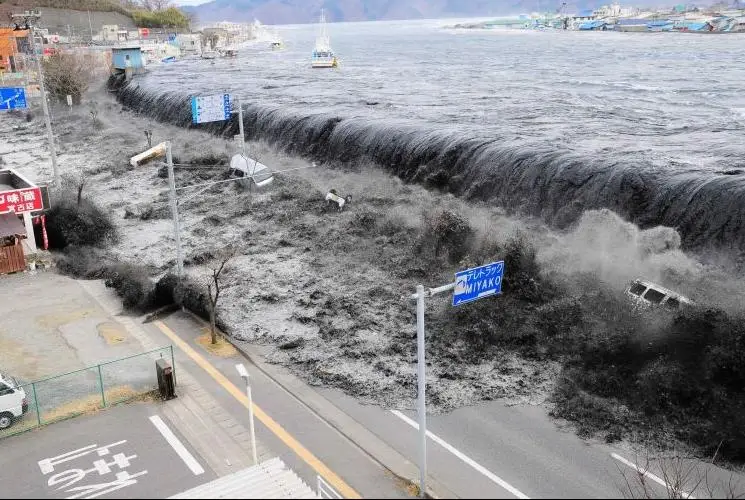
The earthquake’s energy did not stay in the rock. It shoved the Pacific, and the Pacific answered. Local run-up reached as high as about 40.5 meters (133 feet) near Miyako in Iwate Prefecture—roughly the height of a 13-story building. In the Sendai plain, the water raced inland as far as about 10 km, flooding on the order of 560 km² of land.
In the hardest-hit cities, residents often had only eight to ten minutes between the shaking and the first dangerous waves. Many evacuation routes and more than a hundred designated shelter sites were themselves overtaken by water. Cold weather and snow in some towns slowed rescue work after the surge. Most of those who died drowned in the tsunami, not under collapsed buildings—an important distinction for understanding both the disaster and Japan’s later investments in coastal planning.
The surge did not stop at Japan’s shoreline. The Pacific-wide tsunami damaged harbors far from Tōhoku and was large enough, in scientific reports, to break ice shelves in Antarctica. Those distant ripples never matched the human cost at home, but they show how far a single megathrust event can travel.
Fukushima Daiichi: when the sea hit the plant
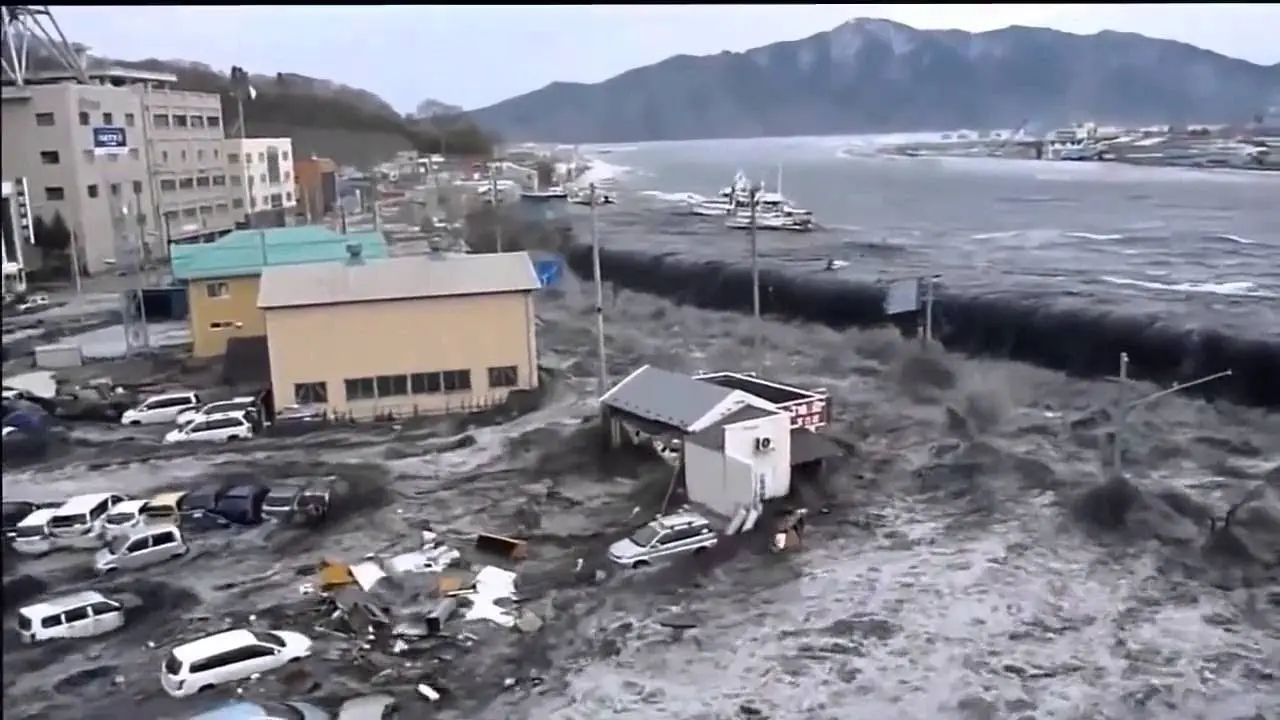
At the Fukushima Daiichi Nuclear Power Plant, tsunami waves of around 15 meters overwhelmed defenses designed for a lower scenario. Flooding knocked out backup power and cooling for the reactors. Three reactor cores melted down. Hydrogen explosions damaged reactor buildings. Authorities ordered mass evacuation; around 100,000 people or more left homes near the plant as exclusion zones expanded and changed over time.
The accident was rated Level 7 on the International Nuclear and Radiological Event Scale—the same top tier as Chernobyl, though the radioactive release profile and sequence of events were different. Years later, “Difficult-to-return” pockets and long decontamination work still mark the map. For many readers outside Japan, Fukushima became the face of 3.11; for people from the Sanriku coast, the tsunami’s wall of water remains the first memory.
Human cost, buildings, and the bill for recovery
Japan’s Reconstruction Agency summarizes the human toll in stark official terms: roughly 19,700 people confirmed dead, more than 2,500 still listed as missing, and about 6,200 injured. Combined dead and missing sit near 22,000—a figure that has moved slightly as investigations closed over the years, which is why older articles often show different intermediate counts.
Damage to the built environment was enormous. About 122,000 buildings were completely destroyed, roughly 283,000 half destroyed, and about 748,000 partially damaged. Early media tallies that spoke of “tens of thousands of buildings” captured only the first weeks of assessment; the full survey took years.
At the peak of displacement, hundreds of thousands of people were evacuated. Even more than a decade later, tens of thousands remained away from their original homes in some tallies, especially linked to nuclear-restricted zones. Direct economic loss estimates vary by method—Cabinet Office, World Bank, insurers—but sit in the hundreds of billions of U.S. dollars, commonly placing 3.11 among the costliest natural disasters on record.
What the numbers still teach
Japan did not invent disaster culture after 2011; the country already built for shaking, drilled schoolchildren for evacuation, and ran earthquake early warnings. The tragedy showed both the value of that culture and its limits when a tsunami arrives faster and higher than coastal defenses assumed. Construction codes, drills, and sensors still save lives every ordinary year—even when one extraordinary afternoon overwhelms everything.
If these figures leave you wanting the longer coastal story, start with the history of tsunamis that have struck Japan and the ranking of Japan’s worst recorded earthquakes. The statistics of 3.11 are a single chapter; the country’s relationship with the Pacific is a much longer book.

Community
Comments
0 comments
There are no published comments in this language yet.
Send comment