

Japanese, Korean, and Chinese people are often mixed up, even though language, culture, and daily habits are very different. This guide helps you spot the main differences more naturally and clearly.
First, it's worth remembering that no one can be identified by a single feature. Eye shapes vary a lot across Asia, and similar traits can also appear in many other parts of the world.
Another useful detail is that eye shapes vary a lot from person to person. In many East Asian faces, the upper eyelid can look different because a larger part of the eye may be covered by skin.
Contents 11
How to tell Japanese, Chinese, and Korean apart by language
The first obvious difference is the language. Once you hear someone speak, Japanese, Chinese, and Korean are usually easy to tell apart. Chinese is tonal and changes syllables in ways that stand out, while Japanese has a very different rhythm. Korean also sounds distinct enough once you get used to it.

An example I often notice is the pronunciation of "R." Many Chinese speakers tend to turn R into L, while many Japanese speakers have trouble with L because that sound does not really exist in Japanese. So you may hear something like Pastel de Flango from Chinese speakers and Pasuteru de Furango from Japanese speakers.
Another simple clue is the name. Japanese names often have more than four letters and rarely end in a consonant. Chinese and Korean names often end in consonants, especially M, NG, or N, and are usually made up of three syllables. Of course, you still need to hear the surname if the person also has a Western first name.
Many believe that Chinese and Japanese writing is practically the same, concluding that they are the same languages. We have already written a detailed article explaining differences in the Japanese and Chinese languages, you can read it by clicking here.
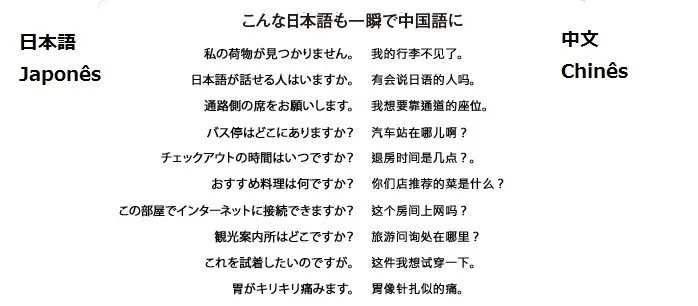
To put it very simply, Chinese characters can look full of strokes and components (他們有理性和良心), Japanese can look a little less crowded in some cases (私はケビンです), while Korean uses a mix of lines and circles (보기가 역겨워).
Physical differences between Japanese, Korean, and Chinese people
It is not easy to guess nationality by skin color alone, but some general patterns are often noticed. Some Chinese people may have slightly darker skin, while Koreans are often described as having lighter, smoother skin. Japanese faces are sometimes seen as wider, longer, and more triangular, while Korean faces are often described as having a stronger jawline and higher cheekbones. Chinese faces are often described as rounder.
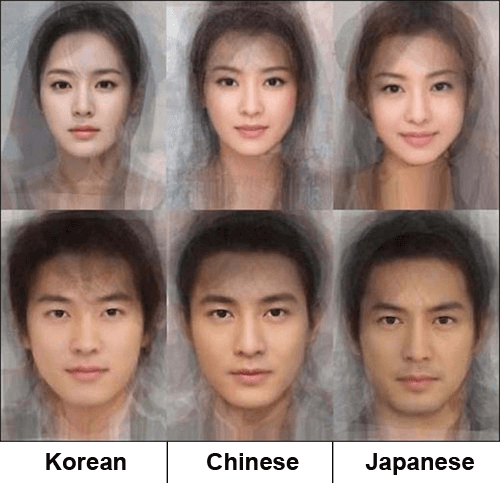
Japanese eyes are often described as slanting upward, while Chinese eyes are sometimes described as slanting downward. Korean eyes are often described as smaller in some general comparisons. When it comes to height, Koreans are often listed with a slightly higher average, followed by Japanese and then Chinese.
Hair is much harder to generalize today because styles are so diverse. In older descriptions, Koreans were sometimes associated with long hair tied back, Chinese with styled or wavy hair, and Japanese with hair curled at the ends and covering the forehead.
How to tell them apart by style, fashion, and culture
Another way to tell Japanese, Chinese, and Korean people apart is through style, fashion, and culture. Fashion changes very quickly, especially in Japan, where it can be extremely varied and unique. Chinese people are often associated more with wealth than with design trends or color choices, so it is not unusual to see shiny accessories, jewelry, gold, and a lot of Western-inspired fashion.
See also: What are the differences between Japan and China?
In Japan, fashion is a mix of traditional and modern, along with cute, colorful, and unique things. In Japan, fashion and style are very free, to the point that young people spend all their time in their school uniforms even outside of school. Korea cares a lot about fleeting fashion; they follow trends that are quick and care a lot about brands, tending to dye their hair more than Japan and China.
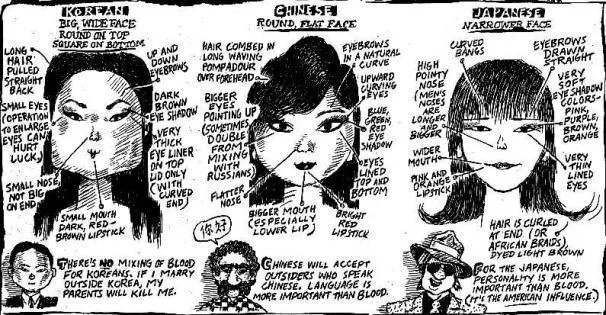
Stereotypical and somewhat racist image released in an old newspaper that received various criticisms.
Chinese people care a lot about reputation, behaving one way with family and another way with friends. Koreans tend to be quite insistent, valuing family, friendship, etc. Japanese people do not like to give opinions or interfere in others' lives; they prefer harmony with others rather than following their own opinion.
We recommend reading:
- See the differences in thinking between Asians and Westerners
- Meaning of Kawaii - Culture of cuteness in Japan
Can you already differentiate Japanese, Chinese, and Koreans?
I am terrible at memorizing faces, but I can quickly differentiate an Asian by their clothing, conversation, and other linguistic details. Things get a bit more complicated when we are trying to know the origin of a descendant living in Brazil; they are basically Brazilian, so we don't need to waste time trying to decipher their origins. Just ask!
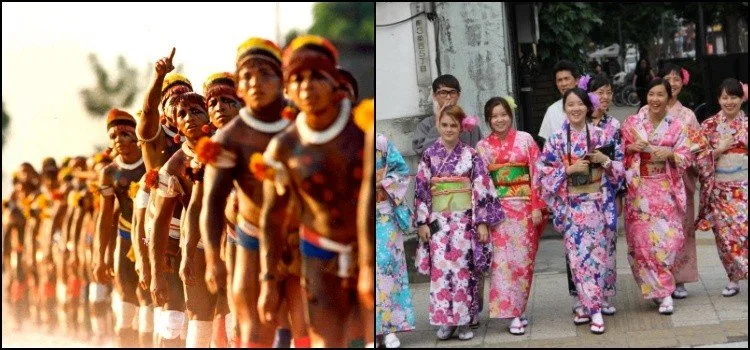
Some claim that there are great similarities between the Japanese and the Brazilian Tupi Guarani tribe.
The harsh reality is that Asians are quite different and have many variations within their own country. For example, northern Chinese tend to have square faces, small noses, and small eyes. Sometimes it can be difficult to differentiate Japanese from Chinese and Koreans! The countries mix; Koreans undergo plastic surgery to enlarge their eyes, so it gets a bit complicated.
With a short time in Japan, you will notice that Asians or even Japanese people differ completely from one another. They are not to blame for the food and climate contributing to standardized skin, eyes, and body.
Perhaps you want to read our other article that explains why Japanese or Asians have slanted eyes.
Therefore, in my opinion, the easiest way to differentiate is by language, name, and culture. If you think you can differentiate, test your knowledge by looking for quizzes on Google!

Other Ways to Differentiate Japanese, Chinese, and Koreans
Besides appearance, language, and clothing, there are many other ways to differentiate Japanese, Koreans, and Chinese, covering cultural, social, and behavioral aspects. Here are some examples:
Customs and Etiquette
- Japan: bowing as a form of greeting and thanks, strong sense of hierarchy and respect for elders, emphasis on punctuality and organization.
- South Korea: bowing is also used but less deeply than in Japan, handshake common among men, importance of family and respect for elders.
- China: handshake as a standard greeting, culture of banquets and toasts, emphasis on interpersonal relationships and "guanxi" (network of contacts).
Cuisine
- Japan: rice as a staple food, seafood, sushi, sashimi, tempura, ramen, sake.
- South Korea: rice also fundamental, kimchi (fermented and spicy napa cabbage) present in almost every meal, Korean barbecue (bulgogi), bibimbap.
- China: great regional variety, rice and noodles as staples, dishes with meats, vegetables, and tofu, dim sum, tea.
Arts and Entertainment
- Japan: manga and anime, tea ceremony, ikebana (flower arrangement), kabuki (traditional theater), traditional music (koto, shamisen).
- South Korea: k-pop and k-dramas, taekwondo, pansori (traditional narrative singing), folk dances, traditional music (gayageum, janggu).
- China: Chinese opera (Beijing, Sichuan, Kunqu), calligraphy, traditional painting, martial arts (kung fu, tai chi), traditional music (erhu, pipa).
Values and Beliefs
- Japan: Shintoism and Buddhism, harmony with nature, valuing teamwork and collective effort.
- South Korea: Confucianism, Buddhism, and Christianity, importance of education and academic success.
- China: Confucianism, Taoism, and Buddhism, respect for authority and hierarchy, pursuit of prosperity and material success.
Social Behavior
- Japan: introversion, avoiding direct confrontations, prioritizing group well-being, expressing emotions in a restrained manner.
- South Korea: important interpersonal relationships, hospitality, expressing emotions more openly than Japanese people.
- China: extroversion, valuing friendship and loyalty, expressing opinions more directly.
It is important to emphasize that these are generalizations and that there are many individual and regional variations within each country. However, understanding these cultural differences can help gain a deeper understanding and avoid misunderstandings when interacting with people from different backgrounds.
Videos to help you spot the differences
Here are two videos that can help you see the differences from another angle. Which details do you usually notice first when you try to tell Japanese, Korean, and Chinese people apart?
Were you able to differentiate the Japanese from the Koreans and Chinese?


Community
Comments
0 comments
There are no published comments in this language yet.
Send comment