Before starting to debate this subject, I must make it clear that this article was sent by my friend Eduardo Toda, who has a project to bring Japanese and Brazilians closer together, so much so that he wrote this article in both languages.
He sent me one among several documents that talk about these and other subjects. These documents show why the two cultures are quite different, especially in the way of thinking. While the Japanese first see the rules, Brazilians or other Westerners think they already know everything and just go ahead. This is causing many problems in factories, and people do not understand why.
Eduardo Toda's thought is to select and develop people interested in Japanese culture to go to Japan. His vision is to try to motivate those interested to specialize in any area of interest in Japan and to learn the language and culture. I hope you enjoy the text; this can be the first among many.
Contents5
Japanese suffering prejudice in Brazil
Little is said, but in 1945 there was a movement of mass violence against Japanese people in Osvaldo Cruz... In the region, groups of Brazilians invaded Japanese homes and dragged family members by their hair in front of their wives and children. They looted the residences...
Some things that led Brazilians to have prejudices against Japanese:
Japanese did not usually mix with Brazilians
Certainly, if the Japanese had been more communicative, they would not have suffered these barbarities. It does not justify a people committing injustices, but the lack of communication can end up generating these prejudices. This is quite similar to IJIME in Japan.
Over time, the Japanese gained the trust of the Brazilian people. To understand more about this subject, read our article on prejudice in Brazil.
Main differences between the two cultures
Let’s analyze the text extracted from a comment on the internet:
What is the difference between the Brazilian and Japanese people in a moment of crisis?
Brazilians look for someone to blame and want to know who will help the victims, while the Japanese first provide aid calmly, then think, if they think, about who is to blame. Brazilians cry, victimize themselves, while noble Japanese run after solutions with dignity. Brazilians quickly understand that it is the end, while Japanese at any moment understand that it is a new beginning, believing that everything will be rebuilt and recovered. - Yahoo Answers This is a view that a Brazilian has of a Japanese person today.
Brazilian
Japanese
Needs to talk
Needs to observe
Likes to be the center of attention
Likes to show what they did
Speaks loudly
Conversation disrupts concentration
Creates their own rules and does not follow others'
Follows more the formalities of the environment
Very good at arguments
Very good at visual details
Prefers more narrative texts
Likes more graphics and schemes
Expresses more feelings in words
Is more formal in words
Does not like hierarchy
Gives more attention to those who teach
Is more individualistic
Needs others' opinions
Worries about the past and future
Lives more in the moment
Some characteristics that Westerners think of Japanese:
Lack of sincerity (falseness) due to not showing what they feel;
Very detail-oriented;
Very clumsy, especially in decisions;
They are closed off. They live in their own world;
Some characteristics that a Japanese thinks of Westerners:
Lacks organization, and everyone does things their own way
Talks too much and does not work
Only lives for parties and has no commitments;
Is not faithful to what they say, that is, cannot be trusted;
The Japanese brain thinks differently from the Brazilian brain
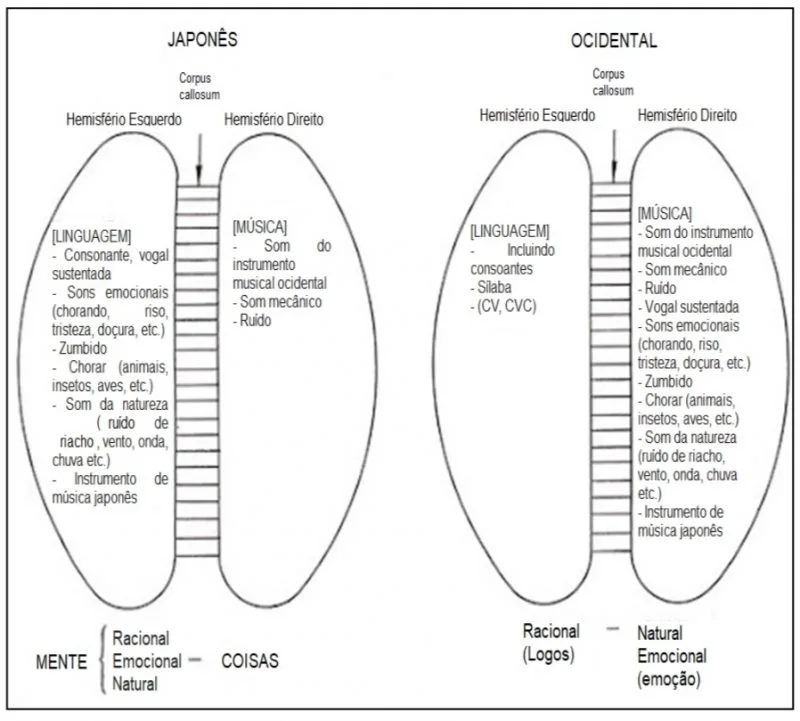
Just as Brazilians find the Japanese language difficult, Japanese people also find any Western language difficult. The origin and explanation lie in the use of the brain's hemispheres. A study has shown that the Japanese brain works differently compared to other Western peoples.
Certainly, this may have influenced the culture of the Japanese people in some way. The biggest difference between one culture and another has to do with the use of KANJI and HIRAGANA / KATAKANA, according to the book “Getting to Know the Brain” written by Luciano Mecacci. This book discusses the influence that ideograms and phonetics have on the use of the brain's hemispheres.
Neurosurgeon Raul Marino, an emeritus professor at the Faculty of Medicine at USP, presides over the Brazilian Institute of Ethics and Bioethics and is the author of the book “The Japanese Brain.” In this book, we can see some differences between the left and right hemispheres of the brain:
LEFT HEMISPHERE
RIGHT HEMISPHERE
Verbal: uses words to name, describe, and define;
Non-verbal: perception of things with minimal relation to words;
Analytical: deciphers things sequentially and in parts;
Synthetic: unites things to form wholes;
Uses a symbol that stands in for something else. For example, the + sign represents addition;
Relates things as they are at that moment;
Abstract: extracts a small portion of information and uses it to represent the entirety of the subject;
Analogical: finds similarities between different orders; understanding metaphorical relationships;
Temporal: maintains a notion of time, a sequence of events. Does one thing and then another, etc.;
Atemporal: without a sense of time;
Rational: draws conclusions based on reason and data;
Non-rational: does not require a basis of information and real facts; accepts the suspension of judgment;
Digital: uses numbers;
Spatial: sees things related to others and how parts come together to form a whole;
Logical: draws conclusions based on logical order. For example: a mathematical theorem or an argument;
Intuitive: makes leaps of recognition, generally from incomplete patterns, intuitions, feelings, and visual images;
Linear: thinks in terms linked to ideas, one thought following another and generally converging on a conclusion;
Holistic: perceives simultaneously, conceiving general patterns and structures that often lead to divergent conclusions.
“The Japanese are the only people who use both brain hemispheres independently, the left side for language and the right side for abstract thought.”
Conclusion of research involving the brains of Japanese and Westerners
What Professor Raul Marinho says is that the Japanese people stimulate both brain hemispheres, taking advantage of all functions. This would lead the individual to be more imaginative and more capable of solving difficult issues in their daily life, making them more resilient, resistant, and creative in the face of life's challenges. Of course, cultural factors also favor this.
Thus, we conclude that Westerners tend to logic, strategy, order, ideas, spoken language, and written language.
On the other hand, Japanese people have more tendencies toward observation, forms, patterns, creativity, and reasoning. According to the study, the configuration of the Japanese brain is not genetic but rather “software.” This configuration affects the way the brain's hemispheres are used, as shown in the following figure:
According to neuroanatomist and American scientist Jill Bolte Taylor, who herself experienced a stroke on the left side of the brain, says that “the right hemisphere functions as a parallel processor, while the left hemisphere functions as a serial processor.”
People who predominantly use the left hemisphere are excessively organized, perfectionists, detailed, and rational. Similarly, people who use the right hemisphere more are creative, dreamers, emotional, and intuitive (some of whom sometimes lack organization and attention to detail to realize their ideals).
Using only the left side of the brain or both sides does not mean that one is better than the other. Both minds (Western and Japanese) bring their own advantages and disadvantages. The best is the association of both worlds and making the most of each. Thus, it is important for everyone to know that these cultural differences exist and that the origin of all this lies in the “way of writing.”
What can we conclude about the differences between the Japanese and Western brains?
Westerners have individualistic characteristics and are more competitive. They think about achieving results quickly, working more with logic, that is, they pay more attention to “procedures.” Thus, decisions are quicker, but there is a higher number of errors due to “decision-making.”
The Japanese have more group characteristics and appreciate beauty more. Since they work more with the right side of the brain, they tend to pay more attention to the “rules of the group,” that is, they tend to dominate the whole before executing. That is why they are more careful in their decisions; in a way, this makes the process slower, but the “decision-making” is more accurate.
Therefore, we must understand that the process of adaptation of a Westerner to the Japanese system is quite complex. Starting with writing, as there is a significant barrier to be broken to create new habits of reading KANJI.
After all, the same process used to learn other languages, such as English, Spanish, and other similar languages, does not fully apply to learning Japanese. One must develop another area of the brain, and for that, one must have patience and a lot of will.
Kevin Henrique has written about the Japanese language, culture, anime, games, and travel since founding Suki Desu in 2014. He first visited Japan in 2016.
Community
Comments
0 comments
There are no published comments in this language yet.


 According to neuroanatomist and American scientist Jill Bolte Taylor, who herself experienced a stroke on the left side of the brain, says that “the right hemisphere functions as a parallel processor, while the left hemisphere functions as a serial processor.”
People who predominantly use the left hemisphere are excessively organized, perfectionists, detailed, and rational. Similarly, people who use the right hemisphere more are creative, dreamers, emotional, and intuitive (some of whom sometimes lack organization and attention to detail to realize their ideals).
Using only the left side of the brain or both sides does not mean that one is better than the other. Both minds (Western and Japanese) bring their own advantages and disadvantages. The best is the association of both worlds and making the most of each. Thus, it is important for everyone to know that these cultural differences exist and that the origin of all this lies in the “way of writing.”
According to neuroanatomist and American scientist Jill Bolte Taylor, who herself experienced a stroke on the left side of the brain, says that “the right hemisphere functions as a parallel processor, while the left hemisphere functions as a serial processor.”
People who predominantly use the left hemisphere are excessively organized, perfectionists, detailed, and rational. Similarly, people who use the right hemisphere more are creative, dreamers, emotional, and intuitive (some of whom sometimes lack organization and attention to detail to realize their ideals).
Using only the left side of the brain or both sides does not mean that one is better than the other. Both minds (Western and Japanese) bring their own advantages and disadvantages. The best is the association of both worlds and making the most of each. Thus, it is important for everyone to know that these cultural differences exist and that the origin of all this lies in the “way of writing.”


Community
Comments
0 comments
There are no published comments in this language yet.
Send comment