
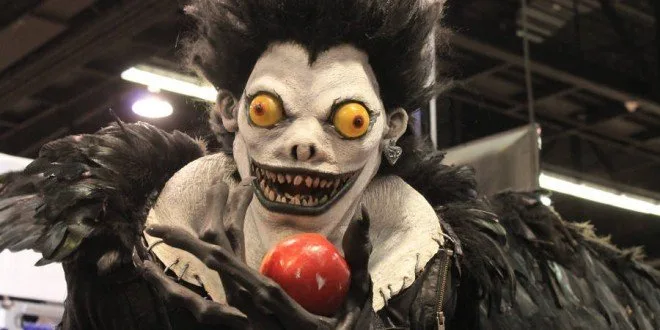
If you somehow missed Death Note, you probably just walked into anime at the wrong corner of the map. The series still sits among the most quoted psychological thrillers of the 2000s — not because of flashy power-ups, but because a notebook turns every name into a moral trap.
This page stacks the essentials: where the manga and anime came from, a spoiler-free outline of the premise, a full spoiler track for readers who already jumped in, franchise spin-offs that followed, and a handful of production trivia. Heavy spoilers start after the synopsis section — skip ahead only if you want the whole cat-and-mouse broken open.
Contents 7
Death Note – Technical Information
Death Note is a Japanese manga written by Tsugumi Ohba and illustrated by Takeshi Obata. It ran in Shueisha’s Weekly Shōnen Jump from December 2003 to May 2006. Its 108 chapters were collected in 12 tankōbon volumes between April 2004 and July 2006.
Madhouse adapted the story into a 37-episode anime directed by Tetsurō Araki, which began airing in Japan on October 3, 2006. A novel by Nisio Isin arrived the same year, and Konami published Nintendo DS games based on the franchise. Viz Media licenses the main print and anime catalog in North America (games and soundtracks sit outside that deal).
Live-action expansions piled up fast: three Japanese films (June 17, 2006; November 3, 2006; February 2, 2008), a 2015 TV drama, the 2016 miniseries Death Note: New Generation and the film Death Note: Light Up the New World, plus an American Netflix film released on August 25, 2017 — you can also browse a wider streaming context in our Netflix anime list.
Story and Synopsis of Death Note
A shinigami — a god of death — can kill anyone by writing that person’s name in a notebook called the Death Note, as long as the writer knows the victim’s face. Bored with the shinigami realm, Ryuk drops his notebook into the human world to see what a mortal would do with it.
High-school prodigy Light Yagami finds the Death Note and tests it by writing the name of a criminal. When the man dies, Light understands the power he is holding. Disgusted with crime and corruption, he starts executing criminals under the public nickname Kira, aiming for a “cleaner” world that would eventually worship him as a god. The Japanese police open a case; the enigmatic detective known only as L joins the hunt. What begins as a supernatural experiment becomes a pure mind game.
If the alias “Kira” already rings a bell, we also unpacked the name itself in a separate note on the meaning of Kira in Japanese.
Spoilers about Death Note
Major spoilers from here on.
After confirming the notebook works, Light keeps killing high-profile criminals. Ryuk appears as the previous owner and hangs around for the entertainment value. L stages a televised trap and forces Light to reveal that Kira is operating from Japan’s Kanto region. Light vows to erase L; L concludes that Kira has inside access to the Japanese investigation led by Light’s father, Soichiro Yagami. FBI agents sent to monitor investigators’ families are wiped out by Light, but L still narrows the suspect list until Light himself sits near the top.
Light graduates and enters college. L recruits him into the task force — each of them trying to bait the other. Model-actress Misa Amane receives a second Death Note from the shinigami Rem and trades half her remaining lifespan for the shinigami eyes, which reveal names from faces alone. Misa identifies Light as the original Kira and demands a relationship; Light accepts to exploit her eyes. L arrests Misa as the likely second Kira. Rem threatens Light if Misa is not saved.
Light’s answer is radical: he and Misa temporarily lose their memories of the Death Note while Rem passes a notebook to Kyosuke Higuchi of the Yotsuba Group, creating a temporary third Kira.
Second arc of the anime
Without Death Note knowledge, Light works the case sincerely. He and L unmask Higuchi, seize the notebook, and force the shinigami reality into the open. Touching the Death Note restores Light and Misa’s memories. Light kills Higuchi and reclaims ownership. When L closes in on Misa again, Rem kills L to protect her and dies for breaking the shinigami rule against saving a human’s life.
Years later, L’s potential successors surface: Near and Mello. Both treat “the new L” (Light) as a prime suspect. Mello’s mafia alliance kidnaps Light’s sister; Soichiro dies during the rescue. As heat rises on Misa, Light hands her notebook to the zealot Teru Mikami and installs newscaster Kiyomi Takada as Kira’s public voice. Mello kidnaps Takada; she kills him with a hidden scrap of Death Note paper, then dies when Light writes her name to erase loose ends.
Near arranges a warehouse showdown. Light orders Mikami to wipe out the task force and Near — but Mikami’s notebook is a decoy Near swapped in. The real page proves Light is Kira: every name is there except Light’s. Chaos breaks out; Light is badly wounded. Ryuk writes Light’s name, ending the game the same way he always promised he would if Light ever lost.
Curiosities about Death Note
A few details fans still trade after the credits:
- The manga’s 108 chapters echo the 108 bells of worldly desires rung at New Year in Japan — a deliberate structural nod, not a random count.
- Real-world “Death Note” replicas have gotten students and adults suspended or fired when names of classmates or colleagues appeared inside them. The prop looks harmless until someone treats it as a threat list.
- The pilot chapter featured a Death Eraser that could revive people whose names had been written — a rule that did not survive into the main serialization.
- Fans sometimes note that “Yagami” written backward looks a little like the English joke phrase “I’m a gay.” It is internet wordplay, not an official author statement about Light’s relationship with Misa.
- The window for writing detailed causes of death (40 seconds after the name, with a total span often remembered as 6:40 in fan discussion) has been read as a playful biblical echo of creation and flood timelines — take it as flavor, not doctrine.
- Early design talk leaned toward more conventionally “attractive” shinigami; Obata’s eerie, bone-and-ink look is what stuck.
- Early planning floated Mello and Near as L’s children before the story settled on Wammy’s House successors instead.
Sequels, one-shots, and “will there be more?”
The core manga and the 37-episode anime both end. What followed is a mixed bag of continuations, not a single official “season 2” of the original TV show.
On the manga side, Ohba and Obata returned with one-shots later collected in Death Note: Short Stories (including the 2008 “C-Kira” story and the 2020 “a-Kira” story). Those pieces check in on a post-Light world, Near’s judgment of lesser Kiras, and Ryuk’s continued boredom — side doors into the setting rather than a full second series.
Japanese live-action films and the 2016 pair New Generation / Light Up the New World invent new Death Note users years after their continuity’s Kira case. They can be fun franchise leftovers, but they do not rewrite the manga’s ending. The 2017 Netflix film is a separate American reimagining with different character dynamics; treat it as its own product, not a missing anime season.
Ohba (widely understood as a pen name) later focused on other long-form collaborations with Obata such as Bakuman and Platinum End. If you want the detective-story of the byline itself, we also covered the public mystery around Tsugumi Ohba’s identity. As long as the notebook stays iconic, remakes and games will keep arriving — but the original duel between Light and L is already complete.
What do you think of Death Note?
Personally, I still respect how cleanly the series weaponizes intelligence. It breaks a lot of shōnen habits: victory is not guaranteed by friendship speeches, and the ending refuses to flatter Kira’s god complex. Whether you prefer the anime’s cinematic finish or the manga’s colder close, the central bet holds — power without limits is a character study, not a power fantasy.
If you already finished the show, the short stories and spin-offs are optional dessert. If you have not started, keep the spoiler section closed and let the first notebook page do the work.





Community
Comments
0 comments
There are no published comments in this language yet.
Send comment