
Hello everyone, how are you? While watching anime, I often see some vulgar words and insults used mainly in moments of anger and other various occasions. Thinking about that, in this article we will learn more about these words. We will learn some slang, swear words, insults, and vulgarities present in anime.
Swear words in Japanese are one of the most searched things on the internet, so much so that we already have an article about insults and swear words in Japanese. This time, however, we will go into detail about these swear words, being more specific, we will talk about the most heard ones in anime. To help navigate the article, we will leave a summary below:
Kuso – 糞 – Shit
Kuso means crap or shit. This is one of the most versatile words in the language and can be used in various situations. This word is informal and is an insult, but it fits in situations like when you hit your pinky toe on the corner of the sofa or when you spill juice on your new shirt; who knows where you will use it.
The ideogram [糞] of the word kuso literally means nonsense, shit, damned, feces, excrement, dung, damn, stupid, bastard, and things like that. There are several variations of words that can slightly change the meaning of the expression. It is one of the most heard insults in anime.

Uzai – ウザイ – Annoying
Uzai literally means annoying or noisy in Japanese. I see this word being used a lot when female characters are angry with someone and throw a tantrum. It is common but not the only way to use it.
If we take a look at the word, we will see that it has several ways to be used, either as an insult or not. And not just this one, but many others also follow this path. This is what is interesting about some insults; they derive from common words.
Note: You can also use “uzai” as “shut up.” It is likely that this expression is derived from the word urusai, which we often hear in anime, and which also means shut up or noisy.
Damare – Another word that means shut up. We can classify it as an aggressive word due to its nature. But it does not apply to all cases.

Chikushou – 畜生 – Damn, animal
Chikushou literally means a despicable person. But the daily usage is quite different. When used as a sudden interjection, it is similar to kuso! So, you can use it in the same way as “damn” or “crap.” This is an example of an ambiguous insult.
The word is written with the ideograms [畜] which means livestock, domestic animal, and [生] which means life. In other words, we are literally saying that the person leads an animal’s life, a despicable life. Variations of this word can give the sense of son of a bitch, incest, unforgivable action, and things like that.
Baka – バカ- Idiot, fool
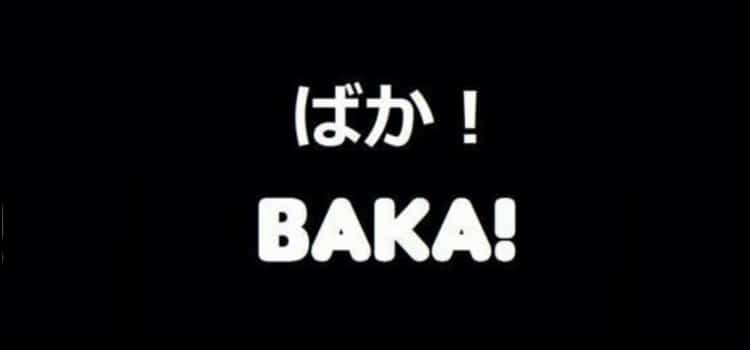
Baka is a very common Japanese word. If you use it on a person, you can use it to say stupid, foolish, or idiot. I believe it is the most well-known as I have yet to watch an anime where this word is not mentioned at least 5 times.
After hearing this insult in Japanese so much, I even use it daily without realizing it; I only notice after the fact. It is simple, quick, easy, and very utilitarian; how can you not use it?
Bakayarou – There is not much difference when superficially analyzed, but there is a significant difference between Bakayarou and Baka. When using Bakayarou, it does not just mean idiot, but a complete idiot.
To explain better, we can say that this is an upgrade of Baka. Or rather, something far beyond a “normal” idiot. I don’t think there is a better explanation for this, and I ended up remembering that easy things are the hardest to explain.

Aho – 阿呆 – Idiot
Well, the Japanese language definitely has many ways to call someone stupid. Aho means idiot, senile, simpleton, or mentally slow. Aho is similar to Baka, although it uses different ideograms. The main difference is that aho is usually used in the Kansai region while baka is used in other central and northern regions like Tokyo.
It is not one of the best ways to be insulted. I believe no one likes to be compared to a senile person. But no one likes to be insulted, and that is why it is called an insult. Divergences always occur, and it is good to always be prepared for those times.
Yatsu – 奴 – Guy
The Japanese language has many secrets and mysteries, and some of them form in subtle things like this insult. Yatsu means just “guy,” but carries a lot of negative air. So, while you are not insulting them, you are placing them at levels below you, referring to them as that (Yatsu can also be used to refer to things).
To explain better, we can make an analogy to “muleque” here in Brazil; if we research it, it means just boy, but it is also a way to belittle other people. For this reason, it is good to be careful with translations that are made; they can lead to a big misunderstanding.
Fuzakeru na – ふざけるな – Don’t joke!
Fuzakeru means to joke, and the particle na is used to negate the word. In other words, don’t joke with me! When used aggressively, it used to alert, intimidate, warn, or threaten other people.
It may not be an explicit insult, but the reference is implicit in the meaning and the way it was used. For this reason, I like to classify it as an aggressive word. How can it not be an aggressive word when someone intimidates you in this way?
The word fuzakeru [巫山戯る] literally means to joke in the sense of deceiving, mocking, laughing at something, making a joke with someone. It is composed of the ideograms [巫] which means wizard, [山] which means mountain, and [戯] which means to play and joke.

Shinee – 死ねえ – Die!
Literally die! It doesn’t need much explanation for this one, as the word itself says it all. I usually see it being used right after the cliché of the protagonist seeing the girls’ panties or entering the room when they are naked. But not just in those situations.
Debu – デブ – Fat
This word literally means fat or chubby, which can or cannot be an insult. Other ways to say fat in Japanese are futoi [太い]; marumaru [丸々] which gives the idea of round, chubby; and chuubutori [中太り] which literally means overweight.
It fits perfectly to describe the protagonist of Accel World, being the most well-known Debu in anime, and also the luckiest Debu of all since he achieved what many dreamed of achieving. Here’s a tip to watch; it is also worth reading the light novel since there is no forecast for a second season.

Hentai – 変態 – Perverted
Speaking of classic words, this means sexually perverted. Its usage is quite common, and here’s a tip not to confuse it with the adult genre of anime. You have to pay attention to the context. To delve deeper into the subject, we wrote an article below explaining why in the West Hentai is used to refer to adult content in anime.
Nanda – なんだ – What the hell?
What the hell? I would classify it as an aggressive question, if such a designation exists. But it is also common to see this question in anime; I believe it is used more than more formal words. It is also accompanied by others to add more emphasis to sentences or even to formulate other questions.
An example is “Nanda yo omae-wa?” which means “Who the hell do you think you are?” But there are also other forms.

Temee – 手前 – You!
To bring back the discussion of words to be careful when translating, this is an example of them, and here’s a warning for anyone who thinks it’s nothing serious. Literally, it can just mean “you,” but in practice, it’s a different story. This “you” is used as an insult, but I can’t recall an analogy I can make to explain it better.
The word temee is written with the ideograms [手前] which means hand and front, thus indicating the person who is in front of me. It is mainly used by men and carries a very vulgar and aggressive tone.
Other slang and swear words in anime?
That’s all for this article. There are many other insults, aggressive words, and others of the kind that are not on this list. I tried to include only the most popular and well-known ones; for this, I used my experience with anime to remember all the ones I had heard before, and with that, I made the selection I presented.
I believe this topic has its controversies, but not everything in life is roses, and every language has its bad words just as a garden has its weeds. But if you have any suggestions, questions, criticisms, or others of the kind, just leave your comment. Otherwise, thank you, dear reader, for reading this article up to here. See you next time!
Leave a Reply