
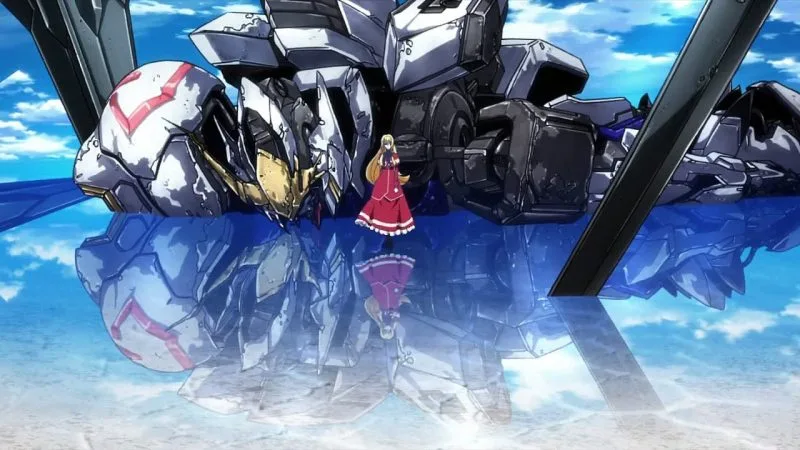
If you grew up with a robot toy in your hands, you already know the basic idea behind Gundam: a machine with a cockpit, a pilot and a war around it. The franchise made that idea specific in 1979, when Mobile Suit Gundam put a reluctant teenager inside an 18-meter weapon and asked what that does to a person.
Nearly five decades later, the catalog is large enough to confuse anyone. Gundam includes dozens of series, films, OVAs, manga, novels, games and a model kit industry, and most of it happens in timelines that do not connect. This guide explains what Gundam is, how the main calendars work and which series make a good first watch.
Contents 27
What Gundam is
Gundam is a Japanese science fiction franchise about piloted combat robots called mobile suits. The Gundam of each story is usually a prototype or a one-off machine with better performance than the mass-produced units around it. The tone stays military. Pilots deal with maintenance, fuel, chain of command and civilian casualties, and the stories treat war as a political failure rather than a tournament.

That approach made Gundam the reference point for the real robot branch of mecha anime. Giant robots had already appeared in Tetsujin 28-go in 1963 and Mazinger Z in 1972. Gundam's contribution was to make the robot a weapon of an army, vulnerable and replaceable, and to put an ordinary boy in the cockpit. The wider history of the genre is covered in our guide to the mecha genre in Japan.

Where the name comes from
Production began under the title Freedom Fighter Gunboy. Early drafts also used "Freedom" in the name of the ship, the fighter and the transport. The commonly told origin is that the writing team combined "gun" with the last syllable of "freedom" and arrived at Gundom. Yoshiyuki Tomino changed it to Gundam, describing a unit that carries a gun powerful enough to hold back an enemy the way a dam holds back water.
You will often see the claim that Gundam is short for "Gun and Freedom". The word did grow out of that wordplay, but the abbreviation is wrong. In Japanese the name is written ガンダム and read gandamu.
How the franchise started
Mobile Suit Gundam was produced by Nippon Sunrise and directed by Yoshiyuki Tomino, with Hajime Yatate credited as co-creator. Yatate is a collective pseudonym that Sunrise uses for staff collaborations, not a single writer. The series ran from April 7, 1979 to January 26, 1980 on Nagoya Broadcasting Network and its ANN affiliates.
Ratings for the first broadcast did not justify a sequel. Sponsors cut the planned 52 episodes to 39, and the staff negotiated a one-month extension that brought the count to 43. The turnaround came later, when reruns and a film trilogy found a teenage audience. Bandai's plastic models arrived in 1980, and the combination of broadcast repeats and affordable kits turned a cancelled show into a franchise.
Three compilation films remain the quickest way into the original story: Mobile Suit Gundam I on March 14, 1981, Soldiers of Sorrow on July 11, 1981, and Encounters in Space on March 13, 1982. They reuse footage from the series with new animation and a tighter cut.
The story of the original series
In UC 0001, humanity begins building space colonies at the Lagrange points around Earth. By UC 0058, the colony called Side 3 declares independence and becomes the Republic of Zeon under Zeon Zum Deikun. Deikun dies in UC 0068, the Zabi family takes control, and the Republic becomes the Principality of Zeon.
On January 3, UC 0079, Zeon attacks the Earth Federation. The first month of the One Year War kills about three billion people, and the Antarctic Treaty of January 31 bans weapons of mass destruction without ending the fighting. Zeon relies on the Zaku II, a mass-produced mobile suit. The Federation answers with the RX-78-2 Gundam, a prototype whose data leads to the mass-produced GM line.
The war ends at A Baoa Qu on December 31, UC 0079, and Zeon surrenders on January 1, UC 0080. Amuro Ray, the civilian teenager who ends up piloting the Gundam, and Char Aznable, the Zeon ace known as the Red Comet, become the central pair of the Universal Century.
Gundam broke with the super robot formula by letting the hero's machine be damaged, repaired and outclassed. That fragility is why later stories can revisit the same war from the cockpit of a Zaku or a Federation grunt.
Why there are so many timelines
The success of 1979 pushed the franchise beyond a single story. Sunrise and Bandai wanted new series that did not all share the same future, so they created separate calendars with their own wars and characters. Fans call these worlds alternate universes. The structure has a practical benefit, because a new viewer can start with a recent series without watching forty years of continuity.
Bandai acquired Sunrise in 1994 and began coordinating anime, films, OVAs, manga, novels, games and model kits as one business. The franchise is now owned by Bandai Namco Holdings through Sotsu and Bandai Namco Filmworks. Its annual revenue reached ¥145.7 billion by 2024. That corporate structure explains the shape of the catalog: several self-contained series running in parallel, with the Universal Century as the long spine.
| Era | Abbreviation | Key titles | Good first watch |
|---|---|---|---|
| Universal Century | UC | Mobile Suit Gundam, Zeta Gundam, Unicorn | Mobile Suit Gundam (1979) or the film trilogy |
| Future Century | FC | Mobile Fighter G Gundam | G Gundam (1994) |
| After Colony | AC | Gundam Wing, Endless Waltz | Gundam Wing (1995) |
| After War | AW | After War Gundam X | Gundam X (1996) |
| Correct Century | CC | Turn A Gundam | Turn A Gundam (1999) |
| Cosmic Era | CE | Gundam SEED, SEED Destiny, SEED Freedom | Gundam SEED (2002) |
| Anno Domini | AD | Gundam 00 | Gundam 00 (2007) |
| Advanced Generation | AG | Gundam AGE | Gundam AGE (2011) |
| Regild Century | RC | Reconguista in G | Reconguista in G (2014) |
| Post Disaster | PD | Iron-Blooded Orphans | Iron-Blooded Orphans (2015) |
| Ad Stella | AS | The Witch from Mercury | The Witch from Mercury (2022) |
Universal Century in order
The Universal Century is the original timeline and the one with the most entries. The dates below are story dates, not release dates. For a first pass, watch Mobile Suit Gundam or its film trilogy, then Zeta Gundam, Gundam ZZ, Char's Counterattack and Unicorn.
UC 0068 to 0079: the road to war
Mobile Suit Gundam: The Origin (OVA, 2015 to 2018) adapts Yoshikazu Yasuhiko's manga and spends most of its running time on Casval and Artesia before the war. It assumes you know the original story, so it works better as a second visit than as an entry point.
- UC 0068 to 0079: Mobile Suit Gundam: The Origin (OVA, 2015 to 2018)
- UC 0079: Mobile Suit Gundam (TV, 1979 to 1980, 43 episodes) and the film trilogy (1981 to 1982)
- UC 0079: The 08th MS Team (OVA, 1996 to 1999), MS IGLOO (OVA, 2004 to 2009), 0080: War in the Pocket (OVA, 1989), Thunderbolt (2015 to 2017) and Requiem for Vengeance (ONA, 2024)
UC 0083 to 0089: Stardust, the Titans and Neo Zeon
Stardust Memory bridges the One Year War and Zeta Gundam, which introduces the Titans, a Federation unit that turns on the colonies it was meant to protect. Gundam ZZ continues directly from Zeta and lightens the tone after its dark ending.
- UC 0083: Mobile Suit Gundam 0083: Stardust Memory (OVA, 1991 to 1992)
- UC 0087 to 0088: Mobile Suit Zeta Gundam (TV, 1985 to 1986) and A New Translation (films, 2005 to 2006)
- UC 0088 to 0089: Mobile Suit Gundam ZZ (TV, 1986 to 1987)
UC 0093 to 0096: Char's Counterattack and Unicorn
Char's Counterattack (1988) closes the conflict between Amuro and Char. Unicorn (2010 to 2014) picks up in UC 0096, sixteen years after the end of the One Year War, and follows a student who inherits the key to a political secret. Hiroyuki Sawano's score is one of the OVA's main draws, and his work across anime is covered in our Sawano guide.
- UC 0093: Mobile Suit Gundam: Char's Counterattack (film, 1988)
- UC 0096: Mobile Suit Gundam Unicorn (OVA, 2010 to 2014) and Silver Phantom (VR film, 2024)

UC 0105 to 0223: Hathaway, F91 and the far future
Hathaway adapts Tomino's novels about the son of a Federation hero who joins an anti-government movement. The first film arrived in 2021 and the second, The Sorcery of Nymph Circe, opened in Japan on January 30, 2026. F91 jumps to a new generation with smaller mobile suits, and Crossbone Gundam continues that story in manga form.
- UC 0105: Mobile Suit Gundam: Hathaway (films, 2021, 2026 and a third still to come)
- UC 0123: Mobile Suit Gundam F91 (film, 1991)
- UC 0133: Mobile Suit Crossbone Gundam (manga, 1994 to 1997)
- UC 0153: Mobile Suit Victory Gundam (TV, 1993 to 1994)
- UC 0203: Gaia Gear (novel, 1987 to 1991)
- UC 0223: G-Saviour (TV film, 2000)
The standalone timelines
These alternate universes are self-contained. They reuse the vocabulary of Gundam, with mobile suits, a conflict between Earth and the colonies, and a young pilot in the middle. Each one tells a story that ends without requiring the others.
Future Century: G Gundam
Mobile Fighter G Gundam (1994 to 1995) replaces war with a tournament held every four years, where representatives of the nations fight for control of Earth. The series is deliberately over the top, with pilots controlling their robots through body movements and fights that look like martial arts films.
After Colony and Mars Century: Gundam Wing
Five young pilots from the colonies bring their Gundams to Earth to fight the Earth Sphere Alliance and the Zodiac organization. Gundam Wing (1995 to 1996) became the franchise's first big hit in the United States when it aired on Toonami in 2000. Endless Waltz (1997) closes the story, and the novel Frozen Teardrop (2010 to 2015) continues it on Mars.
After War: Gundam X
After War Gundam X (1996) takes place after a war that dropped space colonies onto Earth. The population is decimated, and a small group of survivors travels through the ruins. The series gives Newtypes a central role, something rare outside the Universal Century.
Correct Century: Turn A Gundam
Turn A Gundam (1999 to 2000) is set in the Correct Century. The Japanese name, Seireki (正暦), is a pun on the word for the Western calendar (西暦). The story takes place after a "Dark History" and connects almost every earlier Gundam timeline without explaining all of them.
Cosmic Era: Gundam SEED
The Cosmic Era begins with the war between genetically modified Coordinators and unmodified Naturals in Gundam SEED (2002 to 2003). SEED Destiny (2004 to 2005) continues the conflict, Stargazer (2006) adds an ONA side story, and SEED Freedom (2024) brought the cast back for a film after nearly two decades.
Anno Domini: Gundam 00
Anno Domini is the exception that uses the Gregorian calendar, three centuries in the future. In Gundam 00 (2007 to 2009), the private organization Celestial Being tries to end war with four advanced mobile suits. The first season is set in 2307 and 2308, the second in 2312, and the film A Wakening of the Trailblazer (2010) in 2314.

Advanced Generation: Gundam AGE
Three generations of one family carry the story of Gundam AGE (2011 to 2012) through a war against an unknown enemy called UE. The story runs from AG 115 to AG 164, and the OVA Memory of Eden (2013) retells part of it from a different perspective.
Regild Century: Reconguista in G
Gundam Reconguista in G (2014 to 2015) is set about a thousand years after the Universal Century and 500 years after Turn A. Its dense pacing and unfamiliar politics make it a difficult first series, but the film compilation (2019 to 2022) is an easier way to approach it.
Post Disaster: Iron-Blooded Orphans
Three hundred years after the Calamity War, Iron-Blooded Orphans (2015 to 2017) follows a group of child soldiers on Mars. The Gundams are relics from that conflict. It uses ballistic weapons and close combat more than beam weapons, which gives the show a distinct feel.
Ad Stella: The Witch from Mercury
Ad Stella is the newest standalone timeline. The Witch from Mercury (2022 to 2023) begins at a school for mobile suit technology, where a transfer student and a corporate heir get caught in a duel that turns into a family and business conflict. With 24 episodes and a prologue, it is the easiest modern entry point for someone who wants no prior knowledge.
Build: Gunpla as the story
The Build series, including Gundam Build Fighters and Build Divers, takes place in a present-day world where model kits are used in battles. These shows are aimed at Gunpla builders and work as a bridge between the anime and the hobby.

The newest Gundam series and films
Recent years brought several new entries. Requiem for Vengeance (2024) is a six-episode CG ONA set during the One Year War, told from the perspective of a Zeon pilot. Mobile Suit Gundam GQuuuuuuX (2025) came from a collaboration between Studio Khara and Sunrise: a compilation film opened in Japan in January, and a 12-episode series aired from April to June. It is set in an alternate Universal Century where Char Aznable steals the RX-78-2 and Zeon wins the war.
Silver Phantom is a VR film set in UC 0096 that reached PlayStation VR2 in November 2025. The Iron-Blooded Orphans side story Urðr Hunt was compiled into a film in 2025. A 50th-anniversary project, Mobile Suit Gundam RG: XARX-ZERO, is in development as an anime and game with director Kenji Kamiyama and a new universe of its own.
Where to start
The right entry point depends on how much time you want to invest. There are three sensible routes.
The classic route. Start with the 1981 and 1982 compilation films, then watch Zeta Gundam, Gundam ZZ, Char's Counterattack and Unicorn. This is the shortest path through the main story. The Origin and the side stories can wait until you know the war.
The modern route. The Witch from Mercury, Gundam 00 and Iron-Blooded Orphans are self-contained, easy to follow and need no homework. Gundam SEED also works as a standalone, though it has direct sequels in Destiny and Freedom.
The production route. Watch in the order the series were made, from 1979 to the present. Animation, pacing and technology change visibly across four decades, and the later series make more sense as reactions to the earlier ones. This route is for viewers who enjoy the history of the medium as much as the stories.
Gunpla and the hobby side
The most visible link between Gundam and its fans is Gunpla, the plastic model kits made by Bandai. The name comes from "Gundam" and "plamo", a Japanese abbreviation for plastic model. Gunpla accounts for about 90 percent of the Japanese character plastic model market, and the kits are now sold worldwide.
Grades are a practical way to choose a first kit. Entry Grade and High Grade kits are cheap, snap together without glue and rarely need paint. Real Grade packs a detailed inner frame into a 1/144 scale model. Master Grade is larger and more complex at 1/100, and Perfect Grade is the expensive 1/60 line, with moving parts and light-up features on some kits. The RX-78-2 is the reference kit in almost every line, which makes it a safe first purchase.
You do not need a workshop to start. A pair of nippers, a hobby knife and a sanding stick cover most of the work. Panel line markers and a matte top coat are optional, and many builders stop there.

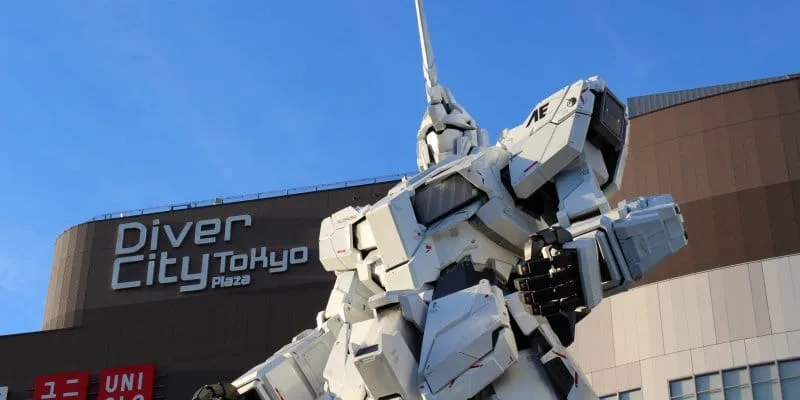
In Tokyo, the Gundam Base Tokyo opened in DiverCity Tokyo Plaza on August 19, 2017, replacing the old Gundam Front. The store carries exclusive kits and tools, and a life-size Unicorn Gundam stands outside. The plaza is in Odaiba, which is easy to combine with a day of sightseeing.
For new kits and tools, Akihabara has several hobby shops within walking distance of the station. For older and out-of-print kits, Mandarake sells second-hand models and collectibles, though stock changes by the day.
Where to watch
Gundam is spread across several services, and the catalog changes by country. The official Gundam website lists the current streaming options for each series and region, and the franchise's official YouTube channel posts trailers and some full episodes for free. Check the official list before you subscribe to anything, because a series that is available in one country may be missing in another.
What Gundam is really about
Gundam has lasted because each timeline asks the same uncomfortable question in a different setting: who is responsible for a weapon once it exists? The Universal Century answers with politics and aftermath. The standalone series answer with smaller, self-contained wars. Neither answer requires you to watch everything.
If you want the classic route, start with the 1981 and 1982 films. If you want a modern series that needs no preparation, start with The Witch from Mercury. If you prefer a completed story with a clear ending, Gundam 00 and Iron-Blooded Orphans both work. I still have a soft spot for the fantasy side of the genre, which is why Knight's & Magic stays on my list, even though it belongs to a different kind of robot story.
One series is enough to decide whether this world is for you. Pick an entry point, finish it, and let the timeline open from there.

Community
Comments
0 comments
There are no published comments in this language yet.
Send comment