
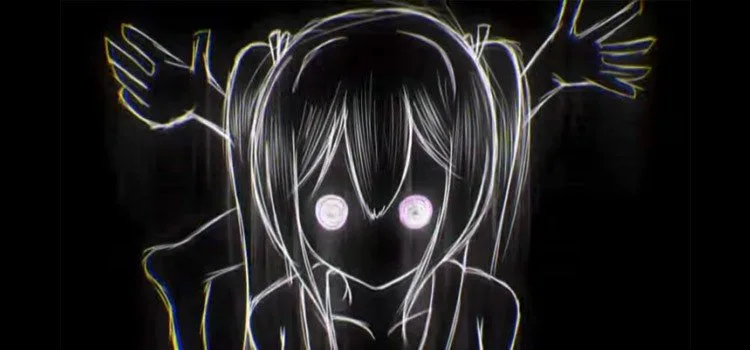
Have you ever come across a Vocaloid song series that sets Japanese ghosts, urban legends, and grim folklore to the well-known synthesizer voice of Hatsune Miku - and yet barely registers in the wider conversation about Vocaloid? Probably not. It is called the Saga Onibi (also Onibi Series), a particularly poorly documented run of Miku tracks that remains practically unknown outside the inner circle of the Japanese Vocaloid scene. Anyone who goes looking for it runs into fragmentary credits, unclear authorship, and a cultural placement that drifts between folklore, mystery trilogy, and a curious subcultural artifact. That, in itself, is what makes it worth a closer look.
The series is not a commercial blockbuster, a game, or an anime. It is a side product of Japan's doujin and Vocaloid subculture - the grassroots movement of hundreds of thousands of producers who, since the late 2000s, have been writing songs, producing videos, and building characters around the voice software made famous by Crypton Future Media. The Suki Desu editorial note on this piece is straightforward: the Suki Desu team explicitly flags its journalistic distance from content that glorifies violence, and the Onibi saga is treated here as a piece of cultural analysis - a song cycle with a mystery narrative, clear folklore references, and an unusually consistent dark tone. The pages below work through what 鬼火 (onibi) literally means, which songs are usually counted as part of the series, what is known about its producer, and why the cycle has remained almost forgotten today.
Contents 10
What does 鬼火 (onibi) mean?
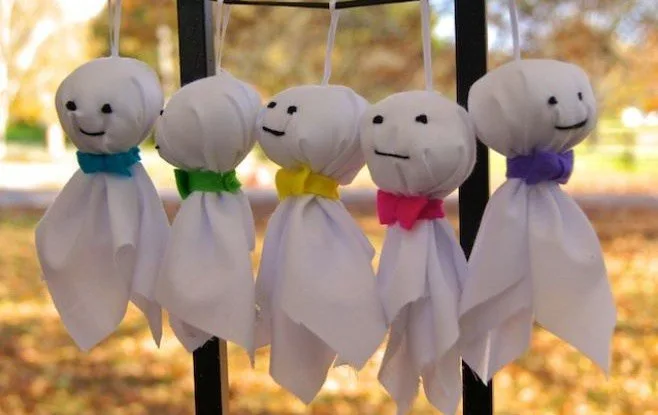
The name of the series is the first clue. 鬼火 is read as onibi in Japanese and translates, almost word for word, as "demon fire" or "demon of fire". In folk belief it names the small, pale, bluish flames said to appear over marshes, graveyards, and mountain passes at night. English speakers will recognise the same idea under the older name will-o'-the-wisp: a flickering light that seems to lead travellers off the path. In Japanese tradition, onibi are usually understood as the restless fire of a spirit - sometimes a fox, sometimes a human soul - rather than a creature in its own right. Calling a Vocaloid series by that word is a fairly deliberate signal: the listener should expect songs rooted in ghost stories, in yokai, and in the older kaidan tradition of Japanese weird tales, not polished pop production.
What is the Onibi saga?
So what is it, exactly? The honest answer is that no clean official record exists. From what can be pieced together across fan archives, the songs are credited to a producer, label, or collective known as masa, and the cycle is generally understood to draw on Japanese urban legends and older folklore motifs. The most common count in the fan community lists ten songs, but that count is not officially confirmed by the producer. Several other tracks are sometimes argued to belong to the same saga, which is part of why the series sits in a slightly fuzzy corner of Vocaloid history: it is documented well enough to be discussed, but not well enough to be settled.
What is consistent across the different sources is the mood. The lyrics are dark, often violent in imagery, and rooted in the kind of supernatural stories that circulated in Edo-period kaidan collections and in modern Japanese urban legends. The musical palette, as far as fan reconstructions describe it, tends to lean on minor keys, low tempos, and an intentionally uncomfortable atmosphere - closer to horror-tinged shinodan ballads than to mainstream Hatsune Miku pop.
The ten songs of the series
The ten songs most often counted as part of the Onibi saga, with brief thematic notes, are:
- The Fox's Wedding - takes its name from the well-known kitsune no yomeiri folk motif, in which foxes are said to marry under a sky that rains while the sun still shines.
- Will-o'-the-Wisp - a direct translation of the onibi idea, built around a wandering ghost light.
- The Spider and the Kitsune-like Lion - a strange, almost folk-tale image of a spider creature paired with a fox-shaped beast, drawn from yokai imagery.
- Beheading Dance - evokes the violent ritual imagery that runs through a number of older Japanese ghost stories.
- The Beautiful Shadow of the Demon's Frenzied Dance - centres on a possessed, dance-like movement often used in kabuki and folklore to signal demonic possession.
- The Clear Demonic Mirror - uses the mirror as a portal or witness, a recurring device in Japanese supernatural tales.
- Death, Misfortune, and the Amanojaku - the amanojaku is a yokai defined by contrariness and spite; the song's title alone signals the cycle's darker leanings.
- Star Lily Dance Performance Capital - an unusual image, often read as a stylised, corrupted version of a stage performance.
- Your Heart and I Becoming One - the most conventional love-themed title in the list, and the one that, in fan discussions, tends to feel the most unsettling precisely because of that.
- My Seventh Celebration - the fan community often points to this as the most "moderate" entry in the cycle, and it is frequently the one newcomers hear first.
It is worth repeating that the list of ten is the community's working count, not an official tracklist. Other songs are sometimes argued into or out of the cycle by different fans, and the saga's boundaries remain quietly disputed.
The folklore behind the songs
Most of the saga's imagery is not invented from scratch. It draws on a stack of older Japanese sources that any reader of kaidan or yokai collections will recognise.
The kitsune - the fox - is one of the most familiar yokai in Japanese folklore. The "fox's wedding" motif, on which the first song is based, describes a strange light rain falling in clear weather; it is folk shorthand for a fox wedding procession passing through. In a darker register, the fox in Japanese legend is also a shapeshifter that can take human form, and stories of foxes marrying humans, tricking them, or in some versions consuming them are part of the older kaidan repertoire. The Suki Desu editorial line here is to treat that motif as a recurring folklore figure, not as a literal claim about the song's plot.
The amanojaku, referenced in the seventh song, is a yokai defined by contrariness: a spirit that, when told to do something, does the opposite, and enjoys pushing people toward worse choices. It appears in medieval settsuwa collections and later Edo-period works, and is a familiar figure in modern Japanese horror as well.
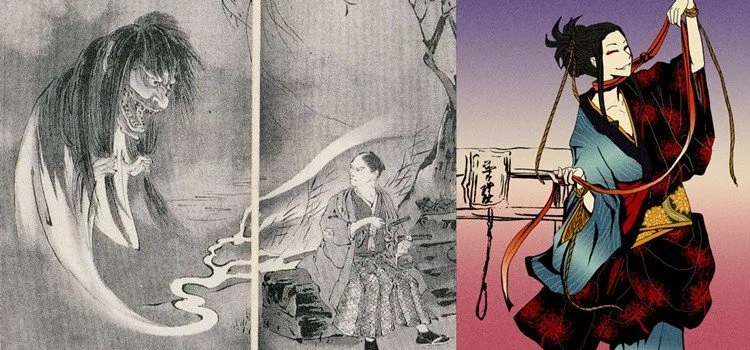
The will-o'-the-wisp / onibi image, the beheading ritual, the demonic mirror, and the frenzied dance all sit comfortably in the older kaidan tradition - stories such as those gathered in Toriyama Sekien's late-eighteenth-century Konjaku Hyakki Shūi, the earlier Tōnoigusa (1660-1661), and the Nihon Ryōiki of the eighth century. The Onibi saga does not quote any of these directly, but it leans on the same visual vocabulary, and that is what gives its songs their particular flavour.
The producer: masa
Almost everything verifiable about the Onibi saga comes down to a single name: masa. The producer is credited, in different sources, as an individual, a small circle, or a label name; the fan archives do not agree, and the producer themselves have not - as far as is publicly known - published a definitive statement. The internet footprint is small, the social media presence minimal, and there is no obvious official site. For a Vocaloid project, that is unusual but not unheard of; doujin producers in particular often work under single-name handles and let the songs speak for themselves.
What is clear is that the credit is consistent. The same handle appears across the songs usually counted as the saga, and the production style - low, atmospheric, lyrically heavy - is recognisably the same. Beyond that, the persona is deliberately opaque, and the saga's mystique is part of what has kept it discussed in niche circles long after the songs themselves stopped trending.
Reception and cultural placement
The Onibi saga never had a commercial release in the usual sense. The songs were uploaded to Niconico and later mirrored on YouTube, picked up by listeners who follow the darker end of the Vocaloid spectrum, and quietly passed around. Coverage in mainstream Japanese media was minimal; coverage in English-language media was, for many years, effectively zero. The result is a small but persistent subcultural footprint: a set of songs that the right kind of fan knows about, but that most people interested in Hatsune Miku will never stumble across by accident.
Culturally, the saga is best read as a small but honest example of how Vocaloid has always been a space for things that the mainstream J-pop industry would not touch. The same software that powers cheerful dance tracks and viral pop also powers songs that lean on the older Japanese horror tradition, sometimes explicitly, sometimes with a wink. The Onibi saga is on the more uncompromising end of that spectrum, and the Suki Desu editorial line, repeated for clarity, is to keep that distance: this is cultural analysis of a niche music series, not endorsement of the violent imagery that runs through it.
Why the saga stayed obscure
Several practical reasons help explain why the Onibi saga has stayed obscure. The producer did very little to push the cycle commercially. The lyrical content, with its dark and sometimes graphic imagery, sits well outside what the broader Hatsune Miku fanbase usually wants to engage with, and the songs were not packaged in a way that made them easy to discover. The official credit trail is thin, the song list is contested, and there is no single page that a curious reader can land on to make sense of the whole thing. In short, the saga is obscure for the boring reason that nobody, including the producer, made a sustained effort to surface it.
There is also a generational and platform-specific element. The cycle circulated most actively in the early 2010s, on Niconico and on Japanese-language blogs, at a moment when English-language Vocaloid coverage was still thin and the international fan community was smaller. By the time Vocaloid had a global English-speaking audience large enough to push a niche cycle into the open, the Onibi saga had already settled into its long quiet.
Vocaloid and the darker corners of the subculture
It is worth stepping back and asking what the Onibi saga tells us about Vocaloid as a whole. Vocaloid is, at its core, a piece of voice-synthesis software. What gets done with it ranges from the bright and commercial to the deliberately bleak. The same Hatsune Miku that headlines Tokyo concerts and anime end-credits has, at various points, narrated suicide-themed songs, hosted horror-tinged concept albums, and appeared in tracks that would not be out of place in a Japanese horror anthology. The Onibi saga is the more consistent and the more folklore-rooted end of that spectrum, but it is not an aberration; it is one of several darker subgenres the Vocaloid ecosystem has always quietly hosted.
For an international audience encountering the saga for the first time, the most useful framing is probably the simplest. The Onibi saga is a small, mysterious, deliberately uncomfortable Vocaloid song cycle, set to the voice of Hatsune Miku, drawing on real Japanese folklore and urban legend, made by a producer who has chosen to stay out of the spotlight. It is not a major work of Japanese music. It is, however, a real and interesting example of what the Vocaloid subculture has been able to produce in its quieter corners - and a reminder that the same platform can host very different kinds of song.
The songs to hear
For readers who want a direct sense of the cycle, the two tracks most often recommended as entry points are The Fox's Wedding and My Seventh Celebration, both of which have circulated on YouTube for years. Embedded below for convenience; viewer discretion is, as always, advised, given the cycle's deliberate dark tone.
Closing: a forgotten cycle with something to say
The Onibi saga is easy to miss, and the people who care about it tend to be the kind of fans who are already deep in the Japanese Vocaloid subculture. For everyone else, the cycle is a small, dark, oddly persistent footnote - a reminder that the Hatsune Miku ecosystem has always been wider and stranger than the popular image suggests. Whether the saga is read as a horror-themed concept album, as a folklore study set to song, or simply as a curio from the early 2010s Japanese internet, it sits comfortably next to other small, deliberate works in the same vein. It is unlikely to break into the mainstream now, but it does not really need to. The Onibi saga has already said what it came to say, and the fans who know it tend to know it well.



Community
Comments
0 comments
There are no published comments in this language yet.
Send comment