
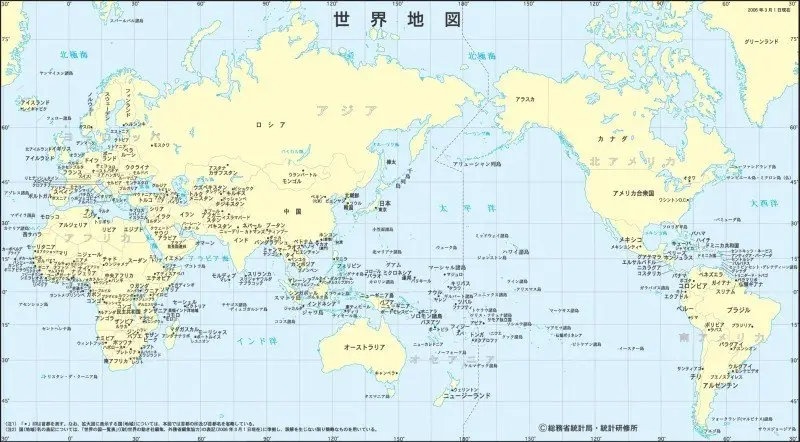
Brazil is burajiru [ブラジル] in Japanese — and in headlines it often shrinks to a single character, haku [伯]. Country names in Japanese are rarely “just” a translation: sometimes katakana borrowed from English or Portuguese, sometimes old ateji kanji, sometimes one abbreviation character that newspapers still use.
Country is kuni [国]; a country’s language is kokugo [国語]. Below you’ll find continents, key country names, and the classic abbreviations — not every UN member, but the spellings learners actually meet in maps, news, and textbooks.
Contents 13
Tairiku - Continents in Japanese
Continents are called tairiku [大陸] in Japanese. Here is the basic list:
| Continent | Kanji | Rōmaji |
|---|---|---|
| Africa | アフリカ大陸 | afurika tairiku |
| Antarctica | 南極大陸 | nankyoku tairiku |
| Asia | アジア大陸 / 亜細亜大陸 | ajia tairiku |
| Oceania | オセアニア大陸 | oseania tairiku |
| Europe | ヨーロッパ大陸 / 欧州 | yooroppa tairiku / ōshū |
| North America | 北アメリカ大陸 / 北米 | kita amerika tairiku / hokubei |
| South America | 南アメリカ大陸 / 南米 | minami amerika tairiku / nambei |
Note: In modern Japanese, almost all country names appear in katakana. Kanji spellings (ateji) and one-character abbreviations show up mainly in newspapers, history texts, and compounds — the pronunciation still usually follows the katakana form.
Countries of Africa in Japanese
Africa is afurika [アフリカ] (also historically written with ateji as 阿弗利加). Below is a selection of major African country names — in everyday use and in the news, the katakana form is usually enough:
| Country | Kanji | Kana | Rōmaji |
|---|---|---|---|
| Egypt | エジプト | エジプト | ejiputo |
| Algeria | アルジェリア / アルジェリア民主人民共和国 | アルジェリア / アルジェリアみんしゅじんみんきょうわこく | arujeria / arujeria minshujinmin kyouwakoku |
| Chad | チャド / チャド共和国 | チャド / チャド共和国 | chado / chado kyouwakoku |
| Libya | リビア / リビア国 | リビア / リビアこく | ribia / ribia koku |
| South Africa | 南アフリカ / 南アフリカ共和国 | みなみアフリカ / みなみアフリカきょうわこく | minami afurika / minami afurika kyouwakoku |
| Nigeria | ナイジェリア | ナイジェリア | naijeria |
| Kenya | ケニア | ケニア | kenia |
| Morocco | モロッコ | モロッコ | morokko |
| Ethiopia | エチオピア | エチオピア | echiopia |
| Ghana | ガーナ | ガーナ | gaana |
| Tanzania | タンザニア | タンザニア | tanzania |
Countries of Asia in Japanese
Below is a list of countries in Asia and the broader East, with names often written in katakana under each subtitle (East Asia is the main exception).
Far East [東アジア]
Some places in East Asia keep kanji spellings that learners meet early — China, Korea, Japan, Taiwan — because of shared character culture. Meanings of a few of these names appear at the end of the article.
| Country | Japanese | Romaji |
|---|---|---|
| China | 中国 | chuugoku |
| Hong Kong | 香港 | honkon |
| Japan | 日本 | nihon / nippon |
| Macau | 澳門 | makao |
| Mongolia | モンゴル | mongoru |
| North Korea | 北朝鮮 | kitachousen |
| South Korea | 韓国 | kankoku |
| Taiwan | 台湾 | taiwan |
- Japanese materials often place Mongolia with the Far East, even though geography textbooks may list it under Central Asia.
- Mongolia is also known as mouko [蒙古]
- China also appears as [チャイナ] or historically [シナ]
- Japan is also called ジャパン in some loan contexts
- The two Koreas are also referred to with chousen [朝鮮] or the loanword koria;
- The Korean Peninsula is chousenhantou [朝鮮半島]
Southeast Asia - Tounanajia [東南アジア]
| Country | Japanese | Romaji |
|---|---|---|
| Brunei | ブルネイ | burunei |
| Cambodia | カンボジア | kanbojia |
| East Timor | 東ティモール | higashi tiimooru |
| Indonesia | インドネシア | indoneshia |
| Laos | ラオス | raosu |
| Malaysia | マレーシア | mareeshia |
| Myanmar | ミャンマー | myanmaa |
| Philippines | フィリピン / 比律賓 | firipin |
| Singapore | シンガポール / 新嘉坡 | shingapooru |
| Thailand | タイ / 泰 | tai |
| Vietnam | ベトナム / 越南 | betonamu |
Indian Subcontinent - Minamiajia [南アジア]
| Country | Japanese | Romaji |
|---|---|---|
| Bangladesh | バングラデシュ | banguradeshu |
| Bhutan | ブータン | buutan |
| India | インド | indo |
| Maldives | モルディブ | morudibu |
| Nepal | ネパール | nepaaru |
| Pakistan | パキスタン | pakisutan |
| Sri Lanka | スリランカ | suriranka |
Central Asia - Chuuouajia [中央アジア]
| Country | Japanese | Romaji |
|---|---|---|
| Afghanistan | アフガニスタン | afuganisutan |
| Kazakhstan | カザフスタン | kazafusutan |
| Kyrgyzstan | キルギス | kirugisu |
| Tajikistan | タジキスタン | tajikisutan |
| Turkmenistan | トルクメニスタン | torukumenisutan |
| Uzbekistan | ウズベキスタン | uzubekisutan |
Countries of Europe in Japanese
Europe is yooroppa [ヨーロッパ] (ateji 欧羅巴), also oushuu [欧州]; the pair Europe–America is often oubei [欧米]. A practical list of European names:
| Country | Kanji | Kana | Rōmaji |
|---|---|---|---|
| Iceland | アイスランド | アイスランド | aisurando |
| Ireland | 愛蘭 | アイルランド | airurando |
| Albania | アルバニア | アルバニア | arubania |
| Andorra | アンドラ | アンドラ | andora |
| United Kingdom - England - Scotland - Wales - Northern Ireland | 英吉利 / 英国 - 英蘭 - 蘇格蘭 - ウェールズ - 北愛蘭 | イギリス / えいこく - イングランド - スコットランド - ウェールズ - きたアイルランド | igirisu / eikoku - ingurando - sukottorando - weeruzu - kita airurando |
| Italy | 伊太利 | イタリア | itaria |
| Ukraine | 烏克蘭 | ウクライナ | ukuraina |
| Estonia | エストニア | エストニア | esutonia |
| Austria | 墺太利 | オーストリア | oosutoria |
| Netherlands | 阿蘭陀 | オランダ | oranda |
| Greece | 希臘 | ギリシア / ギリシャ | girishia / girisha |
| Croatia | クロアチア | クロアチア | kuroachia |
| Switzerland | 瑞西 | スイス | suisu |
| Sweden | 瑞典 | スウェーデン | suweeden |
| Slovakia | スロバキア | スロバキア | surobakia |
| Slovenia | スロベニア | スロベニア | surobenia |
| Spain | 西班牙 | スペイン | supein |
| Czech Republic | 捷克 | チェコ | cheko |
| Denmark | 丁抹 | デンマーク | denmaaku |
| Germany | 独逸 | ドイツ | doitsu |
| Turkey | 土耳古 | トルコ | toruko |
| Norway | 諾威 | ノルウェー | noruwee |
| Hungary | 洪牙利 | ハンガリー | hangarii |
| Finland | 芬蘭 | フィンランド | finrando |
| France | 仏蘭西 | フランス | furansu |
| Belarus | 白ロシア | ベラルーシ | beraruushi |
| Bulgaria | 勃牙利 | ブルガリア | burugaria |
| Belgium | 白耳義 | ベルギー | berugii |
| Bosnia and Herzegovina | ボスニア・ヘルツェゴビナ | ボスニア・ヘルツェゴビナ | bosunia herutsegobina |
| Poland | 波蘭 | ポーランド | poorando |
| Portugal | 葡萄牙 | ポルトガル | porutogaru |
| Malta | マルタ | マルタ | maruta |
| Moldova | モルドバ | モルドバ | morudoba |
| Serbia | セルビア | セルビア | serubia |
| Montenegro | モンテネグロ | モンテネグロ | monteneguro |
| Latvia | ラトビア | ラトビア | ratobia |
| Lithuania | リトアニア | リトアニア | ritoania |
| Luxembourg | ルクセンブルク | ルクセンブルク | rukusenburuku |
| Romania | 羅馬尼亜 | ルーマニア | ruumania |
| Russia | 露西亜 | ロシア | roshia |
Countries of North America in Japanese
North America is kita amerika [北アメリカ] or hokubei [北米]. Selected names:
| Country | Kanji | Kana | Rōmaji |
|---|---|---|---|
| Canada | 加奈陀 | カナダ | kanada |
| United States | 亜米利加 / 米国 | アメリカ / べいこく | amerika / beikoku |
| Mexico | 墨西哥 | メキシコ | mekishiko |
| Panama | 巴奈馬 | パナマ | panama |
| Cuba | 玖馬 | キューバ | kyuuba |
| Jamaica | 牙買加 | ジャマイカ | jamaika |
| Dominican Republic | ドミニカ共和国 | ドミニカきょうわこく | dominika kyouwakoku |
| Haiti | ハイチ | ハイチ | haichi |
Tip: ドミニカ国 is Dominica (the island nation), not the Dominican Republic — easy to mix up in Japanese news.
Countries of South America in Japanese
South America is minami amerika [南アメリカ] or nanbei [南米]:
| Country | Kanji | Kana | Rōmaji |
|---|---|---|---|
| Brazil | 伯剌西爾 / 伯国 | ブラジル | burajiru |
| Argentina | 亜爾然丁 | アルゼンチン | aruzenchin |
| Chile | 智利 | チリ | chiri |
| Colombia | コロンビア | コロンビア | koronbia |
| Peru | 秘魯 | ペルー | peruu |
| Venezuela | ベネズエラ | ベネズエラ | benezuera |
| Uruguay | ウルグアイ | ウルグアイ | uruguai |
Countries of Oceania in Japanese
Oceania is oseania [オセアニア] or taiyoushuu [大洋州]:
| Country | Kanji | Kana | Rōmaji |
|---|---|---|---|
| Australia | 豪州 | オーストラリア | oosutoraria |
| New Zealand | 新西蘭 | ニュージーランド | nyuujiirando |
| Fiji | フィジー | フィジー | fijii |
| Papua New Guinea | パプアニューギニア | パプアニューギニア | papua nyuuginia |
Abbreviation and Kanji of countries in Japanese
The list below pairs common country names with ateji kanji and the one-character abbreviations still seen in newspapers. Even when written in kanji, most names are still pronounced with the familiar katakana reading.
That pattern comes from ateji [当て字]: before katakana became standard for foreign place names, writers chose characters for their sound, not because the kanji described the character of the country.
| Country | Romaji | Kanji | Abbr. |
| Argentina | aruzenchin | 亜爾然丁 | 亜 |
| Australia | oosutoraria | 豪斯多剌里亜 | 豪 |
| Austria | oosutoria | 墺太利 | 墺 |
| Belgium | berugii | 白耳義 | 白 |
| Bolivia | boribia | 波利美亜 | 波 |
| Brazil | burajiru | 伯剌西爾 | 伯 |
| Bulgaria | burugaria | 布爾加利亜 | 布 |
| Canada | kanada | 加拿大 | 加 |
| Chile | chiri | 智利 | 智 |
| China | chuugoku | 中華人民共和国 / 中国 | 中 |
| Denmark | denmaaku | 丁抹 | 丁 |
| Egypt | ejiputo | 埃及 | 埃 |
| United Kingdom | igirisu / eikoku | 英吉利 / 英国 | 英 |
| Finland | finrando | 芬蘭 | 芬 |
| France | furansu | 仏蘭西 | 仏 |
| Germany | doitsu | 独逸 | 独 |
| Greece | girisha | 希臘 | 希 |
| Hungary | hangarii | 匈牙利 | 匈 |
| Iceland | aisurando | 氷島 | 氷 |
| India | indo | 印度 | 印 |
| Indonesia | indoneshia | 印度尼西亜 | 尼 |
| Ireland | airurando | 愛蘭 | 愛 |
| Italy | itaria | 伊太利 | 伊 |
| Japan | nihon / nippon | 日本 | 日 |
| Mexico | mekishiko | 墨西哥 | 墨 |
| Mongolia | mongoru | 蒙古 | 蒙 |
| Myanmar | myanmaa | 緬甸 | 緬 |
| Netherlands | oranda | 阿蘭陀 | 蘭 |
| New Zealand | nyuujiirando | 新西蘭 | 新 |
| North Korea | kitachousen | 北朝鮮 | 朝 |
| Norway | noruwee | 諾威 | 諾 |
| Philippines | firipin | 比律賓 | 比 |
| Poland | poorando | 波蘭 | 波 |
| Portugal | porutogaru | 葡萄牙 | 葡 |
| Romania | ruumania | 羅馬尼亜 | 羅 |
| Russia | roshia | 露西亜 | 露 |
| Singapore | shingapooru | 新嘉坡 | 星 |
| South Africa | minami afurika | 南阿弗利加 | 南阿 |
| South Korea | kankoku | 大韓民国 / 韓国 | 韓 |
| Spain | supein | 西班牙 | 西 |
| Sweden | suweeden | 瑞典 | 瑞 |
| Switzerland | suisu | 瑞西 | 瑞 |
| Taiwan | taiwan | 台湾 | 台 |
| Thailand | tai | 泰 | 泰 |
| Turkey | toruko | 土耳古 | 土 |
| Ukraine | ukuraina | 烏克蘭 | 烏 |
| United States | amerika / beikoku | 亜米利加 / 米国 | 米 |
| Vietnam | betonamu | 越南 | 越 |
Meaning of the names of countries in Japanese
China, chuugoku [中国], literally points to a “central country” or central region. Japan, nippon / nihon [日本], is the familiar origin of the sun / land of the rising sun reading.
Thailand’s single character tai [泰] carries ideas of peace, calm, and ease. South Korea is written kankoku [韓国] — common characters that today mainly identify “Korea” as a country name rather than a poetic description.
North Korea is kitachousen [北朝鮮]: the north character plus elements historically tied to the Korean peninsula’s name. Breaking the characters into “fresh / bright land” is a dictionary game, not how Japanese speakers treat the country name in ordinary speech.
Kanji for place names often package sound first; treat “literal meanings” as cultural footnotes, not as official national slogans.

Community
Comments
0 comments
There are no published comments in this language yet.
Send comment