
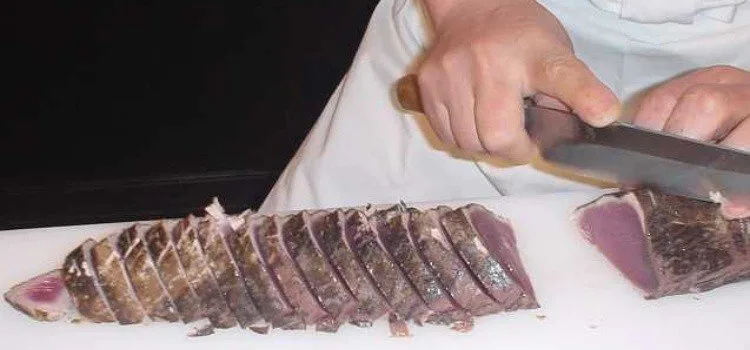
When people in Japan talk about grilling fish, they rarely mean just a piece of fish over charcoal. In the cuisine of Kōchi on Shikoku there is a method of its own: katsuo no tataki, bonito seared only on the surface over a straw fire and left raw inside. The restaurant concept Warayakiya has brought that tradition into the cities. This article explains what katsuo is, how tataki is made, why straw is used and how the dish is eaten.
Contents 7
Katsuo: the fish behind the dish
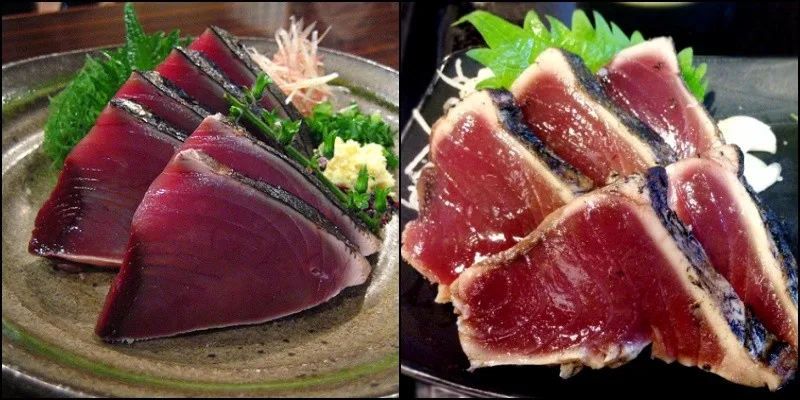
Katsuo (鰹) is the Japanese name for the skipjack tuna (Katsuwonus pelamis). The species belongs to the mackerel and tuna family, grows to about 1.1 metres and lives in tropical and temperate waters. In Japan it is a major food fish: fresh as sashimi, dried and smoked as katsuobushi, the base of dashi stock. Off the coast of Kōchi the fish passes in spring and again in autumn, and both seasons have their own names. The spring catch is hatsugatsuo, the autumn catch modorigatsuo.
The difference matters in the kitchen. In spring the flesh is leaner and firmer; in autumn it is fattier and softer. Someone ordering katsuo no tataki in spring gets a different fish from someone ordering it in October. That is why the dish is treated in Kōchi as a seasonal specialty rather than a year-round menu item.
What tataki means
The name tataki (たたき) means "pounded" or "hit into pieces" in Japanese. There are two readings of the preparation. In one, the fish or meat is seared very briefly over a hot flame or in a pan, then marinated in vinegar for a short time, sliced thin and seasoned with ginger pounded into a paste, which is where the name comes from. In the other, the Tosa version, the fish is sprinkled with salt, seared over an open fire, cooled immediately in ice water, cut into slices about one centimetre thick and served with condiments and sauce.
The method comes from the old province of Tosa, today's Kōchi, where it was applied to bonito. One explanation traces it to fishermen's crew food, another to offcuts from katsuobushi production. Both stories are plausible and neither is proven. What is certain is that the dish is tied to the region, where it is also called Tosa-zukuri.
Why straw
In warayaki (藁焼き), grilling over rice straw, the straw burns very fast and very hot. The flame is so short and intense that the surface of the fish sears in seconds without cooking the inside. That creates a smoky crust while the flesh stays raw. At the same time some of the surface water evaporates, which concentrates the flavour.
The straw is not decoration. It burns differently from charcoal: brighter, shorter, with a sweet smoke that recalls toasted grain. That is why the fish is turned over the flame and cooled at once, stopping the cooking process. Without that rapid switch from heat to ice, the result would simply be cooked fish.
Warayakiya: tradition in a restaurant
The restaurant chain Warayakiya (わらやき屋) takes the principle into the city. The name literally means "grilled over straw". In its branches an open grill stands in the dining room, where the straw burns down and the fish is seared in front of the guests. Katsuo is not the only item: chicken and high-grade beef also pass over the straw fire, and the menu includes Kōchi dishes such as salt katsuo and sashimi variations.
Prices sit above those of a simple izakaya, because the effort and the provenance of the ingredients cost more. In return you get a dish that lives from fire technique rather than from a kitchen behind a door. Branches are found mainly in Tokyo; anyone eating in Kōchi itself gets the version with more salt and citrus, often without soy sauce.
How to eat it
In Kōchi you start with salt. Part of the tataki is eaten with coarse salt and a little yuzu so that the fish flavour stays clear. Then comes the version with sauce, usually ponzu, tosazu or a mix of soy sauce, vinegar and citrus. Plenty of condiments follow: garlic, ginger, onion, spring onion, daikon and sometimes wasabi.
In a restaurant, do not leave the tataki sitting. It is meant to be eaten at once, because the surface should be warm and the inside cold. People sharing usually order two portions, since the slices are small. Rice, a cold beer or sake go well with it. In Kōchi the dish is often served in market halls, where you buy it at a stall and eat at long tables.
Where to eat it
In Kōchi, the Hirome market in Kōchi city is the best-known place for katsuo no tataki. You buy at a stall, receive the slices on a plate with condiments and find a seat at the long tables. Many izakaya in the region also serve the dish, often with a note on where the fish came from. If you are not travelling to Shikoku, Warayakiya branches in Tokyo, Osaka and other big cities offer the same technique.
One last point on quality: freshness is not optional with tataki. Because the inside stays raw, the same rules apply as for sashimi. The fish must be transported chilled and processed the same day. That is exactly why the dish is rarely authentic outside Japan. Anyone cooking it at home needs sashimi-grade fish and a very hot flame.
Conclusion
Katsuo no tataki comes from three simple things: fresh fish, strong fire and the fastest possible cooling. The straw at Warayakiya is the city version of the same idea, and the difference from ordinary grilled fish lies in the technique, not the sauce. Sitting in Tokyo and watching the flame in the dining room, you are eating a piece of the Shikoku coast. More on Japanese grilling is in the articles about yakiniku, izakaya and kogashi ramen.

Community
Comments
0 comments
There are no published comments in this language yet.
Send comment