
If you like dinosaurs and are planning a trip through Japan, Fukui Prefecture holds one of the country's most important natural history museums. The Fukui Prefectural Dinosaur Museum in Katsuyama displays real fossils, life-size skeletons and a view into the work of palaeontologists. For families, school groups and anyone interested in the history of the Earth, it is one of the most rewarding stops in the region.
This article explains what the museum offers, where it is, what it costs and what to know before visiting.
Contents 9
What the museum is
The Fukui Prefectural Dinosaur Museum (福井県立恐竜博物館) stands in the city of Katsuyama, Fukui Prefecture. It opened on 14 July 2000 in a building designed by Kisho Kurokawa, covers around 15,000 square metres and is dedicated to dinosaurs and natural history. Along with the Royal Tyrrell Museum in Canada and the Zigong Museum in China, it is often described as one of the world's three great dinosaur museums.
Location and access
Katsuyama lies in northern Fukui Prefecture and can be reached on the Katsuyama Eiheiji Line of the Echizen Railway. The museum stands at the edge of the city, surrounded by hills where fossils have been found since the 1980s. The area is part of the Dinosaur Valley Fukui Katsuyama Geopark, which links the museum, the excavation sites and the landscape.
The Dinosaur World hall
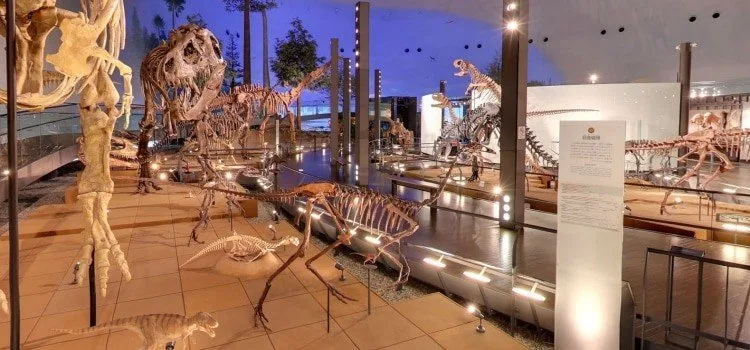
The centrepiece is the main hall called Dinosaur World. The room is 84 metres long, 55 metres wide and 4,500 square metres in area, with a ceiling about 37 metres high. No columns interrupt the space, which leaves a clear view of the skeletons on display.
More than 40 dinosaur skeletons stand there, including a Camarasaurus whose reconstruction tells the story of a nearly complete skeleton found in Wyoming. Some mounts, among them Camarasaurus and Allosaurus, are built from real fossil bones. Labels make clear which pieces are casts and which are originals.
Dinosaurs from Fukui
The collection is special because several species were found in the region itself. Fukuiraptor kitadaniensis was named in 2000, Fukuisaurus tetoriensis in 2003, Fukuititan nipponensis in 2010, Koshisaurus katsuyama in 2015 and Fukuivenator paradoxus in 2016. Skeletons of Fukuisaurus, Fukuiraptor and Fukuivenator are on show in the hall.
The fossils from the Kitadani quarry matter scientifically. In February 2017 the specimens of five new dinosaur species and their excavation site were designated a national Natural Monument of Japan.
Excavation site and outdoor museum
An excavation site belongs to the museum grounds. Since July 2014 the outdoor Dinosaur Museum has offered guided tours to the field station next to the Kitadani quarry. The tours run from late April to early November and are especially popular in good weather.
Research and collection
The museum is more than an exhibition hall. It employs researchers, prepares fossils and works with excavation projects in the region. The collection holds around 41,000 objects. Visitors can watch through glass as staff clean fossils in the preparation laboratory.
Visiting and tickets
Admission is paid, and tickets are sold in advance with a fixed time slot. That is worth doing at weekends and during holidays, when school groups and families fill the museum. Allow time for the journey, because trains from Fukui city do not run every few minutes.
Visitor numbers and renovation
In the 2016 financial year the museum and its outdoor site welcomed about 901,000 visitors. After a renovation the building reopened in July 2023 with a new wing. The number of skeletons on display rose to 50, and visits reached about 1.3 million after the reopening.
Who should visit
Families with children will find one of the best places in Japan to see dinosaurs rather than pictures of them. Anyone interested in palaeontology gets a look at research and preparation. Travellers with only three days in Kyoto or Osaka should not underestimate the trip, because the journey takes about half a day each way.
The Fukui Prefectural Dinosaur Museum is therefore more than a children's attraction. It shows how fossils from the region changed science and connects exhibition, research and landscape. Anyone with time for a day trip in Japan will find one of the country's most impressive museum visits there.
Read more: visiting Osaka, the Hiroshima Peace Memorial, the Ichijodani ruins in Fukui, the Samurai Museum in Tokyo and the danger of instant noodles.


Community
Comments
0 comments
There are no published comments in this language yet.
Send comment