
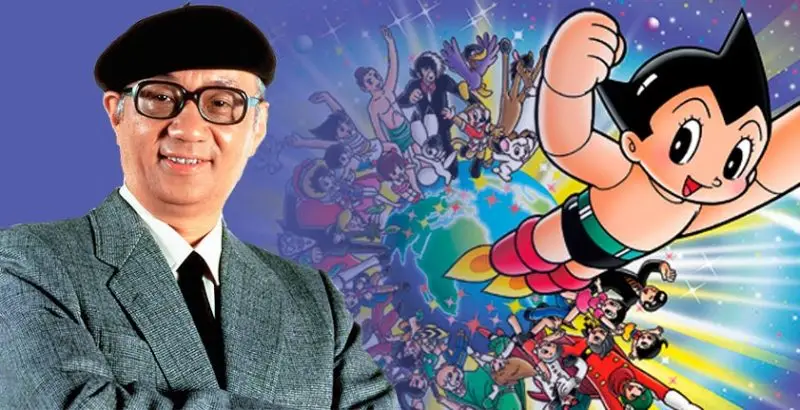
Fans will praise Toriyama, Takahashi, or Miura without blinking — then freeze when someone asks who taught the page to move like a film. That blank stare is usually Osamu Tezuka's fault: the man nicknamed Manga no Kami-sama (マンガの神様, “God of Manga”) built so much of the grammar of modern manga that his name can hide in plain sight.
Tezuka did not invent Japanese comics, and he was never only a kids'-cartoon mascot. He was a doctor-trained storyteller who mixed Disney eyes, Takarazuka theater sparkle, Hollywood framing, and moral unease — then dragged that mix onto TV in 1963 with Tetsuwan Atom (Astro Boy). Here is the path, the style, and the works that still repay a first read.
Contents 9
Who was Osamu Tezuka?
Osamu Tezuka (手塚治虫, Tezuka Osamu) was born on 3 November 1928 in Toyonaka, Osaka Prefecture, and died of stomach cancer on 9 February 1989 in Tokyo, at 60. Japanese readers still call him the Father, Godfather, or God of Manga; English-language fans often meet him first as “the Japanese Walt Disney,” a compliment that fits his early children's hits and blurs how dark and literary his later books became.
His complete output is usually counted in the range of hundreds of titles and well over 100,000 drawn pages. Signature series include Astro Boy, Kimba the White Lion (Jungle Emperor), Princess Knight, Phoenix, Black Jack, Buddha, and Dororo — a shelf that jumps from children's adventure to medical noir and historical epic without changing the signature linework.
Early life: insects, Takarazuka, and medicine
Tezuka grew up in a well-educated family and spent formative years around Takarazuka, where his mother took him to the all-female Takarazuka Revue. Those stage eyes and romantic costumes later leaked into his character design. He was also a Disney obsessive as a boy — the famous anecdote is watching Bambi dozens of times — but he also credited Chinese animation such as Princess Iron Fan for pushing him toward motion on the page.
Even the pen name is a joke with a bug: he folded the insect-sounding osamushi into 治虫. During the war years he was drafted into factory work while still drawing; after 1945 he entered medical school in Osaka. He eventually earned an M.D. (1961) and never fully abandoned that training — it resurfaces in the clinical calm of Black Jack and in sci-fi bodies under pressure.
He did not “work for Walt Disney” as a studio employee. The real link is influence, a later personal meeting at the 1964 New York World's Fair, and the way Western cartoons trained his eye for large, readable faces.
Breakthroughs: from New Treasure Island to Atom
His first professional strip, Diary of Ma-chan, appeared in 1946. The shockwave came with the 1947 book Shin Takarajima (New Treasure Island), developed with story input from Shichima Sakai: cinematic panels, speed lines, and page turns that felt closer to a storyboard than to static four-panel gags. Young readers — including future stars such as Fujiko Fujio — treated it as a revelation.
A science-fiction trilogy followed (Lost World, Metropolis, Nextworld). In 1951 the robot boy who would become Astro Boy appeared in Ambassador Atom; full Tetsuwan Atom serialization began in 1952 and made the character a national phenomenon. Around the same stretch Tezuka pushed long-form adventure for girls with Ribon no Kishi (Princess Knight), often cited as a founding narrative of modern shōjo manga, and animal epic with Jungle Taitei (Kimba the White Lion).
He also treated manga as a craft that could be taught: columns such as Manga Classroom framed drawing as a learnable skill, not pure mystery talent.
What Tezuka changed on the page
Three habits still show up in almost every manga aisle:
- Large eyes as emotion engines — borrowed from Disney faces and Takarazuka stage makeup, not from “just cute style.” If you have ever wondered why anime eyes got so big, Tezuka is a main branch of that family tree.
- Cinematic paneling — pans, close-ups, multi-angle action, and pages that sequence like film cuts instead of static stage pictures.
- A “star system” — stock faces and names reappear across series in new roles, the way a studio reuses actors. The cameo of Tezuka himself (beret, round glasses, spotted nose) is part of that game.
He did not invent manga, and he was not the only postwar innovator. What he did was industrialize long-form cinematic storytelling for a mass kids' market, then later answer the denser gekiga wave with adult books that kept his trademark line.
From print to TV: Mushi Production and Astro Boy
After a rocky film experience with Toei on a Journey to the West adaptation, Tezuka founded Mushi Production (initially his animation arm in the early 1960s) to control more of the pipeline. The 1963 TV series of Astro Boy became the template for Japanese weekly TV anime: limited animation, recycled cycles, aggressive schedules — and the first Japanese animated series sold widely into the U.S. market under the Astro Boy name.
Jungle Emperor (1965) pushed color TV animation; merchandise and overseas sales became part of the business model. The studio's finances were fragile, adult film experiments such as the Animerama features did not save Mushi, and Tezuka later worked through Tezuka Productions while Mushi collapsed in the early 1970s. The industrial aftershocks of that era still shape how anime is staffed and budgeted.
Later masterworks: Phoenix, Black Jack, Buddha
From the late 1960s onward Tezuka answered darker competitors with darker books of his own. Dororo mixed body horror and yōkai with a road-movie structure; Phoenix (Hi no Tori), which he treated as a lifelong project, leaps across eras around immortality and human cruelty; Buddha retells the life of Siddhartha with grit and side characters; Black Jack follows an unlicensed genius surgeon through medical ethics that still feel current.
Shorter adult works such as MW, Ayako, Ode to Kirihito, and Message to Adolf show how far he could push crime, politics, and body horror without abandoning cartoon readability. When he died in 1989, unfinished pages of Phoenix and other series were left on the table — a blunt reminder that even “gods” run out of time.
Brazil, Mauricio de Sousa, and the global afterlife
Tezuka's fame was never only domestic. He promoted Japanese comics abroad, traded ideas with European creators such as Moebius, and in 1984 toured Brazil on a lecture circuit that deepened a friendship with Mauricio de Sousa, creator of Monica's Gang. Decades later, Tezuka Productions allowed a licensed crossover between Monica's characters and Tezuka icons — a rare permission that only makes sense if you know how personal that link was.
For English readers, the useful takeaway is not a catalog of every Brazilian edition, but the fact that Tezuka's network already treated manga as world culture long before streaming made anime default background noise.
Legacy you can still visit
The Osamu Tezuka Manga Museum in Takarazuka, Hyōgo, keeps original art, timelines, and interactive exhibits. Adaptations never really stop: new Astro Boy, Black Jack, Dororo, and Buddha projects keep reopening the archive. Among popular mangaka lists, Tezuka often sits less as a current chart-topper and more as the root system under everyone else's sales graphs — including the giants on any best-selling manga ranking.
Where to start reading Tezuka
Skip the impossible “complete works” checklist. A practical on-ramp:
- Astro Boy — robot rights, cold war anxiety, and the seed of TV anime.
- Princess Knight — adventure, costume, and early long-form shōjo energy.
- Kimba the White Lion — ecological fable that also became a landmark color series.
- Black Jack — if you want the medical mind and adult tension without dropping the cartoon face.
- Buddha or selected Phoenix volumes — for the epic, philosophical mode.
- Dororo — shorter, savage, and a clean bridge to modern dark fantasy anime.
From there, follow whatever snagged you: the star-system cameos, the insect pen-name humor, or the hospital ethics. Tezuka's best trick is still the same — a page that feels light until the moral weight lands.




Community
Comments
0 comments
There are no published comments in this language yet.
Send comment