
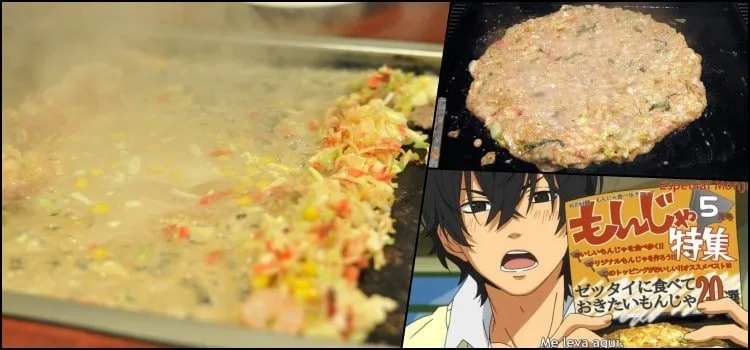
Monjayaki is one of those Tokyo dishes that looks chaotic at first sight and makes perfect sense after the first bite. The batter is much looser than okonomiyaki, the ingredients are chopped small, and the best part is scraping the crisp edges from the hot plate while the center stays soft and creamy.
If you came here because of Tonari no Kaibutsu-kun, the connection is real. In the story, Haru pushes Shizuku to go out for monjayaki, which fits the dish perfectly: it is casual, shareable, and slightly awkward the first time you eat it. This guide keeps that anime connection, but the recipe itself follows the way monja is commonly prepared and enjoyed in Japan.
Contents 6
What is monjayaki?
Monjayaki, often shortened to monja, is a Tokyo-style teppan dish made with a thin flour batter, cabbage, sauce, and add-ins such as seafood, pork, mochi, or cheese. Unlike okonomiyaki, the batter stays runny long enough to spread across the griddle, so you get caramelized bits around the edges and a softer center that is eaten directly from the hot plate with a small metal spatula.
Its roots are usually linked to older mojiyaki snacks sold to children, where batter was used to draw letters on the griddle. Today, Tsukishima is the neighborhood most closely associated with monjayaki, and the dish is still treated as a social meal rather than something neatly plated in the kitchen before serving.
Ingredients for 2 servings
This is a home-style version that keeps the classic Tokyo feel without becoming too heavy.
- 200 g finely chopped cabbage
- 200 ml dashi, or water mixed with dashi powder
- 20 to 25 g wheat flour, about 2 tablespoons
- 1 to 2 tablespoons Japanese Worcestershire sauce or okonomiyaki sauce
- 60 g mixed seafood such as shrimp and squid, chopped small
- 2 tablespoons tenkasu or tempura scraps
- 1 tablespoon dried shrimp, optional but traditional
- 1 small green onion, sliced thin
- 1 teaspoon neutral oil for the pan
- Aonori, extra sauce, and a little mayonnaise for finishing, optional
If you want a richer version, add mochi, mentaiko, or cheese. Those are common monja add-ins and they work better than trying to turn the dish into a thick pancake.
How to make monjayaki
- Mix the batter. Stir the flour into the dashi until smooth, then mix in the sauce. The batter should look thin, closer to a light cream soup than to pancake batter.
- Prepare the fillings. Combine the cabbage, seafood, dried shrimp, green onion, and tenkasu in a bowl. Everything should be chopped fairly small so that it cooks quickly and spreads evenly.
- Cook the solids first. Heat a hot plate or a wide skillet, oil it lightly, and cook the cabbage mixture for a minute or two. Then shape it into a ring, leaving an open space in the center.
- Pour the batter into the middle. Add the liquid to the center of the ring and let it bubble briefly. After that, fold the solids back into the batter.
- Spread and scrape. Flatten the monja into a thin layer. Let the edges caramelize, then scrape off small bites with a spatula while the center stays soft.
The biggest mistake at home is adding too much flour. When the batter gets thick, the dish stops tasting like monja and starts behaving like a rushed okonomiyaki.
Monjayaki vs. okonomiyaki
- Batter: monjayaki is much runnier, while okonomiyaki holds a clear pancake shape.
- Cooking style: monja is spread thin and scraped from the grill; okonomiyaki is flipped and sliced.
- Texture: monja stays creamy in the middle with crisp edges, while okonomiyaki is fluffy and structured.
- Atmosphere: monjayaki feels built for sharing around the teppan, especially in Tokyo shops where everyone eats directly from the grill.
If you already like okonomiyaki, monjayaki is not a stronger version of the same thing. It is looser, more savory, and a little chaotic in the best way.
Monjayaki in Tonari no Kaibutsu-kun
The anime and manga use monjayaki as a small but memorable everyday reference. Haru invites Shizuku out for monjayaki, which works because the dish is casual, noisy, and slightly awkward to eat at first, exactly the kind of setting that suits their chemistry. That is also why fans remember it more easily than a generic restaurant scene.
If you want the full experience, cook it on a tabletop griddle and eat it in rounds instead of serving neat portions on plates. That shared rhythm is part of what makes monjayaki feel different from other Japanese comfort foods.
Serving tips and easy variations
- Mochi and cheese: soft, stretchy, and one of the easiest crowd-pleasing versions.
- Mentaiko and cheese: richer and saltier, common in modern monja shops.
- Seafood-heavy monja: closer to the classic downtown Tokyo style.
- Extra cabbage: useful if you want more crunch without thickening the batter.
Serve it hot, keep a small spatula nearby, and do not wait too long between bites. Monjayaki is best when the edges are still sizzling and the center has not fully set.

Community
Comments
0 comments
There are no published comments in this language yet.
Send comment