
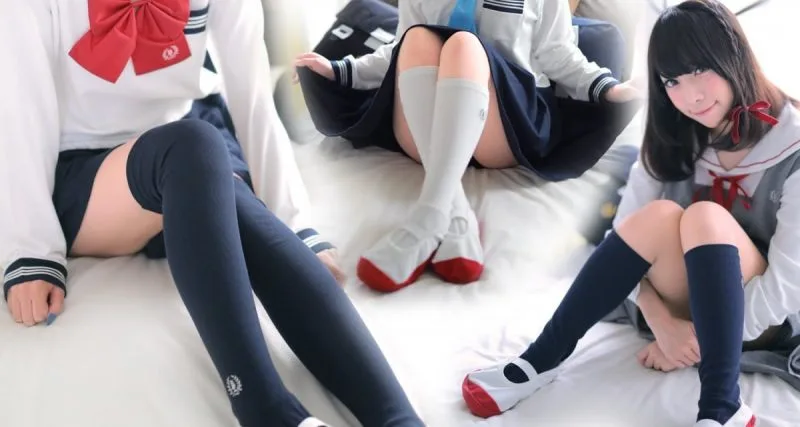
It may seem strange, but there is a Japanese word called Zettai Ryouiki [絶対領域] used to refer to the exposed thighs and legs that appear between miniskirts and stockings or other clothing combinations.
The translation of the word Zettai Ryouiki is Absolute Territory where zettai [絶対] means absolute and [領域] means area, domain, territory, field, and region. Why do the Japanese consider this area as absolute?

As always, it all started in anime and manga, where this combination of words became an otaku slang to attribute kawaii and moe characters from Japanese works. Nowadays this term is recognized by the population of Japan as a fashion style.
Read also:
- Meaning of Kawaii – Culture of cuteness in Japan
- Moe moe kyun – What is the origin and meaning of moe?
Table of Contents
How does Zettai Ryouiki fashion work?
There are 5 levels that define Zettai Ryouiki, it all depends on the length of the stockings and skirts. The image below can better explain how this classification works:

4:1:2.5 is the ideal measurement for the exposed portion of the thigh and the knee area, with a tolerance of 25%. The classifications range from “E” which shows more leg to “A” which shows less legs. Some include hairstyle and deredere personality as criteria for creating an S ranking.
Read also: Tsundere? Deredere? List of Japanese personalities
In Japanese culture, the Zettai Ryouiki trend relates to many other popular fashion trends such as Lolita, Gyaru, Decora, Fairy Kei, and Harajuku.
These trends are characterized by an exaggerated and colorful style, and are often associated with anime and manga characters. Often with a colorful and extravagant style.
Read also: Guide to Japanese Styles – Visual Kei, Decora, Harajuku
How did the term Zettai Ryouiki come about?
The origin of Zettai Ryouiki is uncertain, but it is believed to have emerged as a fashion trend in the 1990s. The only thing we are sure of is that the term originated in the anime Evangelion.
In Neon Genesis Evangelion there is something called Zettai Kyoufu Ryouiki [絶対恐怖領域] or Absolute Terror Field. A type of protective energy shield nicknamed as a sacred area where no one can invade privacy.
It is very likely that this simple influence from the anime Evangelion created this term Zettai Ryouiki that became associated with thighs. The term was first used to praise the legs of Mayura (on the left), a character created as Ukagaka, a type of computer software.

The term appeared around 2001 and became popular over the years, becoming a common word to refer to this area of the body. It is not an otaku word; even girls often use this expression after popularizing it.
In the past, the word was used only to refer to the combination of miniskirts and long stockings; nowadays the term has become popular for thighs and other combinations like swimwear.
We recommend reading: Sukumizu – School swimwear in Japan
Curiosities involving Zettai Ryouiki
In 2009, an online survey was conducted about men’s favorite fetishes, and Zettai Ryouiki won first place in the survey. Various advertising agencies conduct surveys and promote events or advertisements involving this style.
November 28 has become high socks day, a special date for those who appreciate Zettai Ryouiki fashion. Although it is not an official holiday, since 2013 this has been an annual event celebrated by a huge community on the internet.

On the internet, there are thousands of fanart perfectly showing the application of this Japanese fashion and the exposure of the absolute area. Some companies have even gone so far as to tattoo girls on their thighs to advertise in the absolute area.
If you found this term a bit heavy, know that the Japanese have also created another term to refer to glimpses of women’s underwear known as panchira.
We recommend reading: Panchira, Pantsu and Shimapan – History of Underwear in Japan
What do people think about Zettai Ryouiki?
The trend may seem a bit sensual, but on the contrary, it is often associated with innocence and purity. Despite this, the exposure of thighs ends up creating discussions about its contribution to sexual harassment.
The display of legs in this way can be seen as a way to sexualize female characters or young Japanese women, making them objects of desire for the male audience.
Although this term may seem like a type of Japanese perversion, it is worth mentioning that it is not exclusive to Japan; there are also other similar terms and trends such as “knee-high socks” or “thigh high boots.”
Zettai Ryouiki is adopted by young people outside the otaku world, and some people may see it as a way to show confidence and self-esteem. Some consider the trend as a form of female empowerment.
Even some members of the otaku community consider this term offensive, while others do not see it as anything serious, and many girls still use this term. What do you think about this subject? I hope you enjoyed the article, and we appreciate the comments and shares.
Leave a Reply