
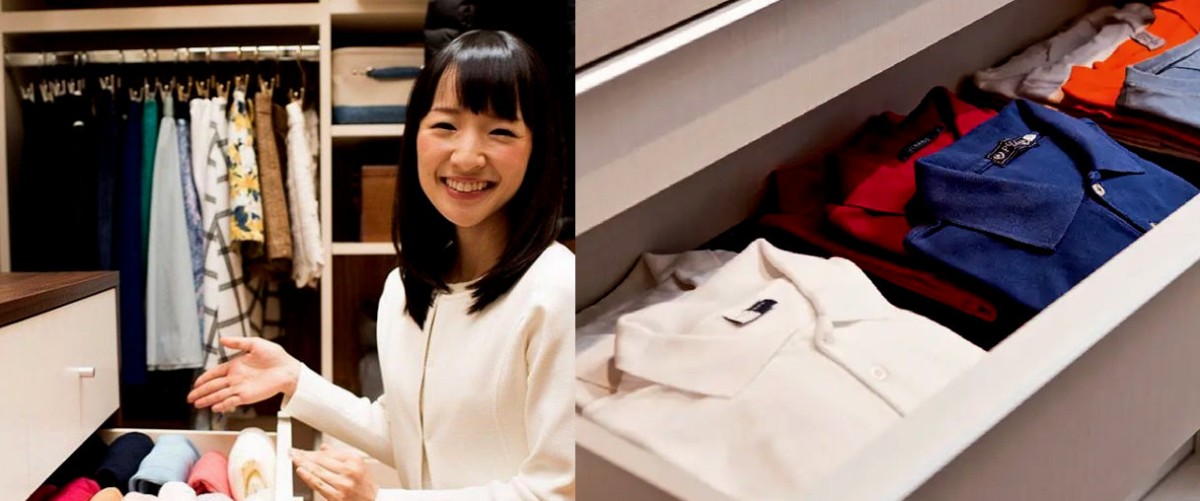
In this article, we will talk about the Konmari method, created by the Japanese Marie Kondo, a Japanese writer specialized in the theme of personal organization. In addition, we will show 13 organization tips proposed from the mentioned method. The Japanese are experts in the art of creating methods to optimize life, organize finances, improve performance at work and in the business environment, lose weight, and even live better in general. Various methods, such as Kaizen or Kanban aim to improve the social, economic, and cultural environment of the individual (and the company).
On the other hand, the Konmari method focuses mainly on the organization and cleaning of a specific space. Considering that the Japanese society values clean and organized establishments and homes, it is not surprising that a method like this was created by them. Next, we will define what the method is and extract from it 13 tips of utmost importance to achieve the proposed goals.

Konmari – Introduction, Meaning, and Definition
The Konmari method, in Japanese こんまりメソッド (konmari messodo), proposed by Marie Kondo, aims to work with the environment we live in to organize it harmoniously, increasing our happiness and, consequently, our productivity. The book that made her popular worldwide is called “The Life-Changing Magic of Tidying Up – The Japanese Art of Decluttering and Organizing” (Portuguese edition published by Editora Sextante), which can be easily purchased at major bookstores in the country and online stores. Another highly recommended book by the author for personal organization enthusiasts is: “Does This Spark Joy? – An Illustrated Guide to the Japanese Art of Tidying Up,” from the same publisher.

Marie Kondo also became known in Brazil and the West through the series “Tidying Up with Marie Kondo” on Netflix (2019). The Konmari method can be summarized, in general terms, as a mix of “letting go” of items that do not bring happiness to the user and categorizing objects, along with other tips. The term “konmari” is a combination of the first syllable of the last name Kondo (“kon”) and the first two syllables of the first name Marie (“mari”) – Kon + Mari. Next, we will explain in more detail the basic principles of the Konmari method through 13 tips:
Tip 1 – Discipline: maintain the good habit of organization.
Consistency, constancy, maintenance of the habit. If, when starting the organization process, you suddenly give up and return to old habits, following the steps of the Konmari method will have been in vain. Therefore, never forget: consistency and constancy are the great secrets!
Tip 2 – Categorization.
Categorize the items that will be organized. Marie Kondo suggests that categorization be done in the following order: clothes, books, paperwork (documents, sheets of paper, loose leaflets, certificates, bills, notes, etc.), small objects (or “komono”: includes various products, from video game consoles to cleaning and personal hygiene products), and finally, items of great sentimental value (the hardest to part with).
Tip 3 – Did it make you happy? Keep it. Did it make you sad or angry? Discard it.
When a particular item in your home (or workplace) does not do you good, evokes anger, sadness, indifference, or discomfort, the best thing to do is to donate it (do not throw it in the trash, but give it to someone who needs it or can benefit from the item).
On the other hand, if you feel happy with a product, box, picture, glass, book, clothing, or any object, and feel that it brings you peace, joy, hope, or happiness, keep it in the space, preferably in a place that is easily visible to everyone.
Tip 4 – The right way to fold clothes.
There is a correct way to fold clothes. As we can see in the video below:
Tip 5 – Be autonomous in the process.
The process of organizing the home and workplace should be solitary. Not in a negative sense, but in a positive sense, as when we are alone we reflect better on our needs and can concentrate more easily on the present moment, which facilitates tidying up.
Tip 6 – Minimalism.
Excess often generates disorder and clutter. Minimalism consists of leaving empty spaces when necessary or putting the minimum amount of information possible in a given space. Many Japanese adopt this minimalist habit in their daily lives.
Tip 7 – Reuse.
Japan is a culture that values environmental health. Always try to reuse materials, as this reduces the amount of information in the environment, stimulates your creativity, and also contributes to the planet.
Tip 8 – What does tidying up really mean?
Tidying up does not mean accumulating. Tidying up is organizing, categorizing, and feeling happy with the result. When you accumulate or store a very large number of objects and utensils in cabinets, drawers, storage rooms, or closed boxes, you end up just hiding the problem and making it even more difficult to find the items you will need to use in the future.
Tip 9 – Only the necessary.
Keep only what is essential and important in place. Combined with minimalism, this tip can be extremely useful for organizing a room, for example.
Tip 10 – Small containers and boxes on shelves.
Small containers and boxes on a shelf can help in categorizing kitchen items, food, and knick-knacks. The ideal is always to keep everything categorized and, preferably, in transparent boxes or containers that show the contents inside. For individuals who have shelves, it is essential to understand this tip well.
Tip 11 – Keep everything visible.
As mentioned earlier, it is necessary for boxes and containers to be transparent and for the objects that bring you happiness to be displayed in an evident and easily identifiable manner. The act of keeping everything visible facilitates the identification of utensils and eliminates the need to open boxes and containers to see what is inside each one.
Tip 12 – Goals.
Define what your organization goals are by initially spreading the objects and clothes in front of you so that an action plan can be formulated to organize the excess information and clutter in the future.
Tip 13 (extra) – Read.
This tip applies to everything in life. Reading is an act that transforms lives. By reading a book, you feel that it was useful to you, and you will see the act of organizing your own library with more pleasure.
So, what do you think? Did you like the article? Then comment, like, and share it with your friends!
Leave a Reply