
It doesn't matter if you just want to better organize your time or manage a large company, the Kanban method can help you be efficient and use your time and resources in the best possible way.
We have in our hands a tool that can help us not only manage our tasks better but also provide clarity on what to do and evaluate how well we do it.
We can all benefit from this organizational tool. But how did Kanban come about? What are its principles? How does it work? And why should you apply this method? This article will answer these questions.
Contents 8
What is the origin of the Kanban Method?
It originated in the late 1940s, during this period Toyota was going through a financial crisis and was on the brink of bankruptcy when the company implemented a production system aimed at producing according to customer demand and identifying possible material shortages within the production line.
Taiichi Ohno is considered the father of the Kanban System. It was created as a simple planning system, whose goal was to control and manage work and inventory at all stages of production in an optimized way.
One of the main reasons for the development of Kanban was Toyota's inadequate productivity and efficiency compared to rival American companies. With Kanban, Toyota achieved a more flexible and efficient production control system that increased productivity while reducing the costly inventory of raw materials, semi-finished goods, and finished products.
Later, Microsoft engineer David J. Anderson realized that the Kanban method developed by Toyota could become an applicable process for any type of company that needs organization. His first book on Kanban - "Kanban: Successful Evolutionary Change for Your Technology Business," published in 2010, is the most comprehensive definition of the Kanban Method for knowledge work.
What are the principles of Kanban?
See below some of the principles of the Kanban Method:
Start with what you do now
Kanban should be applied directly to the current workflow. Any necessary changes can occur gradually over a period of time at a pace with which the team feels comfortable, without interrupting what is already being done successfully. Over time, the method will highlight the problems that need to be addressed and help evaluate and plan changes.
The method will allow you to introduce it incrementally in all types of organizations without fear of excessive commitment or a shock to habits, as there is no need to make radical changes from the start.
Agree to seek incremental and evolutionary change
Kanban will encourage small additional and continuous evolutionary changes in the current process. The reason for this is that radical changes tend to discourage the team because they can lead to resistance due to fear of change.
Respect current processes, roles, and responsibilities
The implementation of Kanban does not require a change in the team's roles and responsibilities. It also does not require an immediate change in the process. It will be the team that decides which roles would do well in their process and when a change in their process should be made.
This allows teams to easily control changes, as they are more manageable and less intimidating. As already mentioned, Kanban was designed to promote and encourage incremental and logical changes without generating fear of change.
Encourage Acts of Leadership at All Levels
Kanban will encourage each team member to express ideas and lead initiatives for process improvement, as well as improve their ways of working and their products and services.
This reminds us that leadership comes from small initiatives we take throughout our daily lives. It is everyone's duty to promote continuous improvement of the team and processes to achieve optimal performance, whether in your company, department, or personal life.

How does the Kanban Method work?
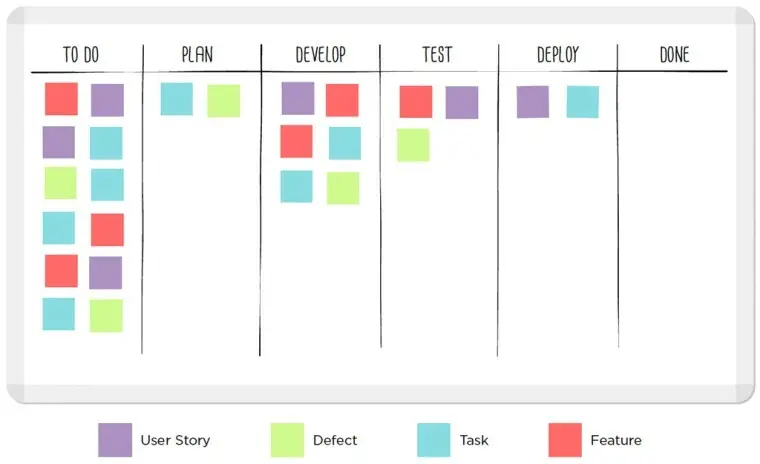
The Kanban method uses cards on a process board that can be physical or digital, the number of cards at each stage is equal to the appropriate capacity for the project, routine, or process. Each card represents a single piece of work that has a start and an end state. The main goal of representing work as a card on the Kanban board is to allow team members to track the progress of work through their workflow in an easy way.
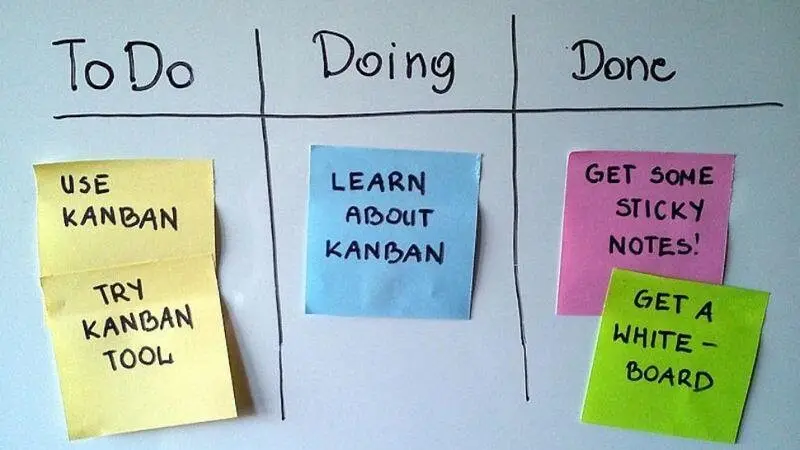
A basic Kanban board has a three-step workflow: To Do, In Progress, and Done. However, depending on the size, structure, and goals of a team, the workflow can be modified to meet the needs of any specific team.
These cards and where they are located on the board function as a signaling mechanism, indicating when to start a new activity. The team can only start working on a new item once a slot for it is available on the board.
Why should you use Kanban?
We can see for ourselves how a clear, organized personal routine and work environment aids in the progress of our work and its efficiency. The method is easy to implement and does not require radical changes in processes.
One of the greatest benefits of the Kanban methodology is the ability for continuous improvement of work. It can be used in any work environment and is excellent in situations where work arrives in an unpredictable manner or when you want to deploy work as soon as it is ready, instead of waiting for other work items.





Community
Comments
0 comments
There are no published comments in this language yet.
Send comment