
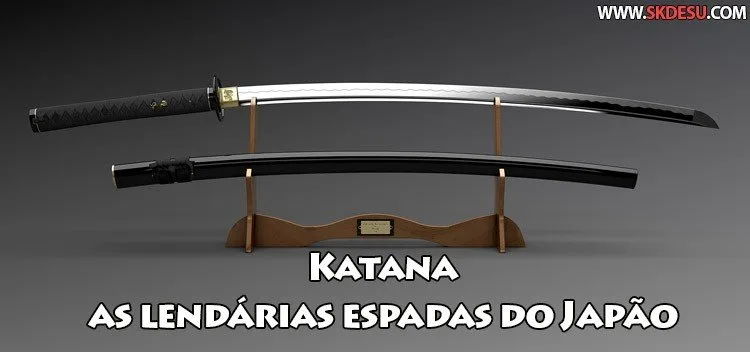
Katana [刀] is the curved Japanese sword most people picture when they think of the samurai: a single-edged blade, long enough for two hands, worn edge-up through the belt. It is also a collector’s object, a museum piece, and a constant guest in games, films, and anime — which is why the word often outruns the real blade behind it.
In medieval Japan the sword family was broader than one silhouette. Beside the katana sat the shorter wakizashi, older cavalry tachi, and straight early blades that barely resemble the modern image. Along the history of Japan, fighting style, steel, and law kept reshaping what warriors carried — and which blades later became legends.
Contents 5
What is a katana like?
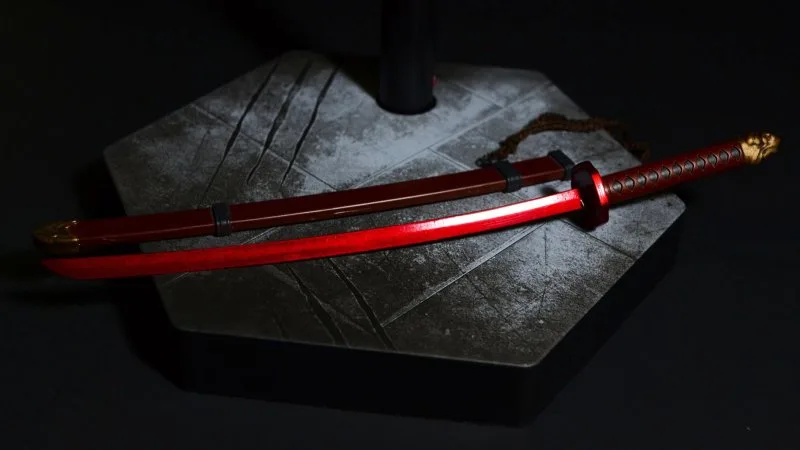
A classical katana is usually defined as a curved, single-edged Japanese sword with a blade longer than about 60 cm (roughly two shaku), a circular or square guard, and a grip made for two hands. It is worn thrust through the obi with the cutting edge facing up, so the draw and the first cut can happen in one motion — the idea behind later arts such as kendo and iaido practice.
It is not the only Japanese sword, and “katana” is sometimes used loosely for any curved Japanese-looking blade. In Japanese sword talk, the long companion blade is often discussed next to the shorter wakizashi as a pair (daishō). The older battlefield long sword worn edge-down from the belt is the tachi; many famous “katana” in museums are actually old tachi that were shortened later (suriage).
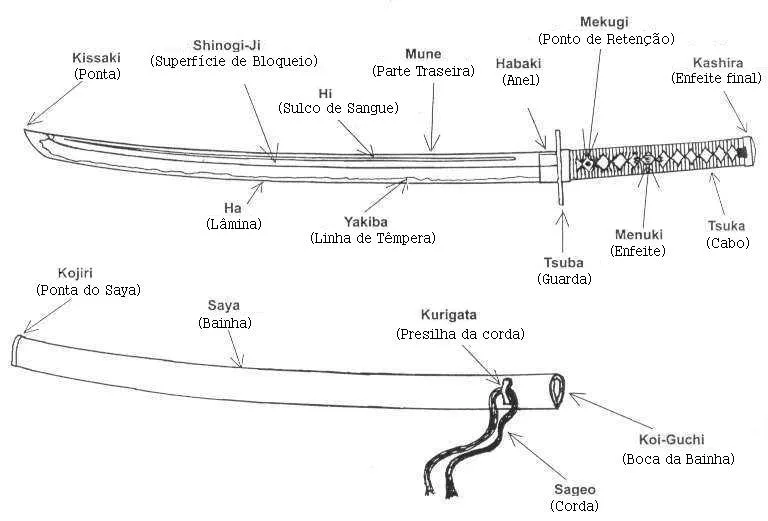
The blade can vary in curve, length, steel texture, and the smith’s signature on the tang. Mountings and fittings are part of the craft too. Some of the parts you will hear most often:
- Saya — wooden scabbard;
- Tsuba — iron (or other metal) disc that guards the hand;
- Tsuka — the hilt / handle;
- Kojiri — tip of the saya;
- Kurigata — knob on the saya where the sageo cord is tied;
- Koi-guchi — the “mouth” of the scabbard;
- Habaki — collar that seats the blade in the koi-guchi;
- Nakago — the tang, where the smith’s signature (mei) often sits.
The diagram below maps several of these parts on a mounted sword:
History of the katana
Japanese swords did not appear fully formed as the movie prop. Blades changed as war changed — from early straight swords to cavalry curves, then to the edge-up uchigatana style that became the classic katana. Collectors and historians also group blades by forging era. The usual sequence looks like this:
Jōkotō (ancient swords, until around 900) — early blades, often straighter, including single-edged chokutō and double-edged ken / tsurugi types. Design was not yet standardized the way later nihontō would be.
Kotō (old swords, roughly 900–1596) — the long age of classical forging. During the Heian period and after, cavalry fighting favored longer curved swords worn edge-down: the tachi. The Kamakura period (1185–1333) is often called a golden age of Japanese swordmaking; many National Treasure blades come from this world. The form we call katana / uchigatana rose later, especially from the Nanboku-chō into Muromachi times, as foot combat and quicker draws mattered more than pure cavalry cuts. By the late Muromachi and Sengoku years, the portable edge-up sword was mainstream even though bows, spears, and later guns still ruled open battle.
Shintō (new swords, roughly 1596–1780) — after political unification and steel trade shifts, forging methods and aesthetics changed. Under the Tokugawa order, the samurai pair of long and short swords became a strong social symbol. Peace pushed many blades toward ceremonial beauty as much as battlefield practicality — though swordsmanship schools kept the weapon very much alive.
Shinshintō (newer swords, roughly 1781–1876) — a revivalist wave tried to recover the bold kotō ideal. At the end of the Edo period, political fighters often preferred practical, sometimes longer blades suited to close indoor fights, not only parade polish.
Gendaitō (modern swords, from 1876) — the 1876 Haitōrei edict largely ended public sword-wearing for ordinary people. Military swords, industrial methods, and later restrictions after World War II reshaped production. Today, licensed traditional smiths still work under strict rules, while museums and martial-arts halls keep the form visible for anyone who wants to see a real blade rather than only a screen prop. If you are in Tokyo, the Samurai Museum is one easy place to start looking with context.
Legendary katanas
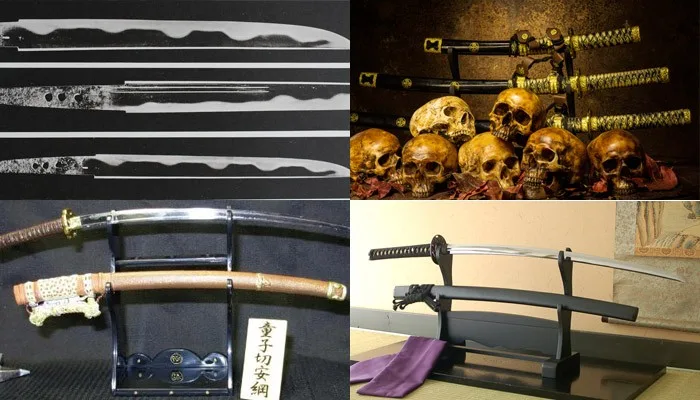
Kamakura-era work still sets the bar for many appraisers: strong shapes, refined steel, and blades that later generations tried to imitate. Some names point to a single famous object; others are smith lineages that produced many swords. A few names that keep returning in stories and museum labels:
Masamune 正宗 — the legendary Kamakura smith whose name sits on some of Japan’s most admired blades. Many works attributed to the Sōshū tradition were later remounted or shortened; “Masamune” on a label is as much a school of excellence as a single movie sword. One well-known case in the news was a Shimazu-related Masamune blade recovered in the 2010s after long absence from public view.
Muramasa 村正 — a famous smith name that pop culture turned into a “cursed” brand. Historical Muramasa blades are real; the demon reputation grew later, partly because several Tokugawa-related deaths were linked in legend to Muramasa steel. We go deeper into that story in our note on the cursed Muramasa sword.
Mikazuki Munechika — “Crescent Moon,” famous for its curve and age, counted among the great blades associated with the smith Sanjō Munechika. It is connected with the Tokyo National Museum collections and with the group of masterworks often called the Tenka-Goken.
Juzumaru 数珠丸 — named for a Buddhist rosary tradition tied to the sword. Long linked with Nichiren’s circle, it is shown only on limited occasions (often noted around November 3 at Honkō-ji in Hyogo), which is part of its aura.
Tenka-Goken 天下五剣 — “Five Swords Under Heaven,” a traditional set of celebrated blades: Dōjigiri, Juzumaru, Mikazuki Munechika, Onimaru, and Ōtenta. Not every list tells the same provenance tale, but the group is a useful map of what Japanese collectors treat as first-rank names.
Katana, tachi, wakizashi: quick differences
If you only remember one practical distinction: how the sword is worn and how long the blade is matter more than movie labels.
- Tachi — older long sword, typically more curved, worn edge-down suspended from the belt; cavalry and high-status battlefield image.
- Katana (uchigatana) — long sword worn edge-up through the obi; the form that became the everyday samurai long sword from the late medieval period into the Edo age.
- Wakizashi — shorter companion blade; with the katana it forms the daishō pair that marked samurai status in the Tokugawa era.
- Tantō — dagger-length blade; appears in earlier warrior kits and later formal sets.
Smiths signed the tang so the signature faced outward when the sword was worn correctly. That is one reason a remounted tachi can look like a “katana” in a glass case while still carrying an older biography.
Where to buy a katana?
A historically made Japanese sword with a sharp battle-ready pedigree is not a casual souvenir. Authentic nihontō involve licensing, registration, and prices that reflect craft, age, and papers — not a weekend impulse buy. What most people can find easily are decorative replicas, martial-arts training swords, or modern production blades sold as wall pieces.
If you are looking with a cool head, common paths include:
- Specialized martial-arts and sword shops — better than generic marketplaces when you want clear product categories (iaitō for practice, display blades, blunt trainers).
- Licensed Japanese smiths and dealers — the route for serious traditional work; expect authentication culture, long waits, and real cost.
- Auctions and antique markets — possible for unique pieces, but only with expertise or a trusted appraiser; forged signatures and polished-up fakes exist.
Wherever you buy, separate three things that shops often blur: a decorative wall sword, a training tool, and a registered traditional Japanese sword. They are not the same object, even when the silhouette looks identical in a photo.


Community
Comments
0 comments
There are no published comments in this language yet.
Send comment